Support or Silence Sibling Amid Political Protests?
Analysis reveals 8 key thematic connections.
Key Findings
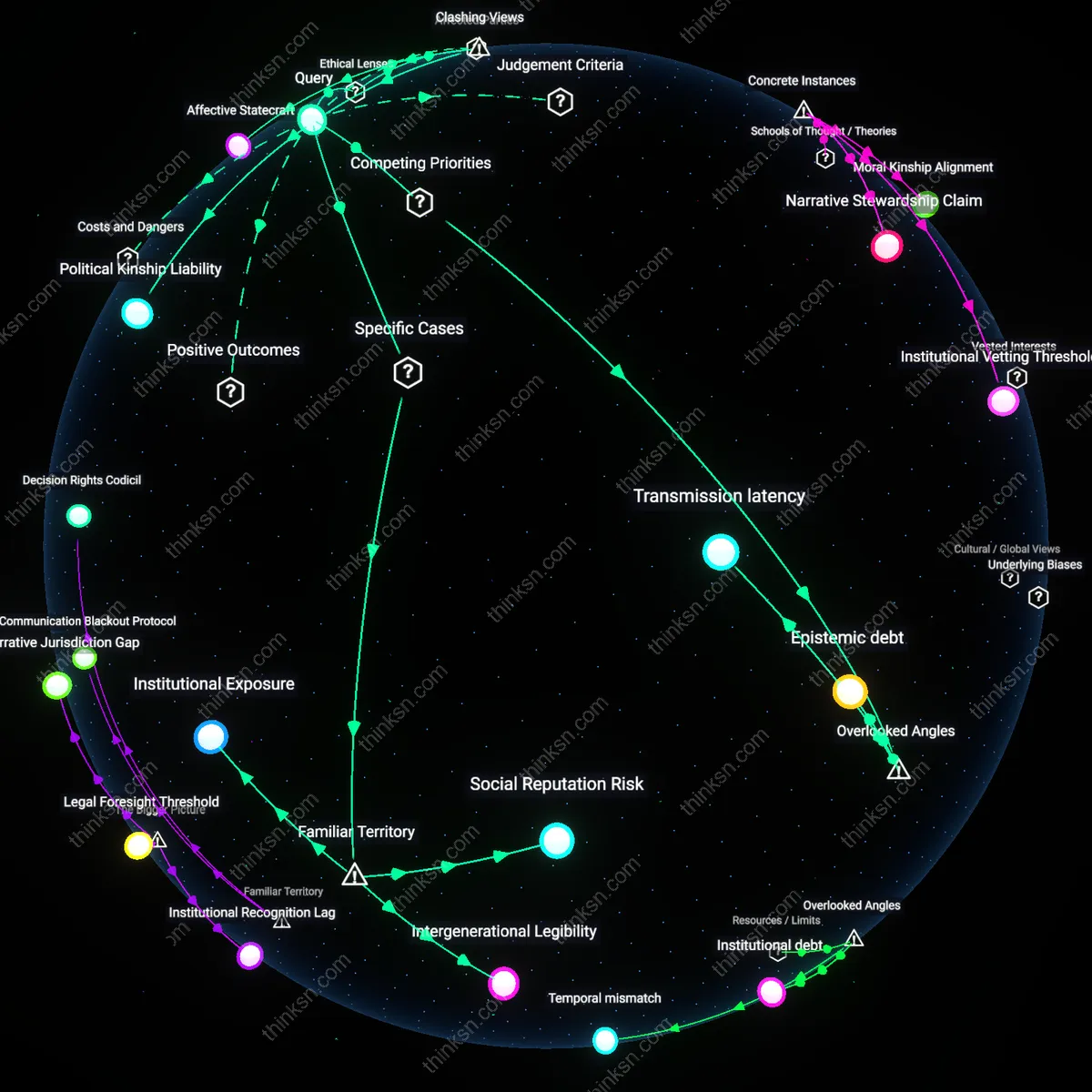
Transmission latency
A family’s decision to support or distance itself from a relative’s politically controversial partner is shaped by how rapidly the controversy spreads through digital networks relative to the family’s ability to interpret and respond to it. When backlash unfolds faster than the family’s internal sense-making—common in cases tied to fast-moving online campaigns like those targeting individuals linked to movements such as BLM or anti-vaccine activism—defensive distancing becomes more likely not due to ideological rejection, but to procedural panic. This mechanism operates through the temporal mismatch between information velocity and relational deliberation, where families default to disavowal to pre-empt reputational harm before facts or context can be assessed. What is overlooked is that timing, not just content or belief, determines moral posture—revealing that silence or rejection may reflect cognitive lag, not disapproval.
Epistemic debt
Families distance from controversial partners when they lack established frameworks for interpreting the political activism in question, particularly when that activism invokes specialized or emerging ideologies such as eco-terrorism or secessionist movements in regions like Cascadia or Texas Nationalist factions. The family’s inability to cognitively anchor the activism within familiar moral or legal categories creates epistemic debt—an accumulating burden of not knowing how to judge the behavior—leading to withdrawal as a default epistemic strategy. This operates through informal kinship systems’ reliance on shared narrative coherence, where unresolved ambiguity collapses into moral uncertainty. Rarely acknowledged is that silence or rejection often stems not from value conflict but from interpretive underpreparedness, reframing distancing as a symptom of cognitive deficit rather than disloyalty.
Juridical precarity
A family's stance toward a controversial political partner often hinges on their collective exposure to legal entanglement, especially when the activism involves charges of material support for terrorism or participation in insurrection, as seen in cases linked to January 6 or Black Liberation Army affiliations. Even if the family ideologically sympathizes, structural vulnerability—such as immigration status, federal employment, or receipt of government benefits—creates juridical precarity that forces distancing as a form of risk mitigation under anticipated state scrutiny. This dynamic operates through the silent operation of legal exposure thresholds within family systems, where privacy, inheritance, or custody rights can be imperiled by guilt-by-association doctrines. The overlooked reality is that public disavowal is often a compliance tactic ahead of investigations that may never come—revealing preemptive submission as a hidden cost of citizenship in securitized political environments.
Political Kinship Liability
A family should distance itself publicly from a relative's partner engaged in controversial political activism when the association risks constituting complicity under legal doctrines of guilt by association, particularly in jurisdictions with surveillance-based political repression such as those applying counter-terrorism laws expansively to dissent. The mechanism operates through state actors interpreting familial endorsements as implicit ideological alignment, which in authoritarian or semi-authoritarian regimes can trigger arbitrary detention, travel restrictions, or asset seizures under laws like China’s National Security Law or Egypt’s Anti-Terrorism Law. This calculus is analytically significant because it reframes kinship not as a private ethical domain but as a vector of political exposure—the family becomes a juridical unit subject to extralegal penalties—thereby prioritizing survival over solidarity, a reality often obscured in Western liberal narratives that treat free expression as universally tenable.
Affective Statecraft
A family's decision to support or disavow should be guided by how the partner’s activism reshapes transnational kinship networks under the pressure of diasporic political polarization, as seen in Sri Lankan Tamil families where backing a partner linked to former LTTE-affiliated advocacy groups can fracture resettlement communities in Canada or the UK. The dynamic operates through affective statecraft—where emotions like shame, loyalty, or fear are mobilized by both state surveillance and community enforcers to regulate diasporic political expression under the guise of familial harmony. This reveals that the family is not a private sanctuary for ethical decisions but a contested site of geopolitical influence, where seemingly personal endorsements become proxies for legitimacy in unresolved national conflicts, complicating the liberal assumption that political loyalty and kinship loyalty operate in separate spheres.
Social Reputation Risk
A family distances itself from a relative's partner involved in controversial political activism when that association threatens their standing in local community networks. In suburban school boards or religious congregations—such as those in affluent counties like Fairfax, Virginia—family identities are tightly linked to perceived stability and non-confrontational civic participation; visible alignment with divisive figures can trigger exclusion from informal power structures like parent committees or neighborhood associations. The non-obvious aspect is that reputational contagion operates not through ideology but through adjacency in tightly monitored social ecosystems, where neutrality is itself a social asset.
Intergenerational Legibility
Families publicly support a relative's partner in political activism when doing so preserves a narrative of progressive continuity across generations. In left-leaning urban enclaves like Brooklyn's Park Slope or academic families tied to institutions like UC Berkeley, parental endorsement of a child's activist partner signals fidelity to inherited civil rights-era values, reinforcing familial identity as part of a moral vanguard. The underappreciated mechanism is that such support is less about the politics themselves than about maintaining symbolic coherence in a lineage—activism becomes a ritual of belonging, not a policy stance.
Institutional Exposure
Families distance themselves from activist partners when members hold positions vulnerable to organizational backlash, such as federal judges, military officers, or executives in regulated industries like banking. When a daughter's partner appears in media coverage of extremist protests—say, linked to anti-NATO demonstrations in Germany—families in Washington, D.C. national security circles may sever visible ties to avoid scrutiny from oversight bodies or professional peers. The unspoken dynamic is that institutional credibility depends on perceived ideological insulation, making private beliefs secondary to observable affiliations.