Regulating Cloud Innovation: Speed vs. Data Sovereignty?
Analysis reveals 8 key thematic connections.
Key Findings
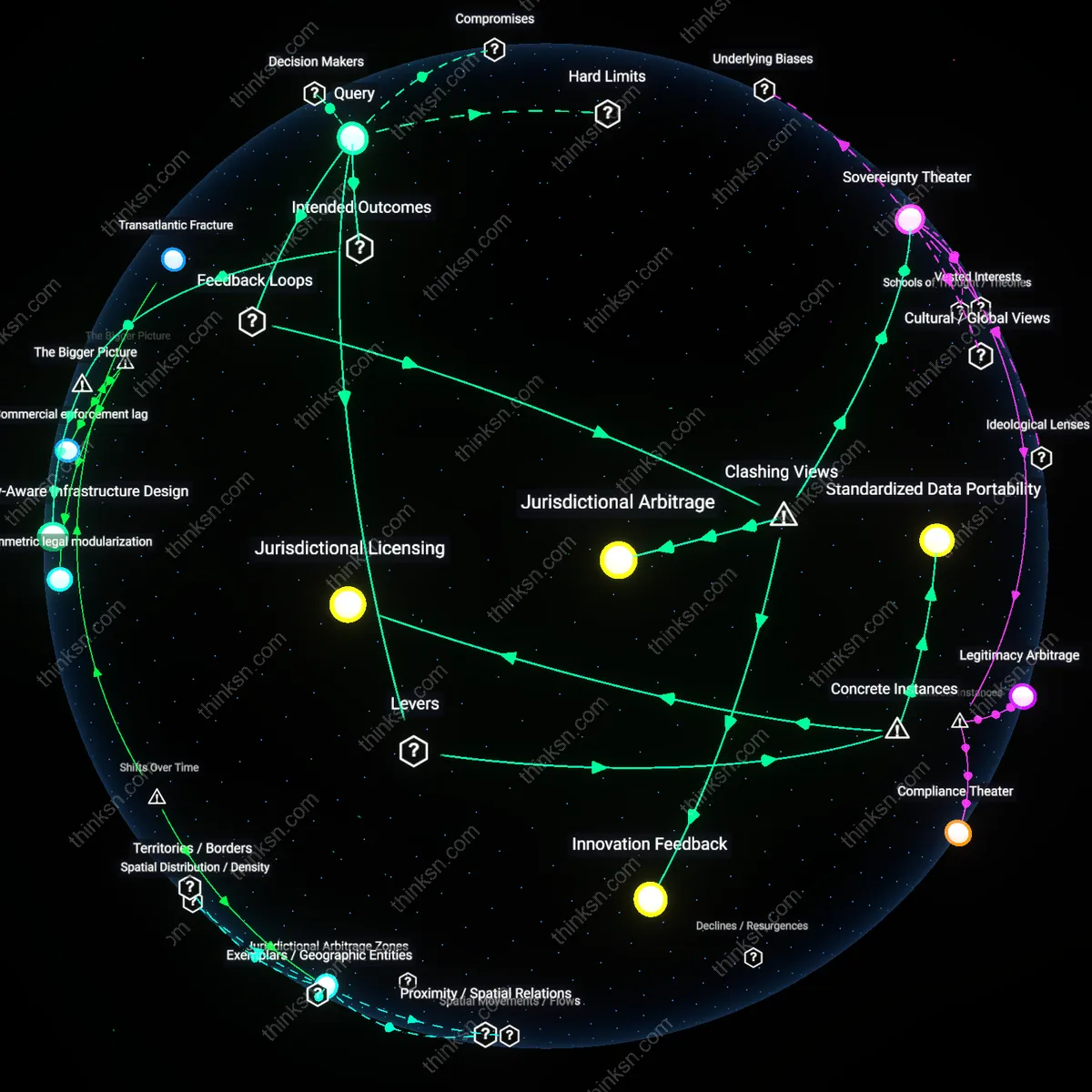
Jurisdictional Licensing
Regulators can require cloud service providers to obtain operating licenses conditioned on compliance with local data residency laws, as demonstrated by China’s Cybersecurity Administration requiring foreign cloud firms like Amazon Web Services to partner with local entities and store data within national borders under the 2017 Cybersecurity Law. This mechanism compels global providers to structurally adapt their infrastructure to national legal frameworks, transforming abstract sovereignty claims into tangible operational constraints. The non-obvious insight is that licensing becomes not just a market access tool but a precision instrument for aligning technical architecture with legal jurisdiction.
Standardized Data Portability
The European Union enforced data sovereignty through the General Data Protection Regulation (GDPR) by mandating standardized data portability and the right to erasure, compelling cloud operators like Microsoft Azure and Google Cloud to implement technical interfaces that allow users to extract or delete personal data upon request. This lever transforms user rights into interoperable technical protocols, ensuring innovation does not outpace individual control. The underappreciated dynamic is that sovereign control is decentralized to end users through engineered compliance, making data mobility a regulatory enforcement mechanism.
Sovereign Cloud Infrastructure
France’s “Sovereign Cloud” initiative, led by the Agence du Numérique and awarded to French consortiums like OVHcloud and Thales, directly constructs state-aligned cloud infrastructure to ensure public sector data remains under national jurisdiction despite reliance on cloud innovation. By funding and certifying domestic cloud capacity with strict governance controls, the state bypasses dependence on foreign platforms while stimulating competitive domestic tech development. The key insight is that sovereignty is not merely regulated but materially re-constituted through public investment in technical alternatives.
Jurisdictional Arbitrage
Regulators should enable mutual recognition agreements between democratic jurisdictions to create interoperable sovereignty standards, transforming data localization from a static boundary into a dynamic compliance circuit. This mechanism allows cloud innovators to operate across borders while adhering to enforceable, reciprocal data rules, shifting sovereignty from a bottleneck to a negotiated flow. The non-obvious insight is that data sovereignty does not require data containment—instead, regulatory credibility emerges through procedural alignment among peer states, not territorial exclusivity, undermining the dominant assumption that localization equals control.
Innovation Feedback
Regulators can impose real-time audit mandates on cloud providers that automatically trigger stricter data controls when sovereignty risks exceed thresholds, embedding self-correcting logic into service evolution. By making compliance responsive to actual data movement patterns rather than fixed rules, this balancing loop aligns innovation velocity with adaptive oversight. The dissonance lies in treating regulation not as a constraint on innovation but as an algorithmic participant in it—where enforcement dynamically shapes technical development, revealing that stability emerges from continuous intervention, not from preventing change.
Sovereignty Theater
Regulators should publicly disclose sovereignty compliance scores for cloud services, leveraging reputational risk to deter non-compliance while allowing technical experimentation to continue unchecked. This transforms enforcement from a binary legal requirement into a visible, market-mediated contest where user perception regulates data control. The counterintuitive outcome is that symbolic compliance—visible audits without direct intervention—can be more effective than strict enforcement, exposing that the appearance of sovereignty often satisfies political demands better than its substantive realization.
Jurisdictional Interoperability Frameworks
Regulators should establish bilateral certification regimes for cloud service providers that align data governance standards across allied nations. This enables data to flow under recognized legal equivalency—such as the EU-US Data Privacy Framework—where sovereignty is preserved through mutual enforcement of localized data rights, not data localization. Sovereign control is maintained because each state retains authority over its nationals’ data, while innovation thrives under predictable compliance pathways. The non-obvious insight is that legal harmonization, not technical isolation, becomes the sovereignty safeguard—leveraging diplomatic agreements as infrastructure.
Sovereignty-Aware Infrastructure Design
Regulators can mandate infrastructure transparency from cloud providers, requiring auditable declarations of data residency and processing pathways at the hypervisor level. This shifts sovereignty enforcement from policy rhetoric to technical realizability, where regulators, certification bodies, and independent auditors verify that virtualized resources respect geopolitical boundaries. The mechanism relies on emerging standards like confidential computing and geo-fencing APIs, which make data mobility programmatically accountable. The underappreciated dynamic is that virtualization, often seen as eroding jurisdictional control, can instead encode it when treated as a governance surface.