Is Setting a Limit on Grandparent Aid Justified?
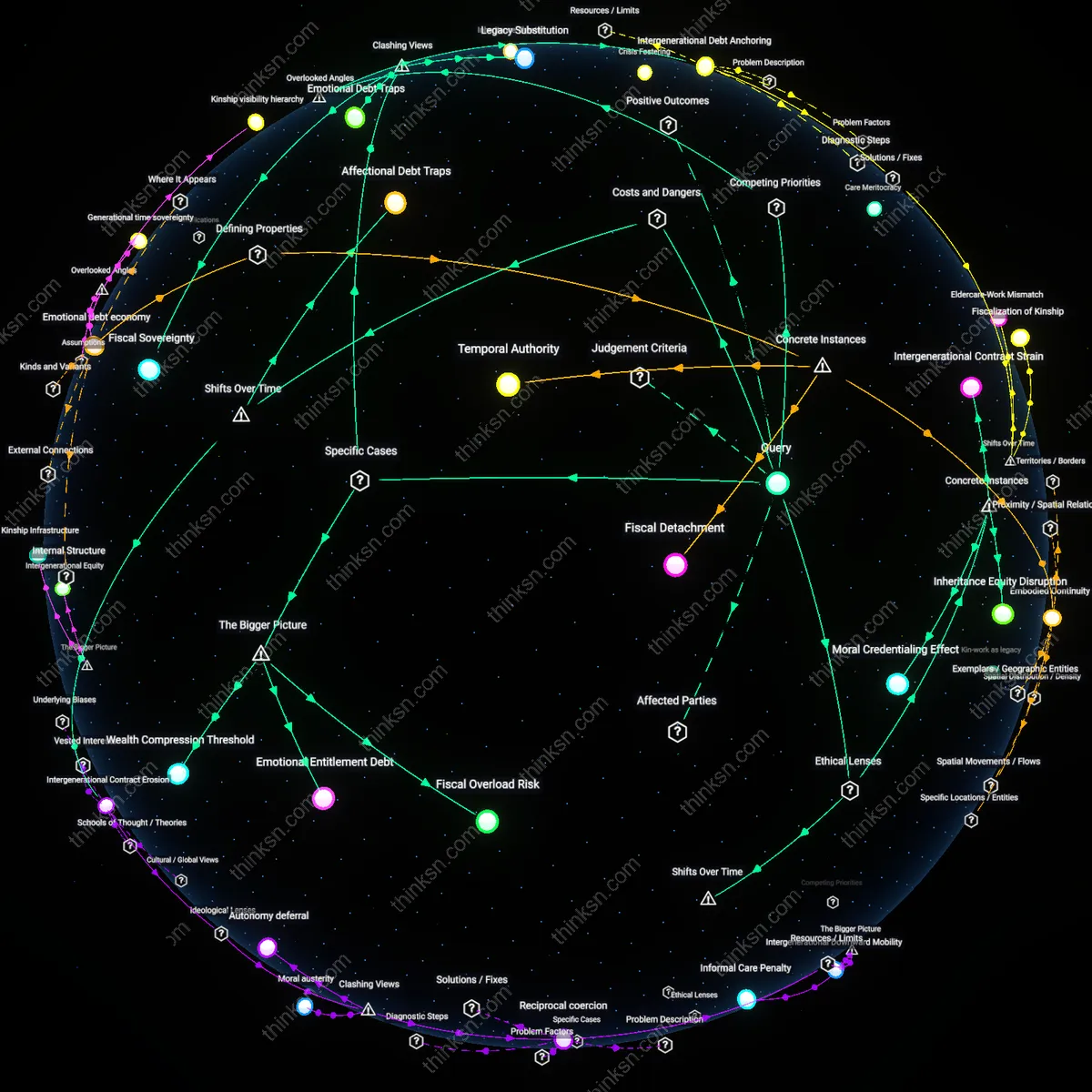
Analysis reveals 14 key thematic connections.
Key Findings
Intergenerational Contract Erosion
One must set a firm limit on financially supporting a sibling's children because the expectation of automatic grandparental-level support emerged only in the postwar welfare retreat, when familial responsibility was repackaged as a moral obligation to compensate for diminished state provisioning. This shift, crystallizing in the 1980s U.S. under Reagan-era austerity, transferred social risk from public institutions to kinship networks, turning what was once a discretionary act of care into a covert financial duty enforced by emotional leverage. The danger lies in replicating this privatized safety net across generations, where unresolved fiscal strain becomes a silent engine of interfamily rupture masked as loyalty. The non-obvious insight is that the 'disappointment' expressed is not personal but structural—a residual demand of a system that dismantled public supports while sanctifying family as the last insurer.
Affectional Debt Traps
Setting a firm limit is necessary because the modern expansion of emotional entitlements within extended families since the 1990s pathologizes financial refusal as relational abandonment, transforming economic boundaries into perceived moral failures. As therapeutic discourse entered kinship norms—particularly in Western middle-class contexts—emotional availability became conditional on material demonstration, so that declining to fund a niece or nephew is interpreted not as choice but as affective betrayal. This creates danger zones where financial contributions are recast as proof of love, making refusal destabilizing to identity and belonging. The underappreciated risk is that this shift securitizes care through monetary performance, converting kinship into an asymmetric economy of affective debt that escalates across developmental transitions like college or childbirth.
Intergenerational Debt Anchoring
One should set a firm limit on financially supporting a sibling's children because unbounded support can anchor future expectations of obligation within extended kin networks, particularly when such support substitutes for absent parental financial responsibility. This creates an implicit debt structure where grandparents become long-term fiscal guarantors, not by choice but through precedent, effectively locking younger generations into dependency loops that bypass accountability for biological parents. The non-obvious mechanism here is that emotional disappointment over reduced support functions as a social enforcement tool, preserving the grandparent’s role as economic fallback even when they lack the means or mandate—transforming generosity into a de facto intergenerational liability swap that distorts household financial planning across decades.
Emotional Infrastructure Debt
One should set a firm limit because sustained financial support often displaces investment in the emotional infrastructure necessary for maintaining family cohesion, such as time, conflict resolution, or symbolic presence, since resources—especially constrained ones—cannot be simultaneously allocated to both material and relational domains. When money becomes the default mode of care, it erodes alternative, less visible forms of intergenerational bonding that are harder to quantify but more sustainable, particularly when economic conditions shift. The overlooked dynamic is that financial consistency is mistaken for relational reliability, leading younger generations to perceive withdrawal not as a budgetary boundary but as emotional abandonment—thus creating a hidden debt in affective capital that outlasts any monetary contribution.
Post-Biological Care Regime
One should set a firm limit because the legal and social normalization of non-marital and non-biological families since the 2000s has severed care obligations from genetic lineage, making any default duty to siblings’ children a vestigial norm. With assisted reproduction, adoption, and chosen families legally codified, care is now a volitional act—ethically governed by relational presence, not kinship position. The overlooked consequence of this shift is that insisting on grandparental-style support for nieces and nephews assumes a biological determinism that family law and social practice have already abandoned.
Intergenerational Contract Strain
One should set a firm financial limit to avoid undermining state welfare responsibilities, as seen when Japanese 'parasite singles' relied on aging parents, shifting care burdens from public systems to familial pockets under neoliberal retrenchment; this reveals how private kinship economies absorb policy failures, making personal generosity a structural subsidy with moral hazard. The non-obvious insight is that unchecked familial support can corrode collective social insurance norms by normalizing privatized welfare.
Inheritance Equity Disruption
One should cap support because unrestricted aid to a sibling’s children risks distorting testamentary justice, as occurred in 2018 British Columbia when a grandparent’s repeated cash gifts to one daughter’s offspring triggered a successful will challenge under the Wills, Estates and Succession Act; this illustrates how informal transfers during life destabilize formal equality among heirs, transforming affection into legal inequity through the doctrine of advancement. The overlooked point is that emotional generosity in kin networks can preemptively redistribute wealth in ways that courts later treat as partial inheritances.
Moral Credentialing Effect
One should enforce financial limits to prevent self-licensing of neglect, as observed in Scandinavian social assistance cases where grandparents who funded grandchild activities claimed moral exemption from broader civic solidarity, reducing public benefit uptake despite eligibility; grounded in Kantian ethics, their conditioned support treated charity as discretionary virtue rather than duty, thereby weakening universal welfare justification. The hidden mechanism is that personalized giving can erode commitment to impartial justice by substituting relational merit for systemic need.
Fiscal Overload Risk
One should set a firm limit on grandparental financial support because without institutional safeguards, individual elders risk fiscal depletion when absorbing intergenerational care mandates, as seen in Japan’s '8050 Problem,' where aging parents finance adult children unable to achieve economic independence. This reflects systemic labor market rigidity and insufficient social care infrastructure that externalizes support costs onto families, making unbounded generosity functionally unsustainable. The non-obvious insight is that private financial restraint becomes a necessary hedge against public policy failure, shifting intergenerational equity into household balance sheets.
Emotional Entitlement Debt
Setting firm financial limits is necessary because unchecked grandparental support embeds implicit obligations that distort family dynamics, as observed in multi-generational Latino households in South Los Angeles, where expectations of abuela-funded childcare create relational asymmetries that persist across generations. These expectations emerge from culturally embedded caretaking norms amplified by limited state childcare subsidies, causing economic decisions to carry disproportionate emotional weight. The underappreciated mechanism is that financial boundaries function not merely as economic tools but as preemptive emotional demarcations against inherited duty claims.
Wealth Compression Threshold
A hard financial limit must be set because sustained transfers to descendants erode capital preservation in precarious middle-class families, exemplified by Black middle-income grandparents in Atlanta diverting retirement savings to avoid housing instability for their grandchildren amid inherited wealth gaps. This occurs within a racialized asset accumulation system where limited intergenerational wealth means any outflow risks irreversible downward mobility. The systemic trigger is that in racially stratified economies, grandparental restraint becomes a survival strategy against the structural dissipation of fragile capital.
Fiscal Sovereignty
One must set a firm limit on financially supporting a sibling's children because intergenerational wealth transfer expectations can weaponize kinship to override individual financial autonomy, as seen in the cases of middle-income professionals in Seoul navigating parental pressure to fund nieces' and nephews' elite education through hagwon systems; this dynamic operates through Confucian-derived familial hierarchies that legally and culturally bind adult children to collective filial duties, revealing that what appears as voluntary generosity is often covert economic conscription.
Emotional Debt Traps
One should set a firm limit on financial support because unstructured aid becomes a tool for emotional leverage, evident in cases like rural Appalachian families where grandparents or aunts disburse irregular cash gifts to siblings’ children, creating cycles of dependency masked as care; this functions through informal economies where monetary contributions substitute for absent state services, exposing how altruism is co-opted to sustain dysfunctional caregiving systems that resist institutional intervention.
Legacy Substitution
One should set firm financial limits because uncapped support risks converting nieces and nephews into emotional proxies for unfulfilled parental ambitions, as observed in childless academics in Berlin who fundraise for siblings' children’s university studies abroad, channeling personal unrealized aspirations into these investments; this mechanism runs through symbolic capital accumulation in post-materialist societies, demonstrating that financial aid is often less about kin welfare than about securing narrative continuity in the absence of direct heirs.