Could Universal Pre-K Pit Schools Against Childcare Providers?
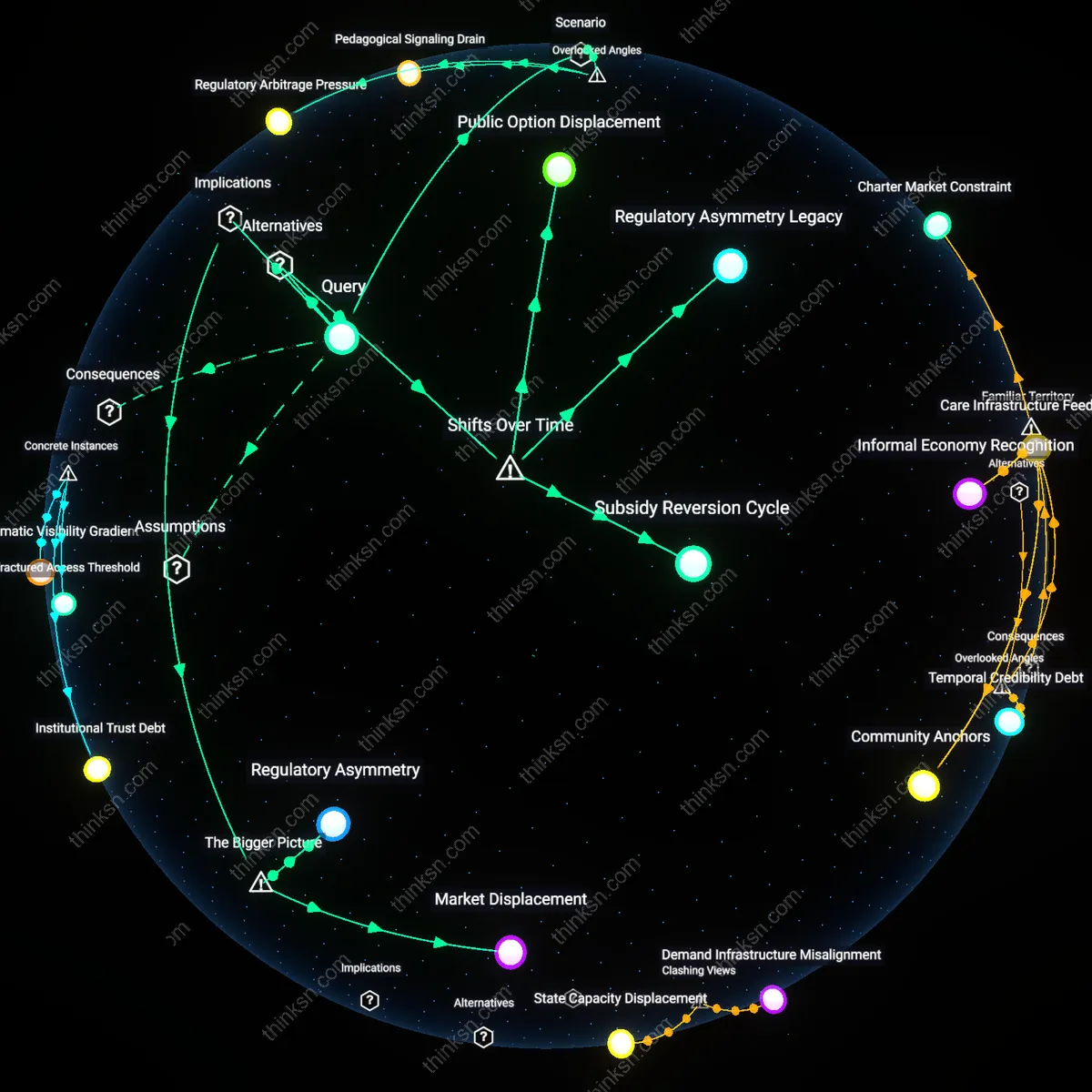
Analysis reveals 8 key thematic connections.
Key Findings
Regulatory Arbitrage Pressure
Universal pre-K could drive private childcare providers to reclassify as non-educational family care operations to avoid compliance with new public program standards. As public funding ties increasingly to curricular benchmarks, teacher credentials, and facility requirements under a universal pre-K framework, small private operators in urban and rural areas may seek exemption by redefining their services outside the 'early education' category—framing offerings as developmental supervision or play-based care instead. This shift would fracture the regulatory ecosystem, creating a shadow tier of de facto early learning providers operating beyond oversight, a response seldom captured in equity-focused rollout models, which assume sector homogenization. The non-obvious mechanism here is not competition or displacement but strategic redefinition to evade administrative thresholds.
Spatial Misalignment Risk
The roll-out of universal pre-K could force public school districts to prioritize geographic coverage over demographic inclusion, resulting in underutilized classrooms in affluent zones while nearby informal care networks in low-income neighborhoods remain the default. Because school-based pre-K programs expand most efficiently along existing district footprints, real estate and zoning decisions may engender insensible gaps—such as a newly built public pre-K center in an upper-middle-class suburb lacking demand, while nearby home-based providers in immigrant enclaves persist unchecked due to cultural trust and language alignment. This systemic tension between infrastructural convenience and community embeddedness reveals how physical placement of mandated services can deepen, not reduce, service deserts if informal care ecosystems are not actively integrated. Research consistently shows care decisions are hyperlocal, yet planning models often ignore granular spatial mismatch.
Pedagogical Signaling Drain
Private childcare providers may begin adopting the language and metrics of universal pre-K curricula without adopting their underlying pedagogical frameworks, weakening the public system’s ability to signal quality differentiation. In districts like those in upstate New York and the Mississippi Delta, where brand conveys trust more than transparency, boutique private centers could incorporate public pre-K buzzwords such as 'social-emotional learning' or 'standards-aligned play' into their marketing while maintaining low staff ratios and exclusionary enrollment, thereby siphoning families seeking both public legitimacy and private exclusivity. This mimetic adoption without accountability reduces the public system’s symbolic capital — a subtle erosion of legitimacy that systemic analyses rarely track because it occurs at the level of cultural perception, not enrollment data.
Public Option Displacement
Universal pre-K could reposition public schools as the default entry point into early childhood education, displacing private providers who historically dominated the 3–4 age cohort. As public school systems in states like Oklahoma and Georgia absorbed pre-K programming post-2000, they leveraged existing infrastructure and per-pupil funding to offer free, full-day programs, undercutting private centers on cost and accessibility. This shift redefined the institutional gateway to formal education, transforming public schools from K–12 entities into birth-through-grade-12 systems, with budgetary and regulatory consequences that marginalized standalone childcare businesses. The non-obvious outcome is not mere competition but a systemic re-centering of educational authority, where public institutions absorb developmental stages once considered outside their mandate.
Regulatory Asymmetry Legacy
The expansion of universal pre-K could deepen regulatory divides between public schools—bound by civil service, curriculum standards, and transparency laws—and private childcare providers operating under looser, market-responsive rules. Following the 1990s federal push for childcare deregulation to expand access, private providers adapted quickly to mixed-income enrollment, while public systems remained constrained by personnel and procurement codes. Now, as cities like New York City and Washington, D.C. universalize pre-K within public school buildings, discrepancies in staffing ratios, pay scales, and oversight persist, creating a bifurcated system where equivalent services operate under incompatible governance logics. The residual tension reveals how historical administrative paths lock in structural inequities even under universal access goals.
Subsidy Reversion Cycle
Universal pre-K may trigger a reversion in how public subsidies flow through the childcare ecosystem, shifting from individual vouchers embedded in welfare policy since the 1960s to institutional block funding directed at public school districts. As this institutional model scales, private providers—especially nonprofit and community-based organizations—face declining enrollment and revenue, eroding a pluralistic delivery model that once diversified service types. Evidence indicates that when state-level pre-K programs prioritize integration with K–12 systems, as in Massachusetts’ 2008 reforms, private centers adapt by targeting infants and toddlers, resegregating care by age and reinforcing earlier developmental silos. The overlooked dynamic is not displacement alone, but the cyclical return of public investment to centralized education bureaucracies, undoing decades of distributed support models.
Market Displacement
Universal pre-K will draw families from private childcare providers by offering comparable services at no cost, thereby shrinking the customer base for private operators. Public schools, as implementers of pre-K programs, gain legitimacy and enrollment at the expense of private childcare, especially in low- and middle-income communities where cost sensitivity is high. This shift is driven not merely by price but by the symbolic authority of public institutions to standardize access — an underappreciated dynamic is how public education absorbs competing sectors not through superiority in service but through structural legitimacy. The erosion of private providers thus reflects a quiet reconfiguration of educational markets, where state capacity to universalize becomes a silent killer of private alternatives.
Regulatory Asymmetry
Universal pre-K imposes uniform quality and licensing standards that private childcare providers must match to remain competitive, but public schools are often exempt from equivalent oversight in practice. This creates a two-tiered accountability system in which public pre-K programs leverage state resources without facing parallel regulatory burdens, skewing provider competition. Evidence indicates that such asymmetry persists in states like California and New York, where public school pre-K expansions are shielded from local zoning or staffing mandates that bind private centers. The systemic tension arises not from market forces per se, but from misaligned governance structures that privilege public actors in regulatory design.