Traditional Values vs Inclusion at Family Holidays?
Analysis reveals 8 key thematic connections.
Key Findings
Relational Capital Reinforcement
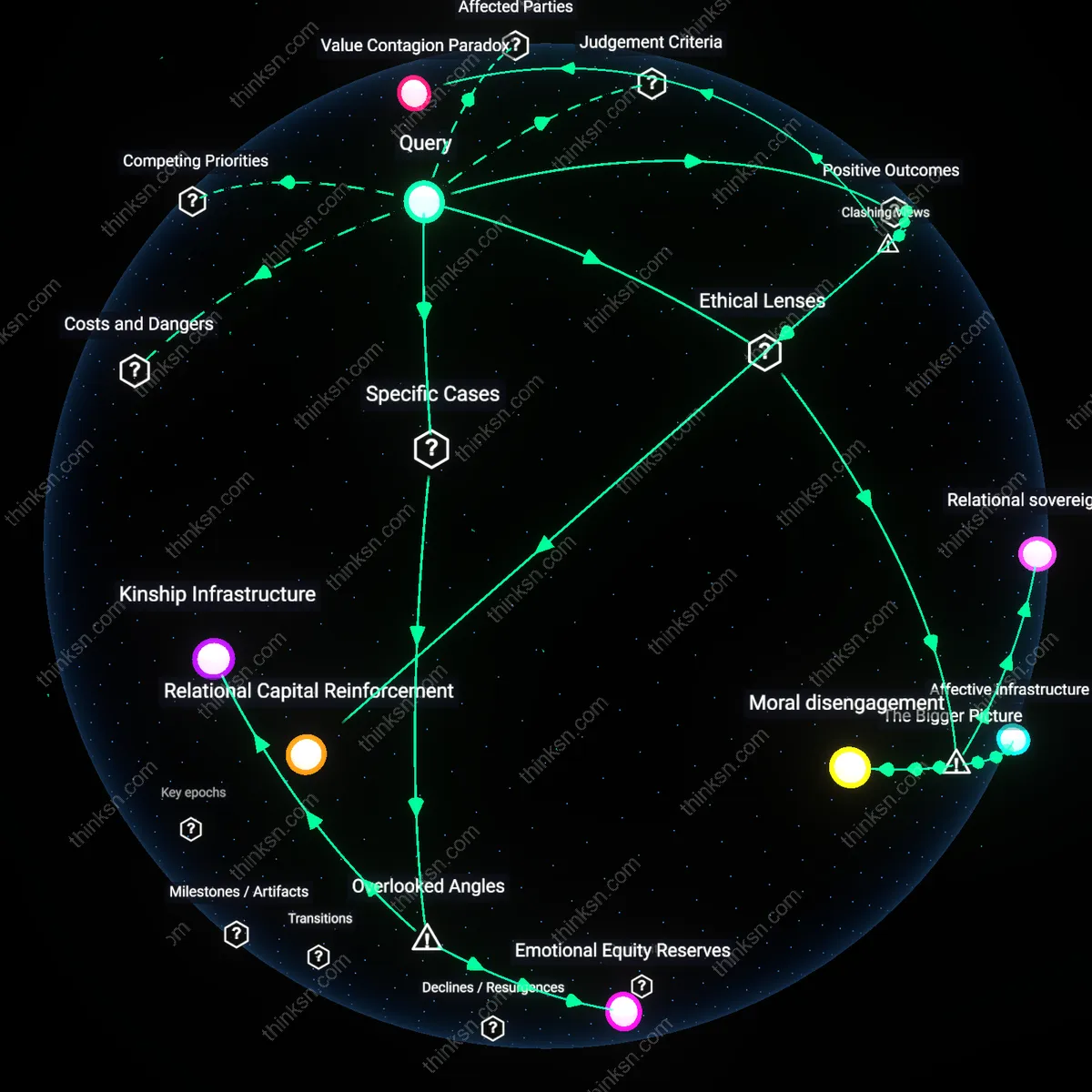
Inviting the gender-nonconforming partner strengthens long-term family cohesion by signaling adaptability, which increases relational capital within intergenerational family systems. This move shifts the source of family legitimacy from rigid adherence to tradition to demonstrated emotional resilience, thereby positioning inclusion as a mechanism for interfamily stability rather than disruption. The non-obvious insight is that traditional values often prioritize surface conformity over functional durability, while inclusion quietly reinforces the very loyalty and mutual obligation that tradition claims to protect.
Moral Boundary Subversion
Extending the invitation destabilizes the assumed moral authority of elders by redefining who holds the power to sanction belonging, turning the act of inclusion into a quiet redistribution of familial sovereignty. This shift operates through ritual participation—holiday gatherings as political theater—where presence, not permission, recalibrates legitimacy. The dissonance lies in recognizing that upholding tradition often requires its violation, as rigid exclusion risks fracturing the unity tradition seeks to preserve.
Value Contagion Paradox
Including the partner accelerates value pluralism within the family by making visible the coexistence of divergent worldviews without requiring resolution, thereby modeling a functional pluralism that enhances adaptive capacity across future conflicts. This functions through observational learning, particularly among younger members, who internalize conflict tolerance as a core family trait. The underappreciated truth is that apparent ideological compromise does not dilute tradition—it inoculates the family against future ruptures by normalizing negotiated identity.
Moral disengagement
Inviting the partner reinforces inclusivity but risks normalizing behaviors that some family members view as ethically impermissible under deontological frameworks that prioritize adherence to traditional moral duties rooted in religious doctrine. This creates a psychological mechanism by which certain relatives may temporarily suspend their usual ethical standards—by downplaying the significance of the conflict or reframing participation as mere politeness—thereby enabling social cohesion at the cost of personal moral integrity. The non-obvious dynamic is that the act of inclusion itself becomes a vehicle for moral disengagement, where individuals compartmentalize values to avoid cognitive dissonance within kinship networks structured around shared belief systems.
Relational sovereignty
The decision hinges on whether the sibling exercises relational sovereignty—the capacity to govern who enters their intimate space within the family system—despite resistance from elders or dominant kin groups who claim authority over ritual inclusion. This sovereignty is enabled by shifting generational power dynamics in Western middle-class families, where autonomy norms now legitimate individual consent as a governing principle in relational boundaries. The underappreciated consequence is that holiday invitations function not just as social gestures but as political acts that redistribute authority within familial hierarchies, challenging long-standing patriarchal or gerontocratic control over collective belonging.
Affective infrastructure
Choosing to include or exclude the partner shapes the affective infrastructure of future family interactions, where emotional patterns become institutionalized through repeated practices of recognition or neglect. This infrastructure emerges from the cumulative effect of micro-decisions that signal who is considered a legitimate participant in shared life, conditioning long-term relational capacities such as trust, repair, and grief-sharing. The overlooked systemic force is that holiday rituals operate as low-frequency but high-salience nodes in this infrastructure, making them disproportionately influential in determining whether difference is absorbed or expelled from the kinship emotional economy.
Emotional Equity Reserves
Inviting a sibling's gender-nonconforming partner preserves long-term emotional equity reserves within extended family networks, particularly evident in multigenerational Midwestern families where unspoken caregiving obligations emerge during elder crises. In these contexts, inclusion during holidays functions not as symbolic gesture but as a ledger of reciprocity that later determines willingness to provide physical or financial support, a mechanism overlooked because emotional labor is rarely mapped as a resource distribution system. Most analyses treat holiday inclusion as a momentary moral decision, missing its function as a quiet investment in future mutual aid under conditions of dependency.
Kinship Infrastructure
Excluding the partner weakens the resilience of kinship infrastructure by eroding the redundancy of care pathways, a pattern visible in Gulf Coast families after Hurricane Katrina, where non-biological kin became primary emergency responders. When non-traditional partners are marginalized during normal gatherings, they are less likely to be integrated into crisis communication trees or shelter networks, not due to explicit exclusion but because informal trust networks fail to form. Analysts rarely treat holiday inclusion as logistical maintenance of a distributed survival system, yet it determines who counts as 'usable family' during systemic collapse.