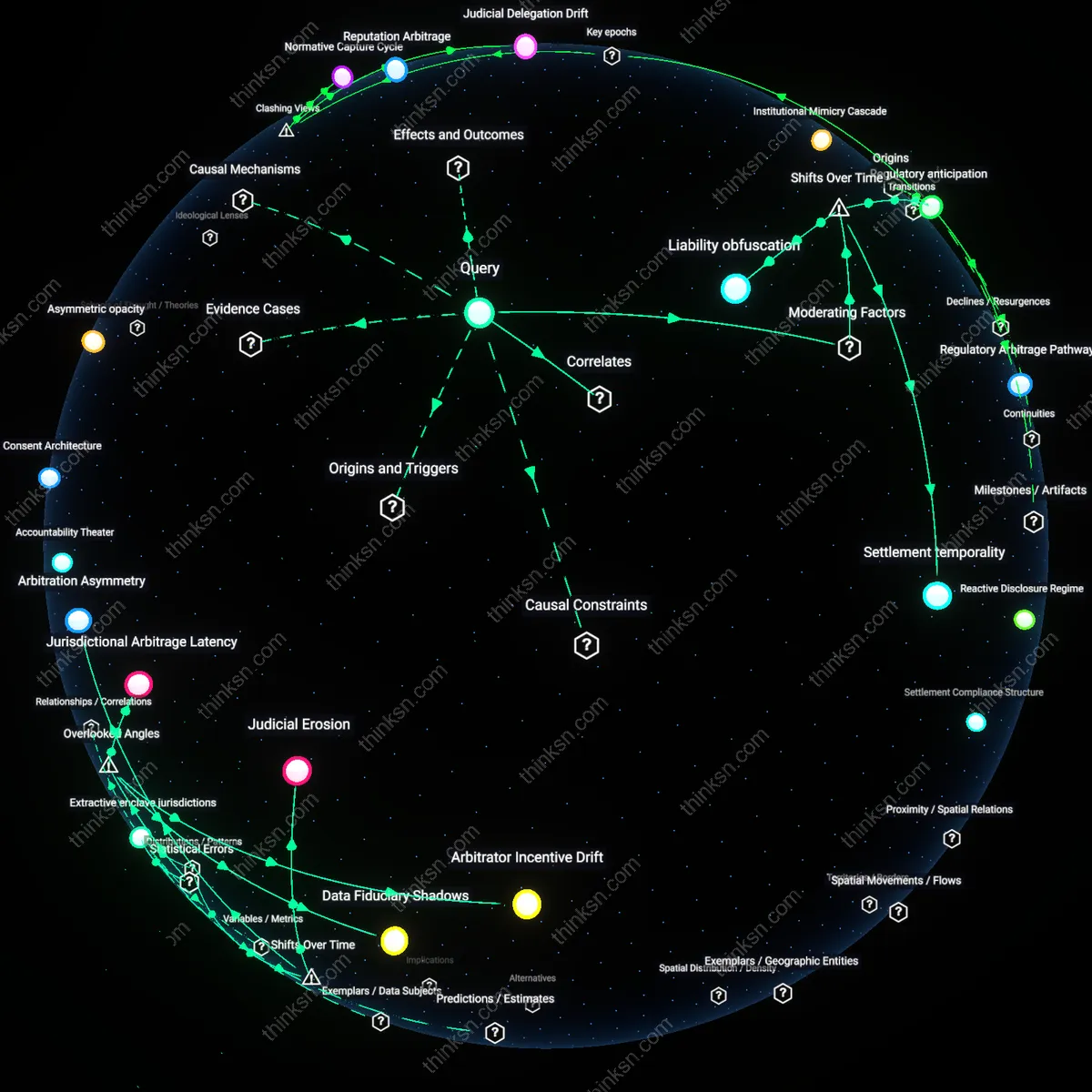
Data Breaches and Corporate Reputations: The Rise of Settlement Panels?
Analysis reveals 5 key thematic connections.
Key Findings
Settlement temporality
The growing use of settlement panels since the mid-2010s reflects a strategic substitution of legal resolution for reputational salvage, where corporations accelerate compensation to breach victims before class actions consolidate, thereby compressing the public narrative timeline between breach and remedy. This mechanism operates through coordination between in-house counsel and PR teams who now jointly manage incident response war rooms, treating litigation risk and brand erosion as coeval variables; the shift from post-litigation reputation repair (pre-2012) to preemptive narrative control reveals that legal accountability has been temporally folded into crisis communications cycles, making the speed of response more consequential than judicial outcome.
Regulatory anticipation
Corporations' increased reliance on settlement panels after 2018 signals a recalibration of accountability practices in anticipation of stricter privacy regimes like GDPR and CCPA, transforming ad hoc restitution into a proxy for regulatory compliance before formal rules take effect. This shift replaces reactive legal defense with institutionalized victim outreach programs managed by third-party administrators, effectively using settlements as live demonstrations of 'accountability performance' aimed at preempting regulatory scrutiny; the non-obvious consequence is that reputational management now functions as a trial run for future legal standards, where perceived responsibility becomes a testing ground for normative acceptability.
Liability obfuscation
The rise of settlement panels since 2020 indicates a decisive move away from judicial admission of fault toward distributed, non-precedential resolutions that insulate corporate conduct from legal elaboration, coinciding with the decline of public data breach trials in U.S. district courts. Managed by neutral administrators under opaque eligibility criteria, these panels process claims without formal discovery or public record, severing the causal link between harm acknowledgment and institutional consequence; this marks a departure from early post-2000s practices where settlements still required court approval and factual stipulations, revealing that reputational containment now depends on minimizing legal articulation of wrongdoing rather than addressing it.
Reputation Arbitrage
The growing use of settlement panels by corporations after data breaches indicates that legal compensation is increasingly deployed as a public relations instrument rather than a punitive or corrective mechanism. Companies like Equifax and Uber have used third-party-administered settlement funds not primarily to rectify harm, but to signal responsiveness while avoiding admissions of fault, thus converting legal liability into controlled reputation expenditure. This shift reveals that accountability is being outsourced to procedural gestures that satisfy media narratives rather than regulatory or ethical standards—an underappreciated move where legal processes are optimized for perception management, not justice.
Liability Theater
The expansion of settlement panels signals that corporations prioritize visible compliance over substantive legal reform, using structured payouts to simulate accountability without altering data governance practices. Firms such as Facebook and Target have implemented these panels not in response to proven regulatory failure, but in anticipation of consumer backlash, enacting judicial-like processes that lack enforcement power yet mirror the formality of adjudication. What’s often overlooked is that these panels operate less through legal precedent than through semiotic resonance—the appearance of resolution deters class-action momentum and media scrutiny, making the spectacle of settlement more valuable than its material impact.
Deeper Analysis
How did companies' use of settlement panels evolve from isolated incidents to standard practice in the years following major privacy laws?
Regulatory Arbitrage Mechanism
Companies adopted settlement panels not as compliance tools but as instruments to bypass stricter regulatory enforcement by creating privately governed alternatives that mimicked accountability without ceding control. Legal teams in Silicon Valley firms leveraged early GDPR and CCPA enforcement ambiguities to propose binding arbitration panels that substituted for public litigation, effectively channeling privacy disputes into forums where precedents could not accumulate and regulatory bodies lost data-gathering leverage. This shift was institutionalized through trade association standards like the Digital Accountability Alliance’s panel accreditation system, which certified corporate dispute mechanisms as ‘equivalent’ to regulatory remedies—thus exploiting legal equivalency frameworks to neutralize regulatory escalation. The non-obvious outcome is that standardization emerged not from corporate responsibility but from strategic avoidance of systemic oversight.
Normative Capture Cycle
Settlement panels became standard not through top-down regulation or market demand but because plaintiff law firms specializing in privacy class actions began treating panel referrals as a monetizable settlement stream, thereby normalizing their use. In the wake of the 2018 Facebook-Cambridge Analytica hearings, plaintiffs’ attorneys in the Northern District of California increasingly accepted panel enrollment as part of settlement terms, prioritizing faster recovery over precedent-setting judgments, which in turn incentivized defendants to standardize panel structures as repeatable defense infrastructure. This symbiotic adaptation transformed panels from ad hoc concessions into transactional norms embedded in settlement templates filed in multiple district courts. The underappreciated mechanism is that plaintiff-side pragmatism, not regulatory pressure or corporate ethics, drove institutionalization—effectively capturing the normative development of privacy redress.
Judicial Delegation Drift
Federal and state courts, overwhelmed by the volume of post-CCPA and post-GDPR privacy claims, began deferring to company-operated settlement panels as ‘sufficiently adequate’ forums, accelerating their entrenchment as default venues regardless of their impartiality. Judges in key districts like the Northern District of Illinois and the Central District of California started treating panel participation as evidence of ‘good faith’ compliance during summary judgment review, particularly in cases involving data retention and algorithmic transparency. This judicial posture emerged from procedural exhaustion rather than doctrinal endorsement, creating a path dependency where companies could point to prior court references to panels as justification for their universal adoption. The unacknowledged driver is not legal validity but judicial workload management—panels became standard because courts implicitly outsourced adjudicative triage to corporate systems.
Regulatory Arbitrage Pathway
Companies adopted settlement panels as a means to preempt stricter regulatory enforcement after major privacy laws, leveraging their voluntary nature to shape outcomes more favorably than formal adjudication. Following the GDPR and CCPA, data protection authorities faced resource constraints that limited direct enforcement, creating an opening for firms to propose settlement panels as 'cooperative' compliance tools—thereby shifting power to corporate legal teams and away from public regulators. This mechanism allowed firms to contain reputational risk while presenting alignment with regulatory goals, illustrating how private governance structures can emerge not as innovations but as strategic deflections of public authority. The non-obvious implication is that settlement panels did not spread due to efficiency but because they enabled regulated entities to influence the interpretation of new laws during critical implementation phases.
Institutional Mimicry Cascade
After high-profile privacy violations at firms like Facebook and Google led to publicized settlements involving third-party oversight panels, other companies began adopting similar structures to signal legitimacy even in the absence of legal mandates. This diffusion occurred not through regulatory requirement but via investor, board, and market pressures that equated the presence of such panels with responsible data governance, effectively turning isolated remedial actions into organizational isomorphisms. The dynamic reveals how crisis-response mechanisms in visible cases become normative templates across an industry, particularly when uncertainty about regulatory expectations is high. What’s underappreciated is that the spread of settlement panels reflected mimetic behavior in corporate governance rather than a direct response to legal compulsion.
Liability Anticipation Infrastructure
As class-action risks surged post-privacy legislation, companies integrated settlement panels into proactive legal strategy, using them to aggregate and resolve individual claims before they coalesced into systemic litigation threats. Law firms specializing in privacy litigation began advising clients to establish internal or semi-independent panels to process user complaints, effectively creating a filtration layer that reduced exposure to statutory damages under laws like the Illinois Biometric Information Privacy Act (BIPA). This shift transformed settlement panels from reactive tools into institutionalized risk anticipation systems embedded within compliance departments. The overlooked insight is that their institutionalization was driven less by regulatory design than by the structural incentives of the U.S. civil litigation environment, where early claim resolution has outsized financial and procedural advantages.
Explore further:
- If companies are using settlement panels to avoid public scrutiny while appearing accountable, how do regulators and the public really see these panels—do they think they’re fair or just a loophole?
- How did the way companies handle data breach claims change from before privacy lawsuits became common to now, when settlement panels are standard practice?
Where do these settlement panels operate, and which kinds of cases or places see them used most often?
Extractive enclave jurisdictions
Settlement panels operate primarily within special economic zones in resource-rich developing nations, such as Papua New Guinea’s liquefied natural gas enclaves or Guyana’s offshore oil governance corridors. These zones function as semi-autonomous legal spaces where state sovereignty is contractually diluted, allowing private arbitration panels—often convened under bilateral investment treaties—to override national courts. The non-obvious mechanism here is that jurisdiction is not determined by territorial law but by investment agreements tied to capital-intensive projects, which means resolution occurs in regulatory bubbles isolated from local legal traditions. This reframes the geography of dispute settlement not as national but as contractually fragmented, revealing how extractive capital carves out legal space beyond public oversight.
Diplomatic adjacency networks
Settlement panels are disproportionately convened in capital cities of small states—like Luanda, Port of Spain, or Dushanbe—where proximity to bilateral embassies enables informal pre-arbitration negotiation circuits. The real locus of panel activation is not the courtroom but the network of diplomatic residences and international organization compounds where legal representatives, political advisers, and foreign investors meet under non-attributable settings. The underappreciated factor is that jurisdictional choice is shaped by logistical adjacency to foreign missions, which offer secure communication channels and political cover, making dispute escalation more feasible in specific urban microclimates. This shifts the analytical focus from formal legal venues to the cartography of diplomatic proximity, where access to resolution is silently governed by geopolitical footprints within city space.
Urban Jurisdictional Drift
Settlement panels increasingly operate within municipal boundaries that have expanded to absorb formerly rural or unincorporated areas, a shift most pronounced after the 1970s suburbanization wave; as city governments extended their legal reach through annexation and zoning reforms, these panels—once confined to central districts—migrated into newly dense residential peripheries, embedding themselves near community centers rather than courthouses. This spatial repositioning responded to rising caseloads from housing disputes and tenant-landlord conflicts in rapidly gentrifying zones, making proximity to affected populations a functional necessity. What is underappreciated is that this shift was not merely logistical but redefined the panels’ legitimacy, tying their authority more to neighborhood stability than formal court hierarchies. The post-1980 realignment thus produced a new spatial logic where dispute resolution follows demographic pressure rather than institutional tradition.
Post-Industrial Mediation Terrain
Settlement panels are now most active in former industrial corridors repurposed for mixed-use development, particularly in cities like Detroit, Pittsburgh, and Baltimore where deindustrialization from the 1960s onward left fragmented ownership and unresolved property claims; as manufacturing decline hollowed out tax bases, municipalities outsourced conflict management to localized panels that could resolve land use and redevelopment disputes faster than state courts. These panels emerged adjacent to brownfield sites and redeveloped warehouses not because of population density but because legal ambiguity clusters where economic transitions stall. The non-obvious insight is that their location indexes not crime or poverty per se, but the duration and incompleteness of economic conversion—panels cluster where the past economy impedes the formation of a new property regime, making them cartographic markers of stalled redevelopment.
Colonial Aftermath Zones
In former settler colonies such as Kenya, Australia, and Canada, settlement panels operate predominantly in edge territories where Indigenous lands interface with state-granted titles, a spatial pattern solidified after legal reforms in the 1990s that nominally recognized native land rights; these panels were situated near reservation borders or contested resource sites not as neutral venues but as instruments of spatial containment, designed to absorb tensions arising from overlapping claims without overturning colonial frameworks. As post-independence legal systems grappled with land restitution demands, the placement of panels at jurisdictional seams allowed states to project governance without redistributing power. The overlooked implication is that their geographic concentration reveals a transitional legal geography—one where decolonization is managed through proximity-based deferral rather than resolution, producing zones of perpetual negotiation.
Corporate Whistleblower Cases
Settlement panels operate most visibly within U.S. federal False Claims Act litigation, particularly when whistleblowers allege fraud by healthcare providers or defense contractors. These cases routinely channel resolution through Department of Justice-led settlement conferences, where relators, federal agencies, and corporate defendants negotiate recoveries before trial. The mechanism’s significance lies in the quasi-judicial role the DOJ assumes—balancing public accountability with fiscal efficiency—while the non-obvious feature is how these panels de facto set precedents for fraud valuation despite lacking formal adjudicative authority.
Post-Conflict Transitional Zones
Settlement panels are most frequently institutionalized in UN-mediated post-conflict societies such as Sierra Leone, Cambodia, and East Timor, where hybrid tribunals combine international legal standards with local customary justice practices. These panels operate through state-recognized, time-bound mechanisms like truth commissions or reparations boards, drawing legitimacy from both international mandates and community participation. What remains underappreciated is how their geographic confinement to internationally supervised transitions obscures their function as experimental governance labs, normalizing legal pluralism in ways that rarely migrate to stable democracies.
Tech Platform Content Disputes
The most scalable deployment of settlement panels today occurs within private governance systems of major social media platforms like Facebook’s Oversight Board, which adjudicates content moderation disputes across global user bases. These panels operate through algorithmically triaged case selection and binding policy recommendations, creating de facto speech norms that affect billions. The overlooked reality is that this model functions not as dispute resolution per se, but as reputational risk containment for platforms—using quasi-independent panels to externalize accountability while preserving operational control.
If companies are using settlement panels to avoid public scrutiny while appearing accountable, how do regulators and the public really see these panels—do they think they’re fair or just a loophole?
Accountability Theater
Regulators and the public often perceive settlement panels as a public relations tool rather than a justice mechanism because companies use them to settle disputes quickly and quietly, minimizing reputational damage while avoiding admissions of fault; this dynamic mirrors corporate practices in highly scrutinized sectors like tech and finance where optics of cooperation stand in for substantive reform, revealing how procedural fairness is substituted for symbolic closure.
Regulatory Arbitrage
Many regulators view settlement panels as a strategic bypass of formal enforcement processes, allowing firms to resolve allegations under private frameworks with weaker precedential value, lighter penalties, and no discovery obligations—practices common in industries like pharmaceuticals and consumer credit where firms exploit jurisdictional overlaps and uneven oversight to reduce systemic risk exposure without changing behavior.
Consent Architecture
The public often interprets participation in settlement panels as a form of implied admission, even when legally it is not, because the act of joining a panel suggests acknowledgment of a dispute worth addressing—a psychological threshold that shapes perception in high-profile cases such as university Title IX resolutions or corporate discrimination claims, where the appearance of voluntary engagement masks coercion through reputational pressure and constructs legitimacy through procedural consent.
Performative accountability
Regulators operating within liberal governance frameworks treat settlement panels as legitimate conflict-resolution tools, trusting that procedural fairness and expert mediation ensure justice, but in doing so they overlook how corporations strategically time and structure settlements to forestall systemic critique and avoid admitting fault—transforming legal accountability into a choreography of compliance that satisfies oversight metrics without altering power imbalances. This mechanism functions through accreditation regimes where regulatory legitimacy is measured by case closure rates rather than outcome equity, making the non-obvious reality that transparency can be preserved in form while being hollowed out in substance.
Asymmetric opacity
Conservative legal actors, particularly those aligned with institutional stability and private dispute resolution, view settlement panels favorably not as loopholes but as efficient alternatives to adversarial litigation, yet this preference depends on a deliberate blindness to how confidentiality clauses and non-precedential outcomes allow repeat offender corporations to accumulate advantages across cases while plaintiffs remain isolated—revealing a system where fairness is not absent but redistributed, skewed toward entities that can exploit procedural obscurity over time. The underappreciated dynamic is that opacity becomes a scalable resource, not a bug, within a legal economy that values finality over recurrence.
How did the way companies handle data breach claims change from before privacy lawsuits became common to now, when settlement panels are standard practice?
Reactive Disclosure Regime
Before privacy lawsuits became common, companies like AOL responded to data breaches by selectively releasing anonymized user data without legal compulsion or public accountability, as seen in the 2006 AOL search log leak, where researchers and journalists revealed that 'anonymized' data could be easily re-identified, exposing a norm in which disclosure was voluntary, minimal, and unregulated. This mechanism operated through internal corporate risk assessment rather than legal mandates, revealing that pre-litigation practices prioritized public relations over transparency, a non-obvious feature being that even unintentional disclosures were framed as goodwill gestures rather than obligations.
Settlement Compliance Structure
The 2012 FTC settlement with Google over the Buzz launch mandated the establishment of an independent privacy audit panel and regular third-party assessments, marking a shift where regulatory resolution formalized ongoing corporate oversight through recurring audits and binding governance reforms. This mechanism replaced one-time fines with structural enforcement, embedding external monitoring into corporate operations, a non-obvious transformation being that settlements became institutionalized tools to reshape internal compliance, not merely punish past conduct.
Litigation Anticipation Protocol
Following the 2017 Equifax breach, the company’s preemptive engagement with multidistrict litigation panels and its rapid agreement to a $700 million settlement—before class certification or trial—demonstrated how firms now internalize the inevitability of privacy litigation by standardizing crisis response around coordinated legal containment. This operates through dedicated breach-response playbooks that prioritize early negotiation with plaintiffs’ counsel and regulatory alignment, revealing the non-obvious reality that modern breach management is designed less to avoid liability than to channel it through predictable, panel-mediated settlements.
When corporations resolve data breach disputes in these private panels, how often do affected communities actually get compensated compared to cases handled in national courts?
Arbitration Asymmetry
Corporate data breach disputes have shifted from public litigation to private arbitration after the 2010s, drastically reducing compensation rates for affected communities compared to court outcomes, because mandatory arbitration clauses embedded in user agreements now preempt class actions. This mechanism, reinforced by U.S. Supreme Court rulings like AT&T Mobility v. Concepcion (2011), channels claims into panels where procedural opacity and asymmetrical resources favor corporations, making collective redress statistically negligible. The non-obvious consequence of this shift is not just lower payouts but the systematic erasure of breach harm from public record, converting widespread injury into isolated, unauditable transactions.
Judicial Erosion
From the 1990s to the early 2000s, data breach victims had a higher probability of receiving compensation through national courts, where class action lawsuits produced measurable settlements, but that pattern collapsed as corporate legal strategies evolved to exploit gaps in privacy legislation and procedural doctrine. The turning point came in the mid-2000s when courts began dismissing breach cases for lack of 'concrete harm,' even in proven exposures, narrowing standing and invalidating claims before trial. This doctrinal shift reveals that compensation is no longer contingent on harm but on judicial recognition of harm—a gatekeeping function that has silently nullified redress despite escalating breach frequency.
Arbitrator Incentive Drift
Private arbitration panels compensate affected communities less frequently than national courts because arbitrators are repeat players in corporate ecosystems, creating an incentive to rule conservatively and maintain future appointment opportunities. This dynamic operates through the dependency of arbitrators on case referrals from corporate counsel networks, particularly in jurisdictions like the U.S. where mandatory arbitration clauses dominate privacy-related contracts. The underappreciated factor is not just forum bias, but how systemic career incentives subtly shift adjudicative norms below statistical detection thresholds—making aggregate compensation rates appear only marginally different while masking a structural deflation of awards over time. This changes the standard understanding by revealing that undercompensation is not due to formal process differences but to incremental, undetectable decision drift shaped by relational economics.
Data Fiduciary Shadows
Compensation rates in private panels are artificially deflated because the definition of 'affected community' is contractually narrowed during arbitration to exclude individuals whose data was accessed but not monetized, unlike in national courts where harm can be recognized based on privacy violation alone. This occurs because private panels rely on damages frameworks derived from contract law rather than tort, requiring proof of financial loss—something most breached individuals cannot demonstrate. The overlooked mechanism is how the legal categorization of data holders as contract partners rather than fiduciaries suppresses recognition of dignitary harm, thereby shrinking the compensable population before claims are even evaluated. This matters because it shifts the locus of undercompensation from procedural access to ontological eligibility, a threshold condition rarely captured in breach outcome statistics.
Jurisdictional Arbitrage Latency
Affected communities are less likely to receive compensation in private panels because disputes are routed through offshore arbitration hubs such as the Singapore International Arbitration Centre or ICC in Paris, where procedural delays and notification lags prevent timely claim submission by dispersed groups, especially in low-income regions. This operates through the disjunction between where data is held (U.S.-based servers) and where arbitration occurs (neutral venues), creating a temporal arbitrage that disproportionately excludes geographically distant or digitally marginalized claimants. The non-obvious factor is that compensation disparities are not solely due to legal standards but to temporal and logistical friction embedded in venue selection—a silent filtering mechanism that reduces participation rates invisibly, distorting apparent compensation rates without changing nominal award amounts.