Why Traffic Fears Trump Quality in School Density Debates?
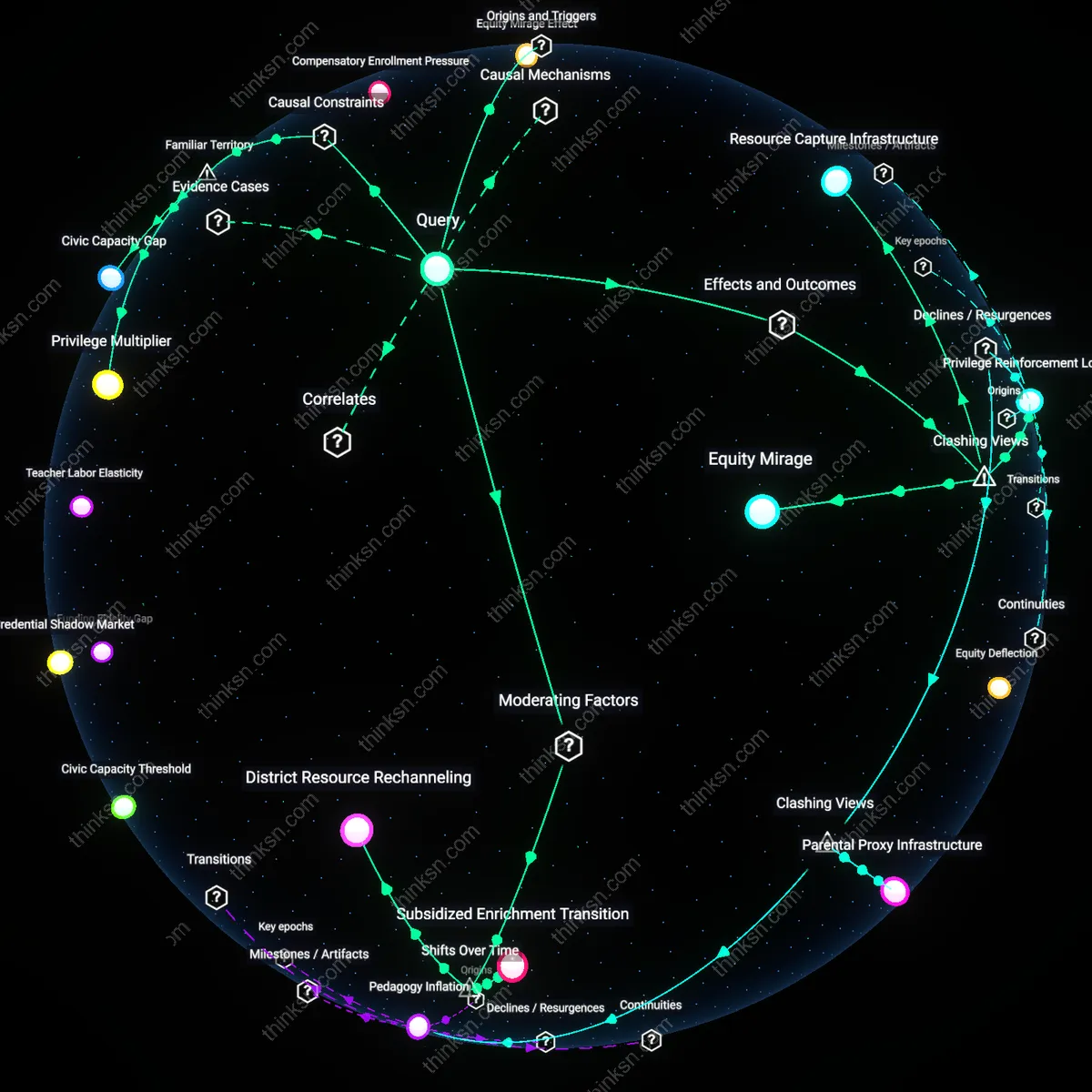
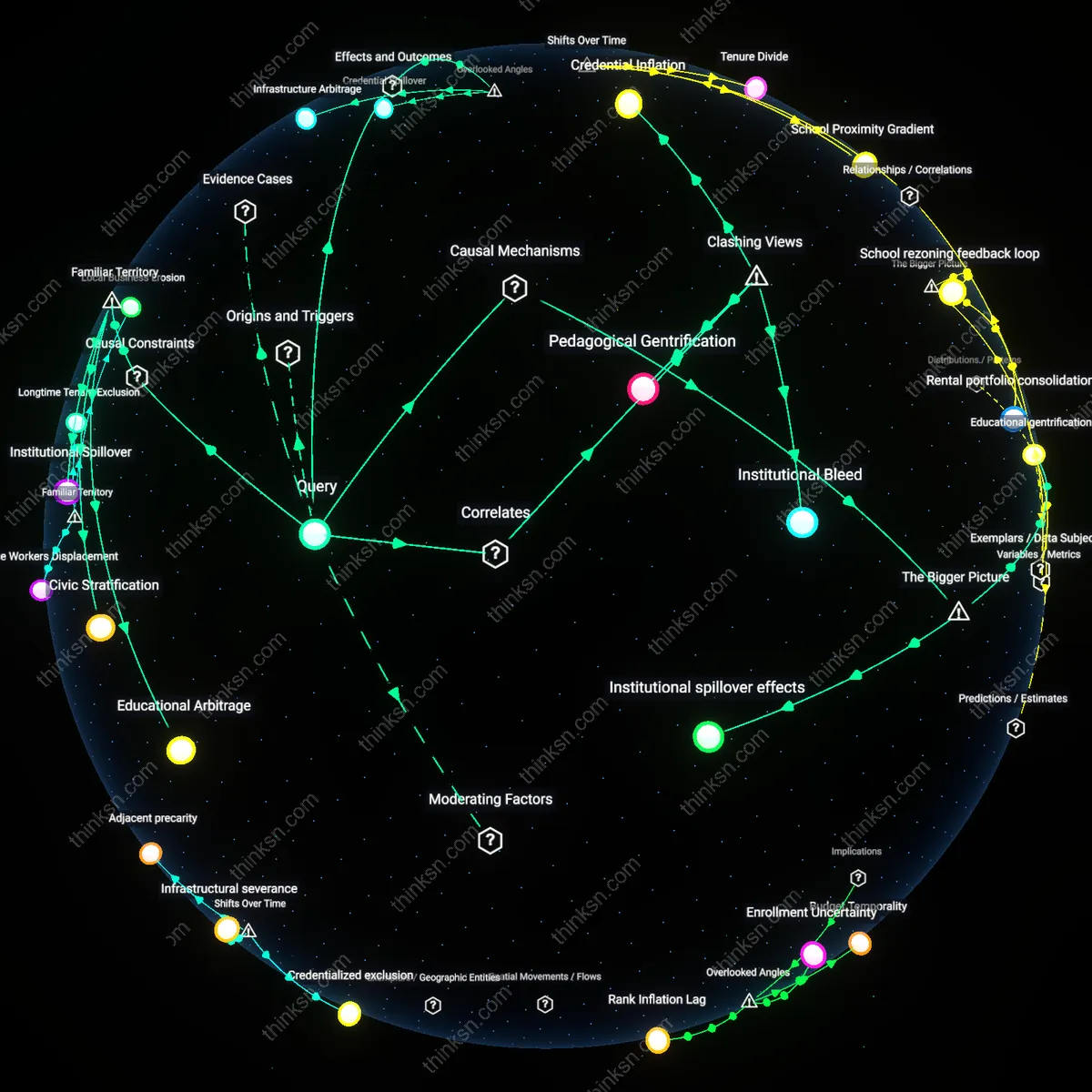
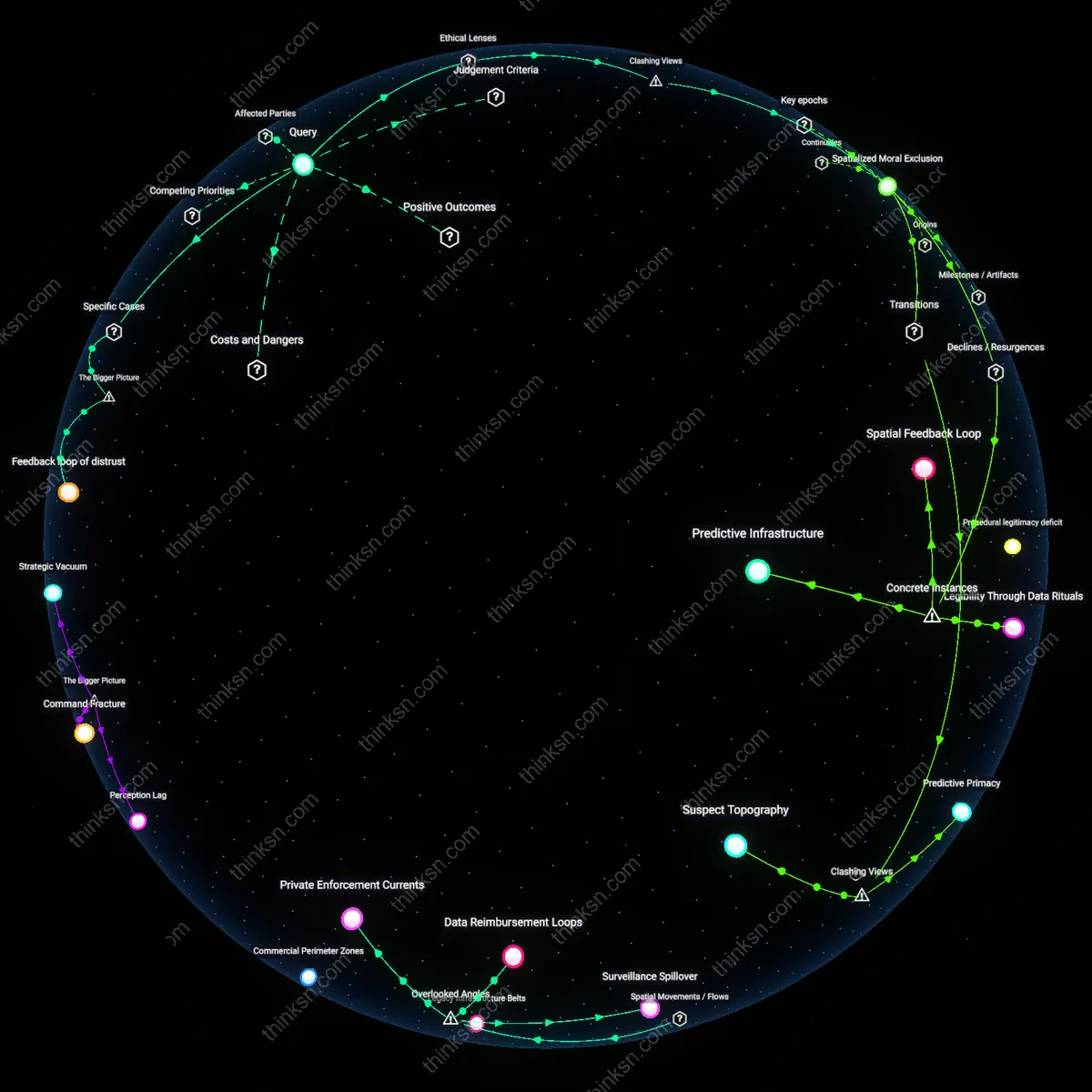
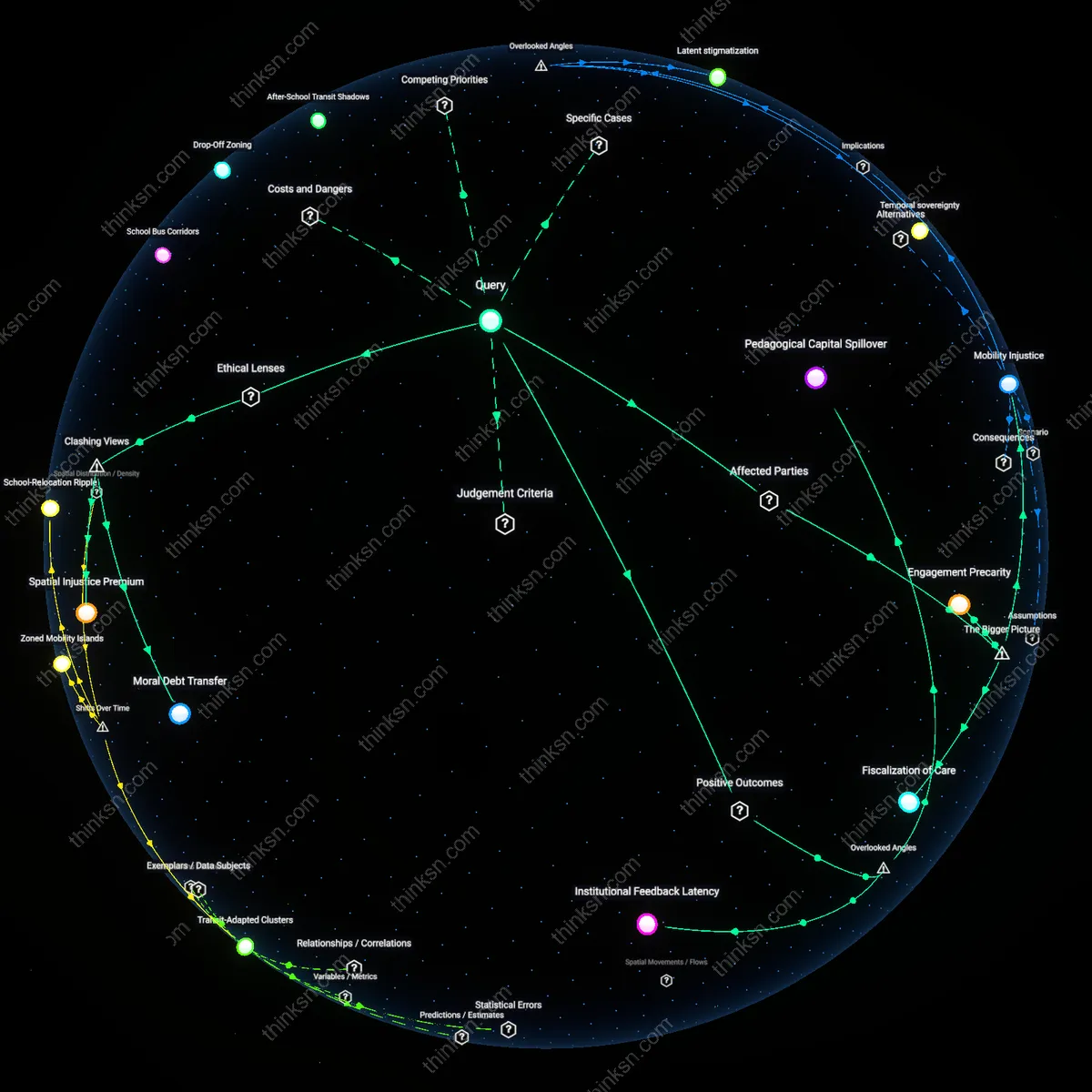
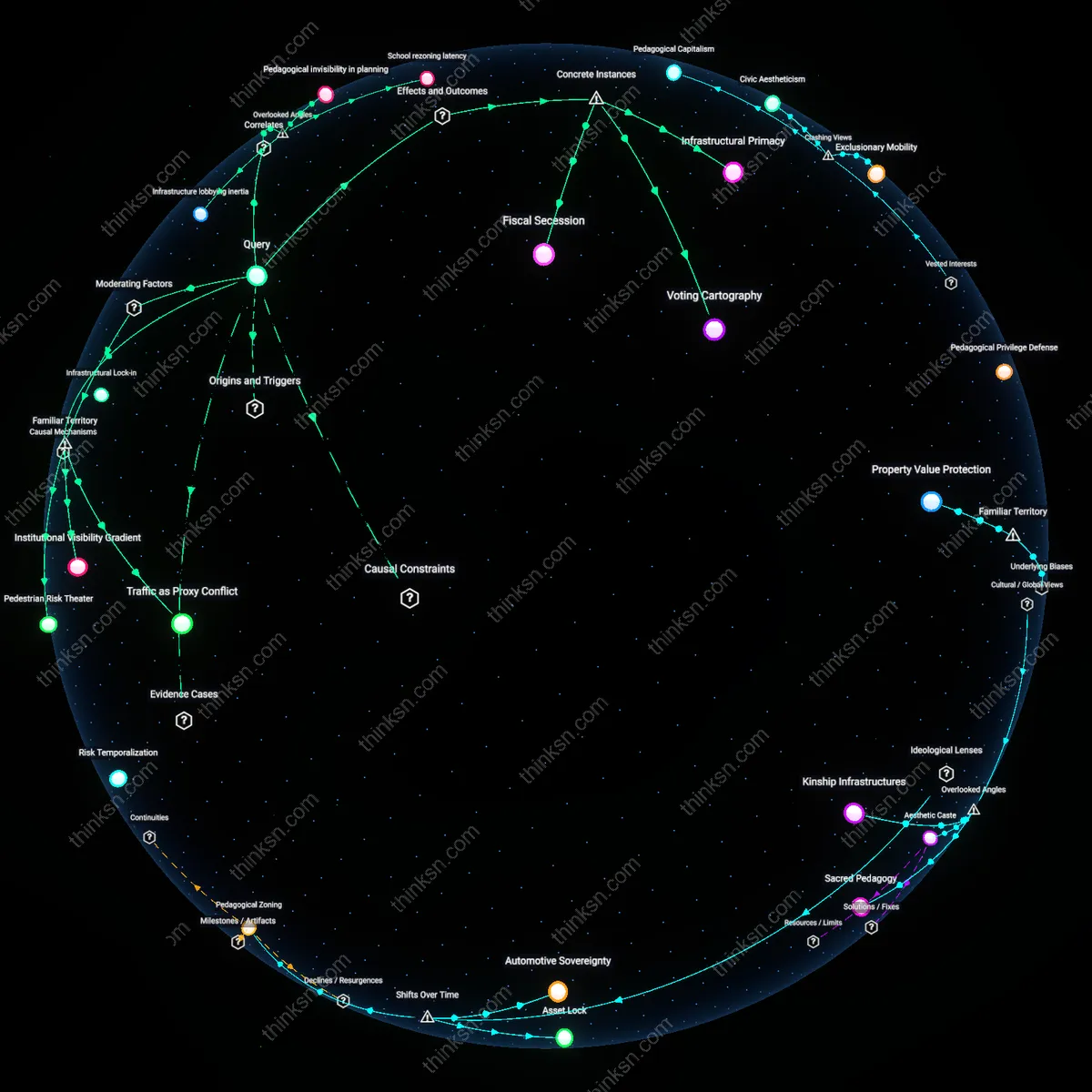
Analysis reveals 12 key thematic connections.
Key Findings
Infrastructural Lock-in
Local governments prioritize traffic mitigation over school quality because post-1950s suburban development entrenched car-dependent zoning around educational facilities, making road expansions politically routine while school capacity upgrades require difficult budget renegotiations. Municipal engineering departments, conditioned by decades of federal highway incentives, reflexively treat congestion near schools as an operational crisis solvable through lane adjustments, whereas academic overcrowding is framed as a long-term capital issue requiring state-level coordination—rendering traffic a visible, immediate demand on local authority that overrides less tangible pedagogical concerns. This split response solidified during the 1970s as school bond measures faced rising voter resistance, revealing how mid-century spatial planning pre-committed cities to mobility management as the default mode of public stewardship around campuses.
Participatory Asymmetry
Parent-led opposition to density near top schools since the 1990s has increasingly weaponized traffic safety as a politically legible grievance, displacing debates about educational equity because transportation impacts mobilize broader coalitions of homeowners regardless of school enrollment status. As gifted program zoning intensified neighborhood stratification in the 2000s, affluent families leveraged Parent Teacher Organizations and traffic impact studies to block mid-rise proposals, exploiting environmental review processes that recognize vehicular delay as a measurable harm while school quality dilution remains uncodified in land use law—turning traffic into a proxy mechanism for preserving exclusivity. This shift, evident in cities like Berkeley and Arlington post-2010, exposes how democratic participation in urban planning became channeled into technical risk avoidance rather than educational visioning, as procedural rules evolved to validate movement disruption over learning environment claims.
Risk Temporalization
After the 2008 transportation reauthorization emphasized 'complete streets' and child pedestrian safety, cities began treating traffic congestion near schools as an acute liability risk, subject to real-time monitoring and legal exposure, while academic quality degradation remained an abstract, longitudinal concern without fiduciary triggers. This regulatory pivot transformed school zone traffic into a metricized emergency—cameras, speed analytics, injury reports—activating public works response protocols that bypass planning commissions, whereas enrollment-driven curriculum strain accumulates invisibly across academic cycles without activating fiscal or legal alarms. The institutionalization of traffic as a real-time risk domain post-2010, exemplified in New York City’s Vision Zero school safety corridors, reveals how risk management timelines have compressed around bodily harm, leaving educational integrity outside the regime of actionable crisis.
Infrastructural Primacy
Traffic concerns override educational quality in proximity debates because transportation infrastructure carries binding regulatory and funding constraints that school planning does not, as seen in the 2019 opposition to dense housing near Palo Alto’s Gunn High School, where Caltrans safety mandates for Highway 101 interchange upgrades forced regional transit impact assessments to supersede school district enrollment projections. The California Department of Transportation’s authority to withhold development permits based on traffic flow thresholds gave transportation engineers effective veto power over residential density, even when proposed units would directly fund classroom improvements via school bond-aligned developer fees. This reveals that mobility systems operate under rigid compliance regimes with immediate fiscal consequences, while educational capacity is treated as a flexible, deferred concern within land-use negotiations.
Voting Cartography
Traffic is prioritized over educational outcomes near elite schools because resident opposition leverages hyperlocal voting power to block density, as demonstrated in the 2022 defeat of Senate Bill 1211 in the Los Angeles Unified School District’s District 4, where homeowners within a half-mile radius of Walter Reed Middle School organized to kill the bill despite its aim to ease construction of affordable housing near transit-rich school zones. These homeowners, disproportionately represented in city council and school board elections, successfully reframed the bill as a traffic hazard rather than an equity intervention, illustrating how electoral geography amplifies the political weight of low-density enclaves adjacent to high-performing schools. The non-obvious mechanism is not NIMBY sentiment per se, but the institutional alignment of school board and city council districts, which enables spatially concentrated voters to obstruct regional housing reforms under the guise of traffic safety.
Fiscal Secession
Near affluent schools, traffic arguments serve as legitimate cover for protecting local property tax advantages, exemplified by the 2020 zoning resistance in Berkeley’s Thousand Oaks neighborhood against the state’s SB 35 near Washington Middle School, where opponents emphasized traffic congestion while omitting that new units would increase parcel taxes that fund school programs. The Berkeley Unified School District’s reliance on local property taxes—despite California’s Proposition 98 guarantees—creates de facto incentives for exclusion, as rising enrollment from density could dilute per-pupil funding if state formulas do not fully compensate. The unspoken dynamic is that traffic discourse camouflages fiscal self-preservation, where access-restrictive land use maintains high home values and concentrated revenue, revealing that educational quality is not preserved through pedagogy but through economic segregation under administrative neutrality.
Traffic as Proxy Conflict
Traffic concerns outweigh educational quality preservation near top schools because affluent parents equate driveway congestion with declining neighborhood status, activating NIMBY coalitions that wield planning influence through school boards and homeowner associations. This mechanism operates through local land-use hearings where testimonials about safety and commute times carry more procedural weight than abstract pedagogical arguments, revealing how transportation friction becomes a socially acceptable stand-in for defending socio-spatial boundaries. What’s underappreciated is that traffic is not the real issue—its invocation is a performative claim of community harm that avoids explicit appeals to exclusivity.
Institutional Visibility Gradient
Municipal agencies prioritize traffic mitigation over educational capacity because road safety incidents generate immediate political feedback loops via 311 calls, media coverage, and police reports, whereas declines in instructional quality accumulate invisibly across academic years. This dynamic functions through jurisdictional accountability structures where transportation departments respond to acute, geolocated complaints near school zones, while curriculum outcomes fall under diffuse, long-term district oversight with muted public signaling. The overlooked reality is that high-visibility systems—like crossing guards and stop signs—become policy proxies for educational investment, even when they have no causal link to learning.
Pedestrian Risk Theater
Local opposition emphasizes traffic dangers near top schools because near-miss anecdotes and child safety imagery mobilize broader voter concern more effectively than debates over teacher retention or classroom size, leveraging emotional resonance in city council votes. This occurs through the ritualization of 'kid zones'—speed-calming campaigns, painted crosswalks, and school patrol routines—that function as public performances of care, allowing officials to demonstrate action without altering enrollment or zoning. What’s rarely acknowledged is that these theatrical interventions satisfy demand for visible governance, rendering density opposition a moral imperative rather than a socioeconomic negotiation.
Infrastructure lobbying inertia
Traffic concerns override educational quality preservation near top schools because parent advocacy groups disproportionately engage in local land use hearings under the banner of safety and congestion, leveraging municipal engineering standards that automatically trigger traffic impact studies while omitting educational equity assessments. These groups, primarily composed of affluent homeowners with children enrolled in high-performing schools, exploit procedural asymmetries in city planning—where traffic mitigation is codified and fundable, but pedagogical continuity is not—to block higher-density housing that could alter neighborhood demographics. This dynamic is non-obvious because opposition appears technically grounded in traffic engineering, yet functions as a socially coded resistance to socioeconomic integration, revealing how routinized infrastructure review processes become de facto exclusionary tools.
School rezoning latency
Traffic concerns dominate over educational quality near elite schools because changes in student enrollment thresholds lag years behind residential development due to slow-moving school board boundary adjustment cycles, making traffic the immediate measurable externality while classroom impacts remain invisible. As developers propose dense housing near top-ranked schools, transportation systems register strain instantly—through observable vehicle counts and commute delays—while shifts in school capacity, teacher ratios, or academic performance are buffered by multiyear redistricting timelines and aggregated district-level data averaging. This delay conceals the true educational consequences of density, allowing traffic to serve as a proxy for deeper anxieties about resource dilution, even though the actual threat to educational quality is muted by bureaucratic time lag and statistical smoothing, a mechanism rarely acknowledged in debates over school-adjacent development.
Pedagogical invisibility in planning
Educational quality is displaced by traffic concerns in density debates near top schools because city planning departments lack standardized metrics to quantify instructional integrity, leaving traffic as the default regulatory fulcrum despite its irrelevance to learning outcomes. Unlike road capacity or parking availability, dimensions like teacher autonomy, curriculum depth, or student-teacher trust cannot be modeled in environmental impact reports or weighted in zoning cost-benefit analyses, rendering them absent from formal decision processes even when residents voice education as a priority. This institutional blind spot—where only quantifiable, physical flows gain policy traction—enables traffic to structurally overshadow pedagogy in public discourse, transforming what should be an educational governance issue into a transportation one, a subtle jurisdictional capture most analyses fail to detect.