Is Remote Work Forever Rational for Corporate Culture?
Analysis reveals 6 key thematic connections.
Key Findings
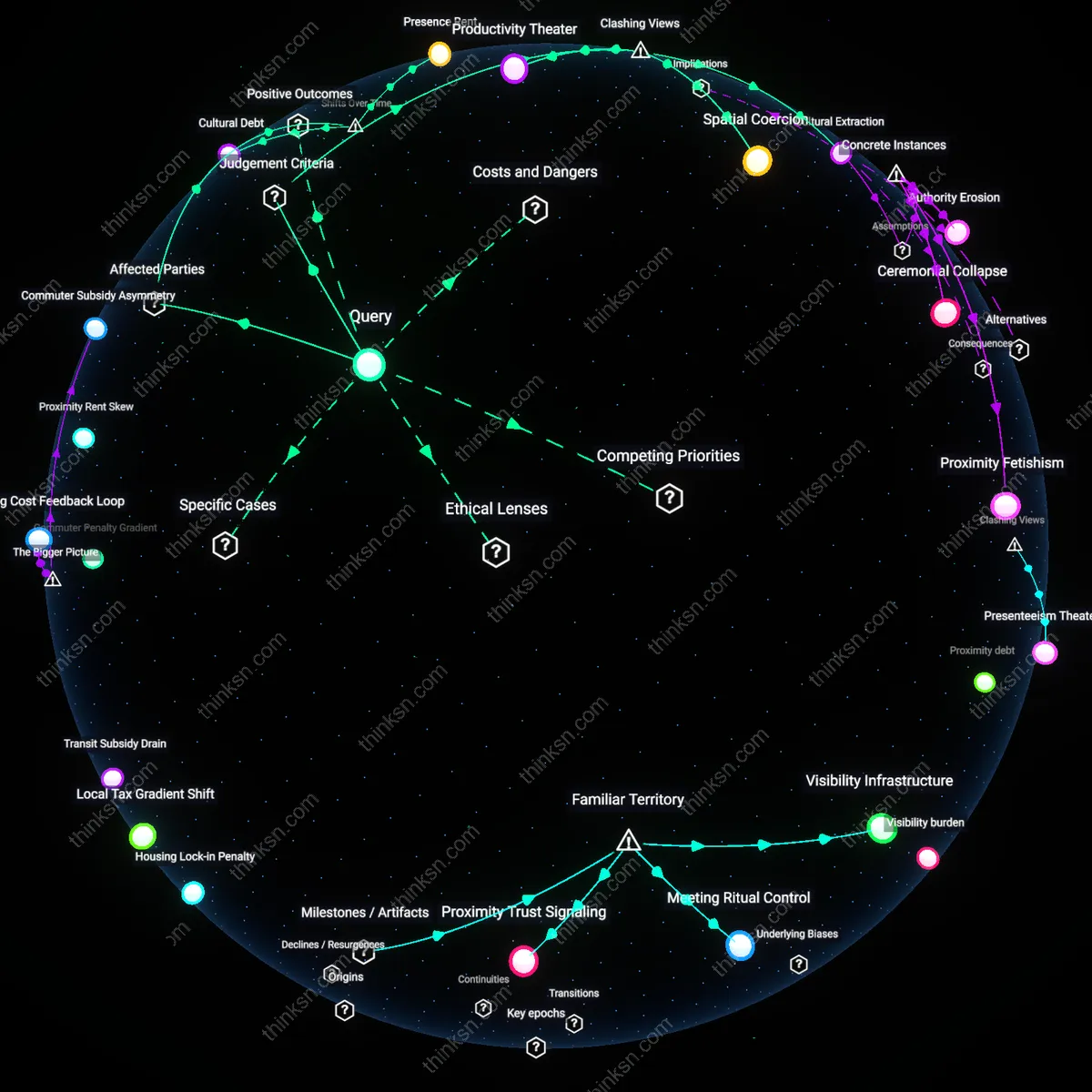
Cultural Debt
It is rational for employees to resist in-office mandates because corporate culture has shifted from a shared set of practices to a rhetorical instrument deployed by management to justify pre-pandemic spatial control, revealing cultural debt—the accrued cost of maintaining symbolic cohesion at the expense of workforce autonomy. Historically, corporate culture in the 1980s–2000s developed through in-person rituals, hierarchical proximity, and implicit socialization, but post-2020, remote work demonstrated that productivity and collaboration could persist without physical presence, undermining the necessity of those rituals. Management now invokes 'culture' not as a living system but as a deferred obligation to reconstitute cohesion on old terms, which employees reasonably treat as a burden they did not create. The non-obvious insight is that culture is no longer an emergent asset but a liability used to extract compliance.
Spatial Bargain
Employees insisting on permanent remote work act rationally because the post-pandemic workplace exposes the breakdown of the 20th-century spatial bargain—where workers traded commute and physical presence for job security and benefits—now invalidated by digital infrastructure and dispersed labor. During the industrial and service economies (1945–2000), colocation was essential for coordination, supervision, and technological access, embedding office attendance as a structural norm. The shift accelerated by remote-capable platforms (e.g., Slack, Zoom) after 2020 decoupled productivity from geography, making employer demands for return-to-office appear not as functional necessity but as institutional inertia. The underappreciated reality is that employees are renegotiating a geographic contract that technology has already nullified, rendering resistance a form of contractual realism.
Presence Rent
It is rational to refuse return-to-office mandates because employers are now extracting presence rent—a premium demanded not for output but for the symbolic performance of availability—marking a shift from output-based compensation to surveillance-embedded participation. In the pre-digital era (pre-2000), managerial oversight required proximity, so attendance correlated with oversight feasibility; after the shift to cloud-based workflows and asynchronous collaboration (post-2020), physical presence became decoupled from productivity yet persisted as a proxy for commitment. Companies like Apple or Goldman Sachs demanding office returns despite proven remote efficacy signal that loyalty is being measured performatively, not functionally. The overlooked dynamic is that presence has become a non-productive tax on labor, and refusing it is a rational rejection of unpaid symbolic labor.
Cultural Extraction
Yes, it is rational for the employee to refuse returning to the office because corporate culture functions as a mechanism of unpaid labor extraction, where presence is not about collaboration but symbolic compliance with managerial visibility. Employees' physical attendance subsidizes a narrative of cohesion and loyalty that disproportionately benefits executives and retention strategies while externalizing well-being costs onto workers; this dynamic is institutionalized through proximity-based promotion and informal networking, which entrench power hierarchies. The non-obvious reality is that 'culture' often serves as a legitimizing myth for control, not a shared benefit—revealing that insisting on remote work is a refusal to participate in ritualized performance rather than a rejection of community.
Spatial Coercion
Yes, it is rational because the employer’s demand for office presence constitutes spatial coercion—a practical assertion of authority disguised as cultural necessity—where control over location replaces direct surveillance in maintaining organizational hierarchy. By centralizing operations in a physical site, firms leverage commuting burdens, fixed schedules, and environmental design to shape behavior and filter out employees who resist assimilation, particularly those with caregiving roles or neurodivergent needs; this system prioritizes homogeneity over productivity. The dissonance lies in recognizing that 'culture' claims mask a power-based sorting mechanism, making remote work resistance a rational act of bodily and temporal autonomy against institutional territoriality.
Productivity Theater
Yes, it is rational because the employer’s invocation of corporate culture often serves as a cover for 'productivity theater'—a performative display of work that substitutes observable busyness for measurable output, especially in knowledge sectors where results are intangible or delayed. Managers reliant on visibility to justify their role perpetuate office mandates to sustain ritualized oversight, even when remote performance metrics exceed in-office ones; this exposes a misalignment between stated goals (culture) and actual incentives (control signaling). The underappreciated point is that rejecting the office is not cultural rejection but a rational response to institutionalized charades that privilege appearance over value creation.