Why Do Affluent Districts Have Long Waitlists for After-School Programs?
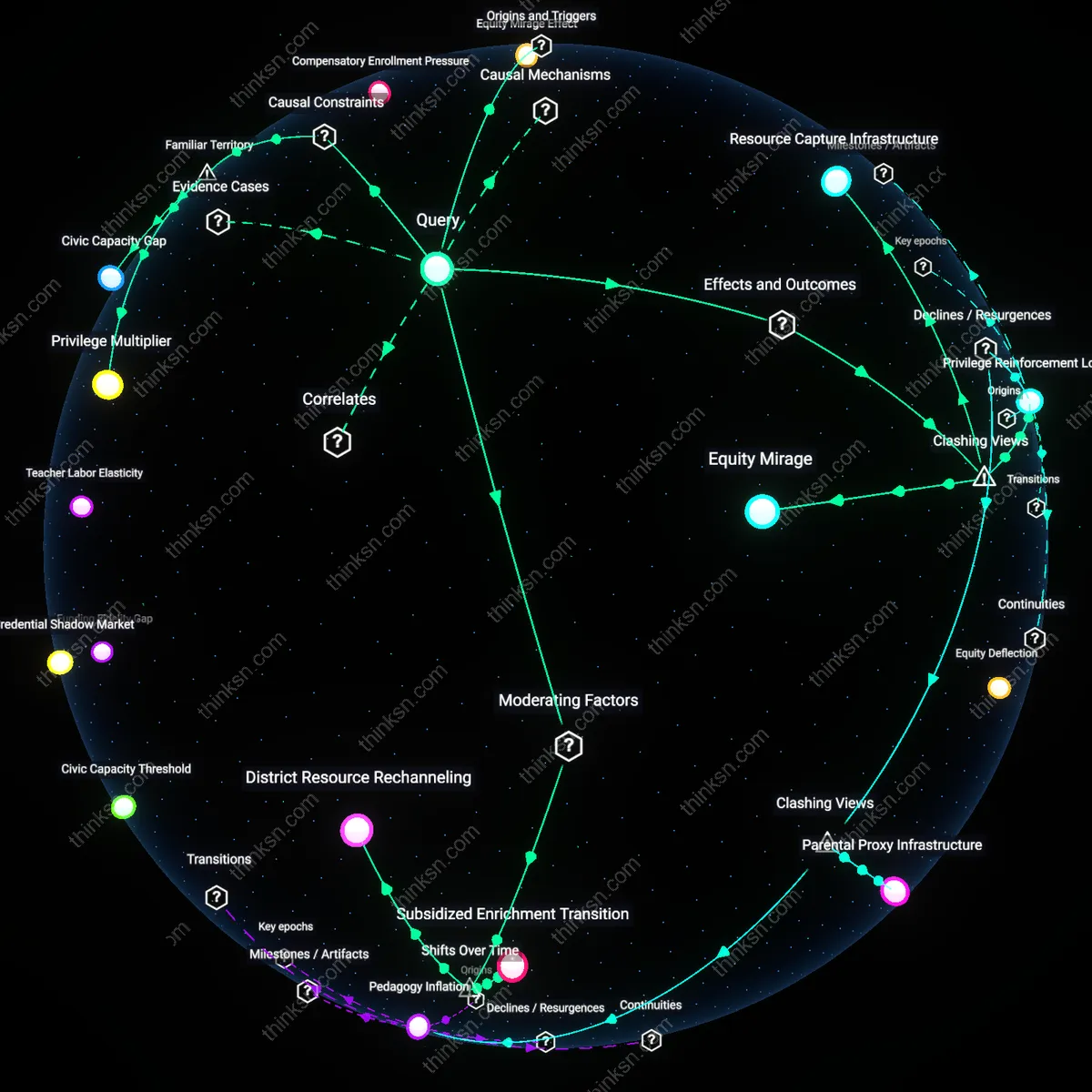
Analysis reveals 11 key thematic connections.
Key Findings
Resource Diversion Mechanism
High demand for after-school programs in wealthy districts indicates that public education funding structures enable affluent communities to redirect public resources toward supplementary services. Local control over school budgets and access to booster nonprofits allow wealthy districts to channel taxpayer dollars and private donations into enriching extras like STEM labs or performing arts—services nominally inclusive but practically contingent on family ability to supplement. This shifts the de facto public offering toward what affluent parents prioritize, effectively redefining 'essential' education in ways that marginalize core needs in less resourced areas. The non-obvious effect is not overinvestment in rich schools, but the systemic redirection of public goods into layered, privatized-enrichment regimes.
Compensatory Enrollment Pressure
High demand for after-school programs in wealthy districts signals a systemic erosion of perceived adequacy in the standard school day, driven by competitive college admissions and credentialing economies. Affluent families, able to organize collectively, exert pressure on district leadership to expand programming as a means of maintaining academic advantage—framing enrichment not as luxury but as necessity. School boards comply because tax base stability depends on keeping high-income families in the public system; losing them to private alternatives would reduce revenue and political capital. The underappreciated driver is not excess wealth but the structural dependency of public schools on elite retention to preserve funding and legitimacy.
Equity Mirage Effect
High demand for after-school programs in wealthy districts reveals how equal access metrics mask the concentration of effective educational power in privileged hands. While programs may be 'open to all,' their design—timing, prerequisites, language, implicit cultural norms—presumes family capacity to support participation, filtering out less resourced students indirectly. This produces a visible portfolio of district offerings that appear equitable while reproducing stratification through differential access. The overlooked mechanism is not funding inequality alone, but the normalization of participation barriers that make inclusion nominal rather than substantive, allowing policymakers to claim equity without redistributing influence.
Privilege Reinforcement Loop
High demand for after-school programs in wealthy districts indicates that public education resources are being leveraged to amplify existing advantages, not compensate for deficits. Affluent families use public funding for after-school initiatives to secure enrichment—such as robotics, debate, and STEM labs—that extends the school day for skill accumulation, directly tying taxpayer-supported infrastructure to competitive private benefits. This mechanism reveals a system in which ostensibly public resources are rechanneled through locally controlled institutions to serve elite closure, undermining the redistributive ideal of public education and instead reinforcing intergenerational advantage at the neighborhood level.
Resource Capture Infrastructure
The surge in after-school program demand in wealthy areas reflects a systematic capture of public education capacity by socioeconomically dominant groups, who exploit decentralized funding and program governance to prioritize their children’s access to premium services. School boards, PTAs, and municipal education committees in these districts allocate facilities, staffing, and grants to after-school initiatives that align with middle-class cultural capital—such as college prep tutoring or arts intensives—effectively colonizing public time and space. This dynamic contradicts the assumption that resource gaps only disadvantage the poor, showing instead that public systems can be internally subverted to serve the already resourced.
Equity Mirage
Intense demand for after-school programs in affluent districts exposes how equal access to public education funding produces deeply inequitable outcomes when local wealth supplements baseline resources. While state and federal formulas may distribute funds per pupil uniformly, the ability of high-income communities to match, bundle, and target those funds with private fundraising and volunteer labor creates parallel education systems under the same district umbrella. This outcome challenges the liberal conception that increased programming reflects healthy civic engagement, revealing instead how procedural equity in resource allocation can mask and even enable structural stratification.
Subsidized Enrichment Transition
High demand for after-school programs in wealthy districts indicates that public education resources shifted from core instructional support to enrichment outsourcing after the 1990s, as federal accountability policies like NCLB narrowed school-day curriculum to tested subjects, pushing arts, social development, and project-based learning into fee-based after-school spaces; affluent families responded by treating these programs as de facto extensions of schooling, effectively redistributing educational advantage through privatized time. This shift reveals how policy-driven curricular compression in the standards era transformed the temporal architecture of learning, with after-school becoming a zone of accumulation rather than remediation—what was once a safety net for at-risk youth now functions as a launchpad for already-advantaged students.
District Resource Rechanneling
The surge in after-school demand in wealthy districts since the 2008 recession reflects a rechanneling of local education funds from district-wide allocations to site-specific enrichment, as property-tax-dependent budgets recovered faster in high-income areas, enabling schools to partner with private providers for robotics labs, debate coaching, and college prep—services once considered supplementary but now treated as essential. Unlike in underfunded districts, where after-school programs shrank due to austerity, affluent communities leveraged economic recovery to institutionalize academic escalation beyond the school day, revealing how uneven fiscal resilience transformed voluntary programs into stratified pipelines, effectively privatizing advantage within public school ecosystems.
Parental Investment Inflection
The growing reliance on after-school programs in affluent districts since the early 2010s signals a structural inflection in parental investment logic, where middle-class parenting shifted from supplementing school to compensating for its perceived limitations, particularly in college preparatory rigor and individualized mentorship; this pivot intensified as elite university admissions grew more holistic and competitive, prompting families to treat after-school hours as critical for résumé-crafting. Unlike earlier eras when schools alone shaped academic trajectories, this demand surge reveals how higher education gatekeeping mechanisms have decentralized credential production into extracurricular time, turning public school campuses into platforms for privately funded advancement.
Privilege Multiplier
High demand for after-school programs in wealthy districts indicates that public education resources are distributed in a way that amplifies existing advantages. Wealthy families already have access to quality schools, but they leverage public or publicly subsidized after-school programs as additional academic and social enrichment, effectively using public resources to extend the reach of their private advantages. This occurs because program funding often follows student participation rather than need, allowing affluent districts to absorb more resources under the guise of demand, which masks inequities in baseline access. What’s underappreciated is that demand here functions not as a signal of unmet need but as a mechanism of accumulation—turning public goods into layered benefits for those already served well.
Civic Capacity Gap
High demand for after-school programs in wealthy districts indicates that public education resources are distributed based on community organizing power, not just fiscal inputs. Affluent parents are more likely to serve on school boards, lobby district officials, and mobilize volunteers, creating operational capacity that makes program implementation feasible—thus attracting more public funding and partnerships. The bottleneck isn’t money alone, but the presence of coordinated civic infrastructure that can activate and sustain programs, which less resourced communities often lack due to time poverty and institutional disengagement. The non-obvious reality is that equality of program access assumes equal community bandwidth to demand and deliver them, which obscures the systemic advantage of organized privilege.