How Community Health Centers Thrive or Struggle in Payer Systems?
Analysis reveals 10 key thematic connections.
Key Findings
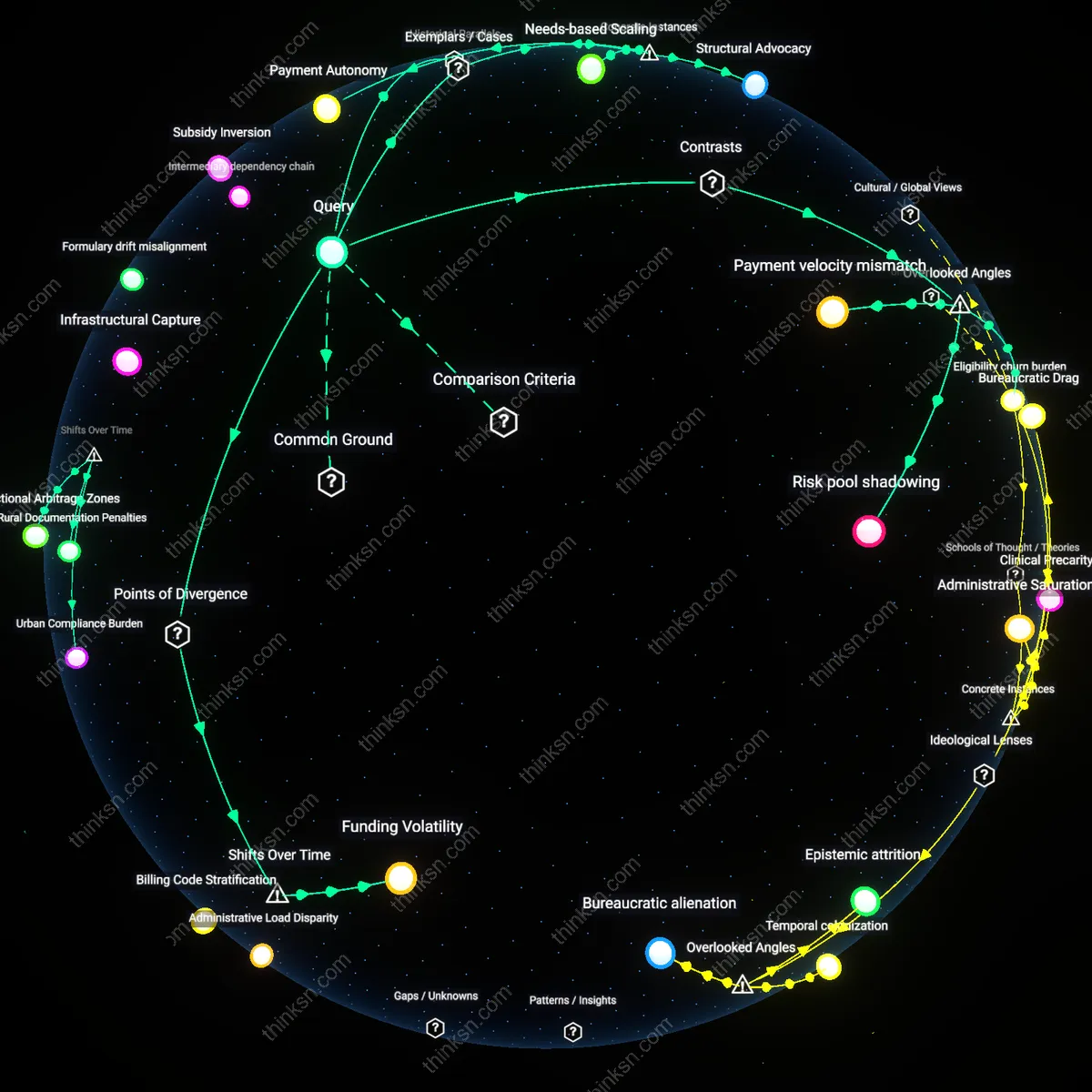
Infrastructural Capture
Community health centers in multi-payer systems function as conduits for insurance-based revenue extraction rather than needs-based care, transforming clinical spaces into sites of financial triage. Staff divert clinical time into billing coordination, eligibility verification, and payer-specific documentation—labor that actively displaces preventive outreach or chronic disease management for low-income patients. This dynamic mirrors the 19th-century railway land grants in the U.S., where public infrastructure was leveraged to serve private financial circuits rather than uniform public access, revealing how funding architecture embeds institutional priorities beneath a façade of universal service.
Subsidy Inversion
In single-payer systems, community health centers become de facto disciplining mechanisms that manage population risk for the central fund, prioritizing cost containment over equity through standardized treatment protocols. Canada’s Primary Care Networks, for example, distribute public funds via capitated payments that penalize centers for serving transient or complex patients—precisely the populations most underserved—thereby shifting distributive burden onto local clinics while preserving system-level solvency. This inverts the expectation that pooled financing automatically enhances access, exposing how centralized control can weaponize efficiency to sidestep structural vulnerability.
Fragmented Advocacy
Multi-payer systems fracture political agency within community health centers by tying their survival to competing insurer contracts and patchwork grants, preventing unified claims-making on behalf of patients. Unlike the UK’s National Health Service, where frontline providers can mobilize collectively around care standards, U.S. clinics in Medicaid-Medicare-private hybrid zones must tailor services to payer incentives, splintering advocacy into isolated bargaining episodes. This fragmentation undermines the development of a coherent countervailing power, revealing how financial multiplicity disables systemic challenge even when local care remains technically accessible.
Payment velocity mismatch
Community health centers in multi-payer systems operate under staggered and unpredictable reimbursement cycles due to fragmented insurer processing timelines, forcing centers to divert clinical staff into revenue assurance roles; this administrative drag slows care delivery more acutely for low-income patients, whose insurance types—Medicaid, marketplace plans—are processed slowest, a dynamic absent in single-payer systems where remittance is synchronized and unconditional. This timing misalignment between service delivery and fund arrival—payment velocity mismatch—is a hidden tax on care coordination that disproportionately compresses the time clinicians can spend with underserved patients, an effect rarely modeled in health equity assessments that focus on coverage rather than cash flow rhythm.
Eligibility churn burden
In multi-payer systems, community health centers bear the operational cost of constant patient insurance re-verification and program recertification, especially under Medicaid’s frequent eligibility churn, whereas single-payer systems eliminate this administrative loop; this eligibility churn burden forces frontline clinics to act as de facto insurance caseworkers, consuming up to 15% of clinical support hours in high-turnover urban centers like Detroit or Oakland—effort that does not improve health but prevents denial-triggered care gaps. This hidden labor load distorts clinic staffing models and suppresses outreach capacity, a structural drain invisible in macro-level access metrics that assume coverage equals care.
Risk pool shadowing
Community health centers in single-payer systems implicitly benefit from population-wide risk pooling that stabilizes funding regardless of local morbidity spikes, whereas in multi-payer systems, centers serving high-burden populations are penalized through payer mix degradation—insurers avoid patients with complex needs, leaving clinics overexposed to underfunded public plans. This risk pool shadowing means clinics become de facto reinsurers of last resort, absorbing financial volatility that private insurers externalize, a dynamic obscured in policy debates that treat financing and care delivery as separate when they are in fact co-constituted through risk selection behavior.
Funding Volatility
Community health centers in multi-payer systems diverged from their single-payer counterparts in the 1980s when U.S. federal policy tied reimbursement to patient-level insurance billing, making center sustainability dependent on payer mix and collection rates rather than per-capita allocations; this shift replaced steady public funding with fluctuating revenue streams, embedding centers in the instability of insurance fragmentation and forcing administrative adaptation to billing complexity—especially in urban safety-net clinics serving uninsured or underinsured populations. The result was a structural divergence where financial survival increasingly hinged on maximizing billable encounters rather than population health outcomes, a transformation rarely visible in national health systems like the UK’s NHS, where health centers have remained fiscally insulated from patient insurance status. The non-obvious consequence has been the quiet privatization of public health infrastructure under fiscal pressure, where clinical care is subordinated to revenue-capture imperatives.
Payment Autonomy
Community health centers in the United States, such as theDenver Health system, operate under fragmented multi-payer financing that forces them to prioritize billing capacity and payer mix optimization, which directly shapes their service expansion decisions—not just medical need. Because reimbursement rates vary across private insurers, Medicaid, and uninsured patients, these centers must allocate administrative resources to claims management and payer negotiation, weakening their ability to uniformly serve high-need, low-income populations. This dynamic reveals how financial survival in a multi-payer system redistributes clinical attention based on revenue potential rather than morbidity burden.
Needs-based Scaling
In Canada’s single-payer system, community health centers like those operated by Vancouver Coastal Health receive capitated or block funding from the provincial government, enabling them to scale services in direct response to local population health indicators such as opioid overdose rates or housing insecurity—without requiring payer-level approval. This funding model detaches service delivery from revenue capture, allowing frontline providers in places like the Downtown Eastside to initiate mobile clinics or extend hours based solely on emerging community need. The absence of billing-driven operational constraints makes visible how public financing alignment can turn health centers into real-time public health sensors.
Structural Advocacy
The Māori-owned and operated Poutiri Charitable Trust clinics in New Zealand function within a hybrid national health framework that centralizes funding yet allows community governance, enabling them to embed cultural safety and preventative care as non-negotiable clinical standards—something unilaterally mandated models often fail to achieve. Because the Trust controls its performance metrics and reports directly to the Ministry of Health, it can redirect preventive funding toward whānau (family)-centric models that reduce ER visits for asthma or diabetes in Tairāwhiti. This case demonstrates how single-payer systems, when combined with community ownership, institutionalize advocacy into the funding mechanism itself.