Administrative Immunization
Caseworker staffing and training adjustments before election years would institutionalize procedural rigor to absorb elderly applicant surges without informal prioritization. Election-sensitive social service offices—like local SSA field offices—would recalibrate hiring tempo and simulation-based training to align with biennial demand cycles, embedding surge capacity into standard operating procedures. This would preempt political suspicions of favoritism by formalizing responsiveness, transforming what is typically seen as an ad hoc crisis response into a routinized, auditable function of administrative design. The non-obvious insight within familiar concerns about election-year interference is that bureaucracy can preempt politicization not by resisting pressure but by absorbing it as a predictable input.
Eldercycle Forecasting
Adjusting caseworker resources ahead of election years would anchor workforce planning to demographic event models rather than political calendars, using Medicare enrollment spikes and biometric eligibility triggers as lead indicators. State Disability Determination Services and federal ACL-funded Area Agencies on Aging would shift from reactive hiring to predictive resourcing by treating elderly applicant volume as a time-series phenomenon with known lags post-election policy announcements. The familiar fear of senior citizens being exploited as political leverage would be defused not by moral restraint but by replacing calendar-based urgency with clinically dated life transitions. What's underappreciated is that seniors’ needs are more biologically scheduled than politically manipulated—making them uniquely forecastable in systems designed to see them as patients, not voters.
Neutralization Ritual
Pre-election staffing adjustments would become a public audit trail of bureaucratic neutrality, where published caseworker deployment schedules serve as performative proof of non-partisanship. State workforce agencies like Michigan’s MDHHS or California’s CDSS would issue pre-election resourcing proclamations, timed to coincide with FEC disclosure deadlines, converting internal HR decisions into transparency theater. The familiar anxiety about backdoor favors for elderly voters—deeply rooted in anecdotes of ‘election-year kindness’ at motor vehicle or benefits offices—would be answered not with denial but with ceremonial administrative acts designed to be seen. The non-obvious function is that some policies exist less to solve problems than to demonstrate their own impartiality, turning staffing plans into civic rituals of legitimacy.
Bureaucratic Temporalization
Adjusting caseworker staffing and training ahead of election years would institutionalize anticipatory rhythms in social service delivery, embedding electoral cycles into the administrative calendar. This shift reflects a departure from needs-based responsiveness to election-synchronized programming, as seen in the post-1996 welfare reforms when performance metrics began aligning with political timetables rather than demographic demand. What is non-obvious is that such adjustments do not merely respond to demand surges but actively produce them by timing outreach and eligibility campaigns to precede elections, thereby normalizing state temporality around the electoral clock rather than the life-course trajectories of elderly applicants.
Administrative Preemption
Increased staffing and training in advance of election years would function as a preemptive strike against application backlogs, transforming reactive welfare systems into anticipatory governance machines. This represents a break from the mid-20th century model of post-hoc casework triage, emerging only after the 2008 financial crisis exposed systemic delays in elderly benefit disbursement during periods of political vulnerability. The significance lies in the quiet substitution of equitable access with calibrated efficiency—ensuring claims are processed just in time to influence voter perceptions, not necessarily to meet applicants’ earliest needs.
Elderly Eligibility Frontloading
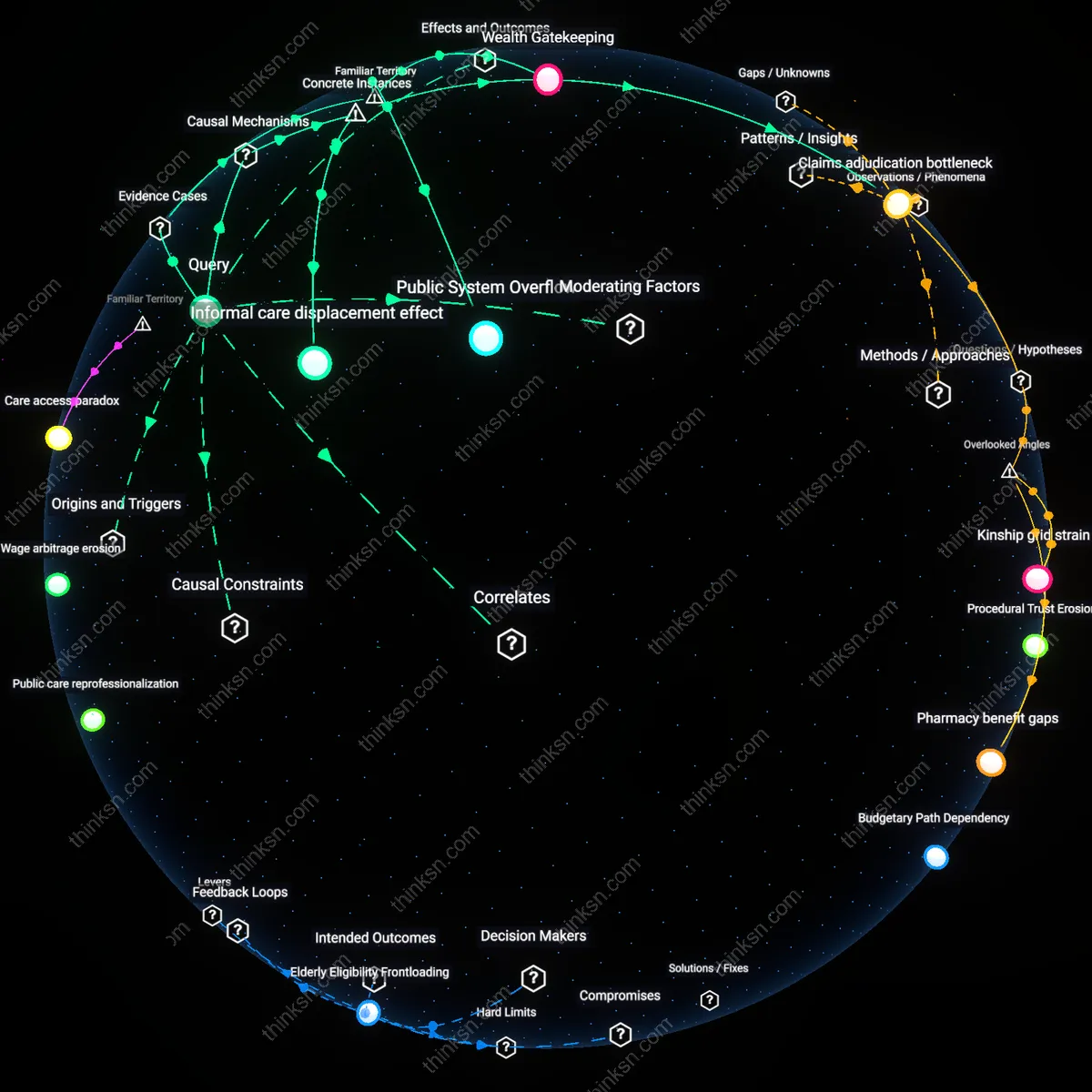
Preemptive caseworker deployment before election years reshapes the lifecycle of benefit enrollment by compressing the typical lag between eligibility and application into a politically timed window. This trajectory became visible after the 2014 Social Security Administration pilot in swing states, where training modules emphasized rapid intake protocols tailored to elderly migrants relocating before voter registration deadlines. The underappreciated effect is that aging itself becomes administratively synchronized—not through medical or social markers, but through the state’s strategic frontloading of bureaucratic capacity to convert demographic inevitability into political temporality.
Procedural Trust Erosion
Increased caseworker staffing and training before election years would inadvertently amplify perceptions of administrative favoritism, even in the absence of formal priority lanes, because observed service acceleration during politically sensitive periods activates public suspicion of hidden bias. This occurs not through misconduct but through the timing of resource allocation, which aligns with electoral cycles that already heighten scrutiny of bureaucratic neutrality—particularly among younger applicants whose wait times remain static or lengthen comparatively. The mechanism operates through interpretive public sense-making rather than procedural wrongdoing, making it a silent catalyst for institutional distrust. This dynamic is overlooked because most analyses focus on actual corruption or discrimination, not the epistemic effect of policy-timing coincidence on perceived fairness.
Budgetary Path Dependency
Preemptive surges in caseworker capacity for elderly applicants before elections would embed cyclical funding patterns into agency operating norms, causing non-election-year budgets to be evaluated against inflated baselines and making downsizing politically unviable. Program managers, observing consistent pre-election resource injections, begin to treat temporary boosts as structural entitlements when negotiating annual appropriations with state fiscal offices. This transforms what was intended as a time-limited adjustment into a de facto permanent expansion driven by administrative precedent rather than demographic need. The effect is rarely modeled because standard cost assessments assume rational reset mechanisms, ignoring how bureaucracies cognitively internalize temporary allocations as anchors for future demands.
Intergenerational Data Asymmetry
Enhanced training for caseworkers focused on elderly applicants before elections would generate richer, more standardized documentation for older clients while inadvertently widening data quality gaps between age cohorts—particularly disadvantaging near-elderly applicants (ages 55–64) whose records remain less consistently captured. This occurs because training protocols emphasize geriatric eligibility criteria refinement, shifting worker attention and documentation rigor toward older age bands, thereby deepening latent biases in backend analytics used for program forecasting. The asymmetry alters how algorithms interpret need over time, distorting long-term planning in ways invisible to real-time service delivery metrics. This dimension is overlooked because equity evaluations typically compare across race or income, not inter-cohort data fidelity gradients shaped by staff training focus.
Electoral Vulnerability Feedback
Boosting caseworker capacity before elections would temper bureaucratic strain but unintentionally reinforce political responsiveness cycles, where agencies adapt visibly only when officials face re-election. Frontline adjustments timed to election years are shaped less by demographic need than by the electoral calendar, which activates intergovernmental pressure from local elected officials fearing elderly voter backlash. This reveals how service delivery becomes seasonally optimized not for equity but for governance risk, embedding an unacknowledged feedback loop between voter demographics and administrative timing—what we might call Electoral Vulnerability Feedback, where aging populations become salient to state efficiency only when their electoral weight is electorally immediate.
Bureaucratic Double-Binding
Pre-emptive staffing spikes before elections paradoxically entrench informal triage by signaling that normative capacity is insufficient without political cover, thus making future appeals for baseline funding harder to justify. Caseworkers trained to handle surges under temporary political clearance find their routines absorbed into performance metrics that later become benchmarks—without stable support, this distorts professional norms toward crisis responsiveness rather than steady-state equity. This dynamic creates Bureaucratic Double-Binding, where administrators are rewarded for partisan-tolerant surge capacity while penalized for advocating permanent structural reform, trapping them between public service mandates and political feasibility.
Anticipatory Accommodation
Scaling training and staffing proactively transforms election-year surges into a policy rehearsal ground where agencies simulate crisis response without altering permanent entitlement frameworks, allowing legislatures to defer systemic modernization. By treating elderly applicant spikes as cyclical and manageable through temporary inputs, policymakers avoid overhauling eligibility systems or digital interfaces that could reduce long-term load—revealing a pattern where readiness substitutes for redesign. This practice crystallizes into Anticipatory Accommodation, a form of institutional complacency that rewards short-term operational mimicry of reform while preserving outdated administrative architectures.