Hidden Costs of Mental Health Coverage Disparities?
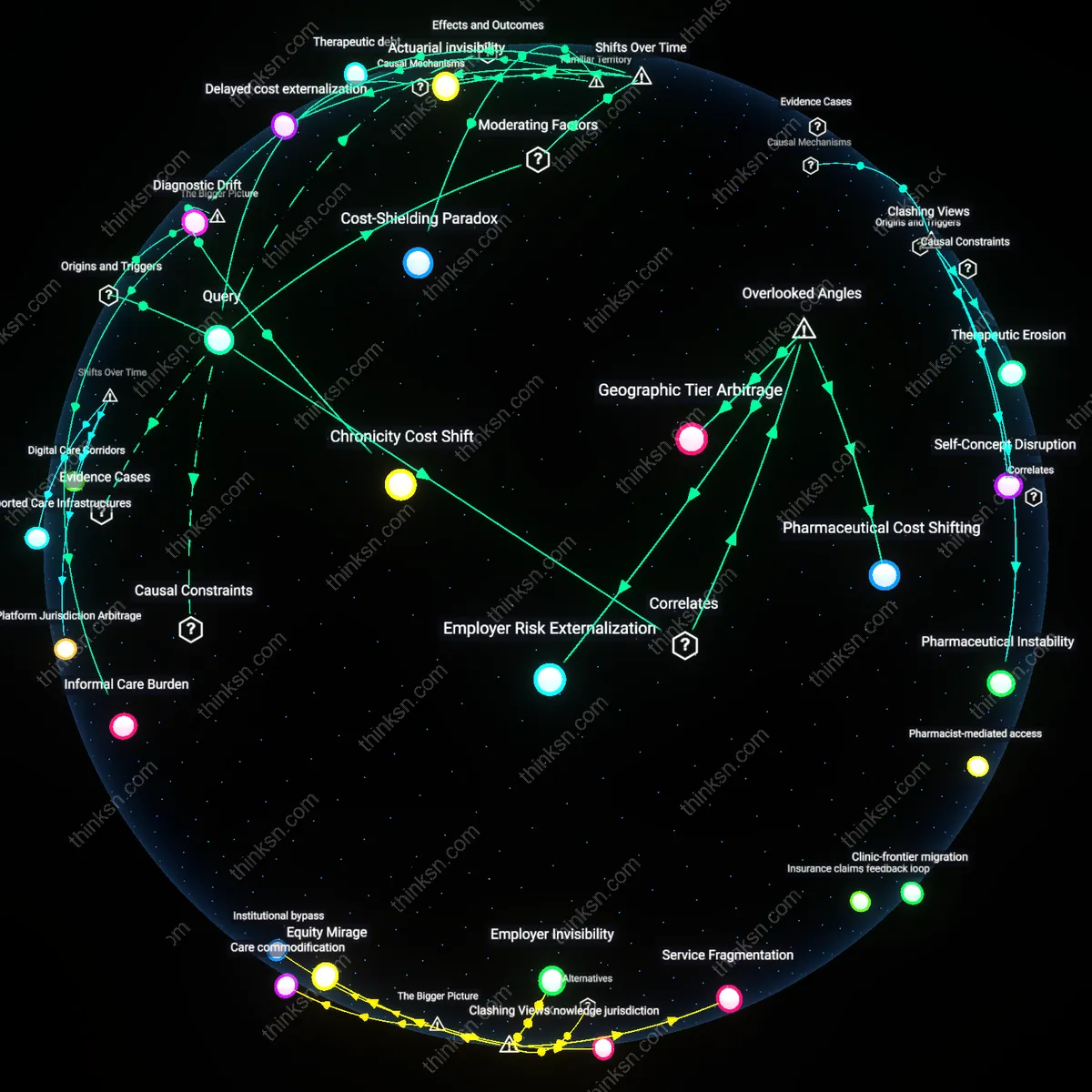
Analysis reveals 12 key thematic connections.
Key Findings
Benefit Design Asymmetry
Unequal insurance coverage for mental health services initiates concealed financial risks by embedding benefit design asymmetries that appear compliant with parity laws but systematically limit access through higher cost-sharing mechanisms. These asymmetries—such as elevated copays, stricter visit limits, and narrow provider networks for mental health—are structurally enabled by weak enforcement of mental health parity regulations, allowing insurers to exploit regulatory loopholes while maintaining legal compliance. The non-obvious consequence is that individuals face escalating out-of-pocket expenses over time, especially when wellness requires continuous care, making long-term treatment financially unsustainable despite apparent insurance coverage.
Chronicity Cost Shift
The underfunding of mental health benefits relative to physical health services triggers a chronicity cost shift, where delayed or fragmented care converts manageable conditions into long-term, complex illnesses requiring more intensive interventions. This shift is driven by payer incentives to minimize short-term claims, which suppress early intervention and push costs into later stages when untreated conditions lead to comorbidities, lost productivity, and emergency utilization. The structural dynamic—where insurers and employers optimize for immediate fiscal outcomes—obscures the long-term financial burden transferred onto individuals, who ultimately absorb costs through medical debt, reduced earning capacity, and unmet care needs.
Informal Care Burden
Disparities in mental health coverage activate an informal care burden that redistributes financial and labor costs from formal health systems to families and community networks. When individuals cannot access consistent, affordable professional care due to inadequate insurance, relatives assume caregiving roles involving lost wages, travel, and out-of-pocket support, creating hidden economic liabilities that remain off official balance sheets. This transfer is sustained by a systemic absence of public mental health infrastructure in the U.S., especially in rural and low-income regions, rendering familial labor the de facto safety net—effectively privatizing social risk and distorting the perceived affordability of mental health 'coverage.'
Cost-Shielding Paradox
Unequal insurance coverage leads individuals to delay mental health care until crises occur because high out-of-pocket costs for routine therapy make prevention financially unaffordable. Insurance plans often cover emergency psychiatric hospitalization more fully than outpatient sessions, creating a perverse incentive where patients and providers only access care when symptoms escalate to acute stages. This mechanism operates through insurer reimbursement structures that prioritize episodic, high-cost interventions over continuous, low-intensity support—despite evidence that early treatment reduces long-term utilization. The non-obvious insight is that financial protection in mental health is often structured to shield insurers from small, predictable expenses while exposing individuals to catastrophic personal and financial breakdowns.
Diagnostic Drift
Patients facing limited mental health coverage increasingly receive physical health diagnoses to gain access to covered services, such as being prescribed medical tests or primary care visits instead of psychotherapy. This occurs because insurance networks and provider incentives favor reimbursable somatic treatments over psychiatric ones, pushing clinicians to reframe depression as chronic fatigue or anxiety as gastrointestinal disorders. The mechanism runs through clinical coding systems and gatekeeping protocols in integrated care settings, where financial constraints distort diagnostic accuracy. What’s underapprec proteccted is that the erosion of diagnostic integrity becomes a hidden cost of coverage disparity—one that compromises long-term treatment coherence and perpetuates misaligned care pathways.
Care Fragmentation Tax
When mental health services are undercovered, individuals resort to piecemeal care across informal supports, sliding-scale clinics, and intermittent medication management, bypassing coordinated treatment plans. This fragmentation emerges because continuity requires sustained payment for integrated providers like therapists and psychiatrists working in tandem—services rarely bundled or fully reimbursed. The dynamic plays out in urban safety-net clinics and rural telehealth deserts, where logistical and financial discontinuities prevent holistic care. The overlooked consequence is that patients pay an invisible tax in time, instability, and worsened prognoses—not just from lacking insurance, but from navigating a system that rewards disjointed, crisis-responsive engagement over sustained healing.
Delayed cost externalization
Unequal insurance coverage shifts mental health costs from insurers to individuals over time, intensifying financial exposure as treatment delays accumulate. Under pre-2008 fee-for-service models, limited mental health parity allowed insurers to restrict access while insulating themselves from long-term systemic costs; patients absorbed downstream consequences through crisis-driven care. The shift toward value-based care post-Affordable Care Act revealed that early underinvestment in mental health generates higher societal costs later—an effect masked during periods of fragmented accountability. What was once seen as insurer prudence is now recognized as intertemporal cost displacement, where near-term savings morph into individual financial toxicity.
Therapeutic debt
Inadequate insurance coverage for mental health services compounds unmet care needs over time, transforming episodic gaps into chronic financial and clinical liabilities. Before the 1990s, employer-sponsored plans often excluded mental health altogether; as parity laws emerged in the 2000s, residual benefit design flaws—like higher copays and narrow networks—preserved access barriers despite apparent inclusion. Individuals navigating this transitional period accumulated untreated conditions while incurring informal caregiving or lost productivity costs unrecognized in traditional risk models. This evolving mismatch between formal coverage expansions and persistent practical exclusion produces a form of deferred therapeutic obligation—akin to debt—that only becomes legible in longitudinal treatment trajectories.
Actuarial invisibility
Mental health coverage gaps persist because insurers rely on risk models that systematically underrepresent longitudinal psychosocial costs, especially after regulatory shifts that decoupled mental and physical health data. Prior to the DSM-5’s 2013 recalibration, diagnostic categories were too static to inform dynamic risk adjustment; subsequent adoption in insurance underwriting lagged, leaving predictive models blind to early intervention savings. As population health management gained traction post-2015, this data lag revealed that individuals with mild-to-moderate untreated conditions faced escalating out-of-pocket burdens due to absence of preventative benchmarks. The temporal misalignment between clinical timelines and actuarial cycles produces a hidden risk profile—one that remains invisible until costly deterioration occurs, at which point it’s too late for cost-effective intervention.
Pharmaceutical Cost Shifting
Unequal insurance coverage for mental health drives patients toward medication-dependent treatment pathways because insurers reimburse psychiatric drugs more reliably than therapy sessions. This shifts long-term cost burdens to patients when side effects or dependency necessitate additional care, which is rarely anticipated in wellness planning. The non-obvious mechanism lies in how reimbursement asymmetries between therapy and medication—rooted in pharmacy benefit managers and formulary design—distort clinical decision-making toward cheaper, initially scalable solutions that accumulate hidden liabilities over time. This changes the standard understanding by revealing that cost containment strategies in insurance design actively promote financially risky treatment trajectories under the guise of access.
Employer Risk Externalization
Employers offering mental health benefits through high-deductible plans with narrow behavioral networks inadvertently transfer long-term financial risk to employees by limiting access to sustained care, increasing the likelihood of relapse and downstream productivity loss. This dynamic persists because employers optimize for premium cost and regulatory compliance, not employee biopsychosocial continuity, and are insulated from the full societal cost of under-treated mental illness. The overlooked angle is that employer-sponsored insurance functions as a risk displacement system, where corporate financial strategy leverages incomplete care as a silent subsidy—preserving short-term fiscal health at the expense of individual financial resilience.
Geographic Tier Arbitrage
Insurance networks frequently classify mental health providers in rural or underserved areas into lower reimbursement tiers, effectively pricing out qualified clinicians and forcing patients into either travel costs or suboptimal care. This creates a spatially embedded financial risk where individuals must choose between out-of-pocket expenditures for access or treatment delays that worsen prognoses and increase lifetime costs. The underappreciated factor is how actuarial geography—mapping provider supply to reimbursement tiers—functions as a concealed form of risk rationing that correlates with structural underinvestment, yet appears neutral in coverage documents, masking its regressive financial impact on long-term wellness seekers.