Credentialized Orthodoxy
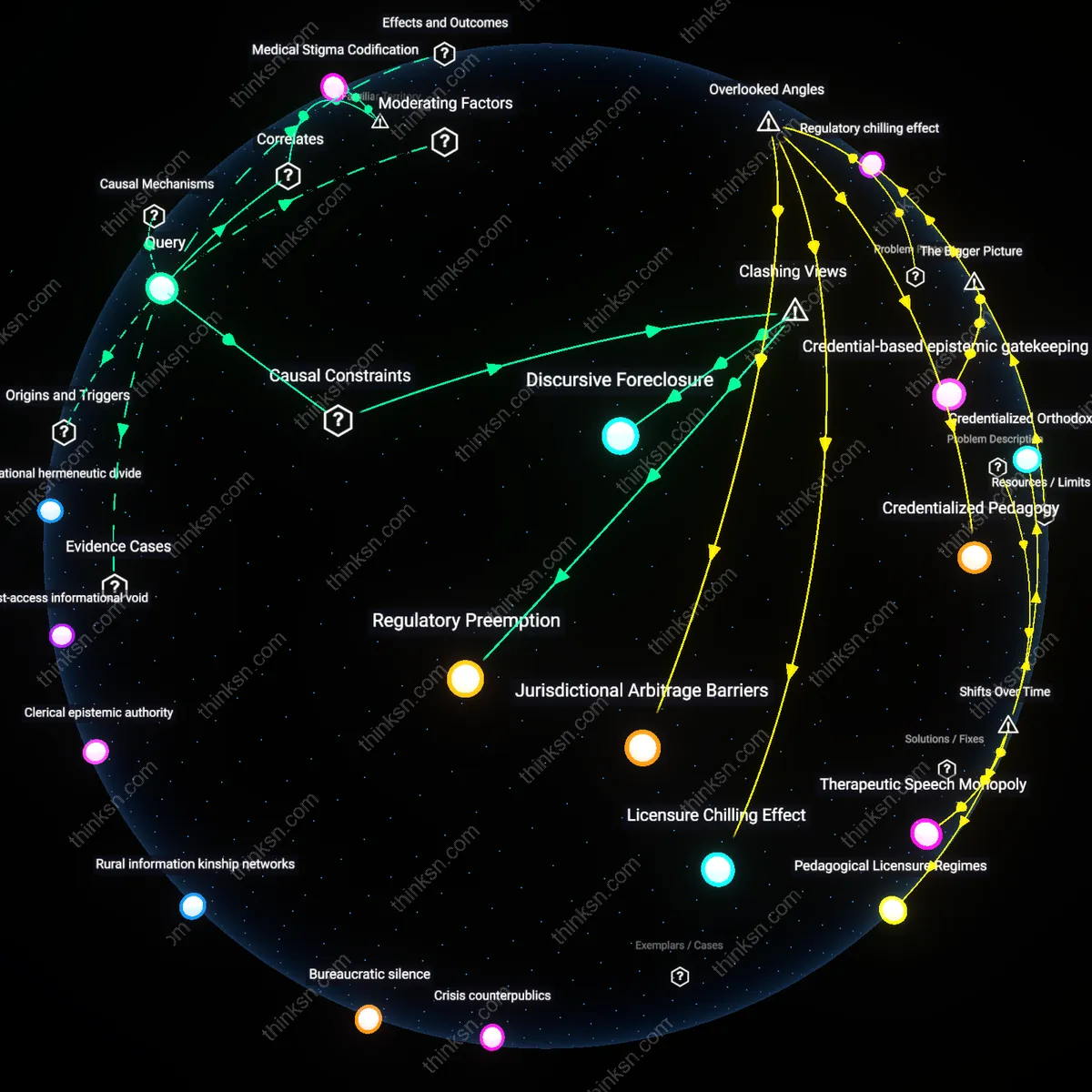
State licensing of mental health professionals has progressively restricted non-clinical emotional discourse by equating regulated practice with clinical legitimacy, thereby marginalizing religious, communal, and peer-based forms of counsel that were once socially authoritative. This shift, institutionalized after the 1960s with the expansion of DSM-based diagnostic regimes and insurance-driven service models, embedded a monopoly of expertise where speech acts—like listening, advising, or interpreting distress—became legally suspect if unlicensed. The non-obvious outcome is not overt censorship but the administrative displacement of alternative epistemic communities, rendering their speech invisible rather than illegal.
Pedagogical Licensure Regimes
Public school teaching certification requirements have, since the mid-20th century professionalization wave, evolved into a gatekeeping mechanism that suppresses legally protected political and cultural expression by conflating curriculum delivery with state-sanctioned pedagogy. Under this system, individuals with subject-matter knowledge or community-based educational roles—such as Indigenous knowledge keepers or independent political educators—cannot legally teach in public schools without clearing state-mandated training that often includes ideological conformity, especially in history and civics. The historically underappreciated shift is that licensure now functions not merely as quality assurance but as preemptive ideological filtering, displacing pluralistic educational speech from formal institutions.
Therapeutic Speech Monopoly
The post-1980 expansion of state-licensed counseling fields has progressively displaced non-medicalized forms of public moral discourse by redefining personal testimony, spiritual direction, and political critique as de facto therapeutic interventions requiring certification. Through scope-of-practice enforcement and liability frameworks, states now treat unlicensed facilitation of group discussions on trauma, identity, or healing as unlawful practice, even when participants consent. This represents a shift from regulating clinical treatment to policing the forms and venues of personal narrative—what was once a protected aspect of religious, artistic, or activist speech now risks administrative sanction, revealing the quiet substitution of therapeutic bureaucracy for First Amendment pluralism.
Credentialized Pedagogy
State licensing of educators enforces approved methods of knowledge transmission, thereby suppressing pedagogical speech that challenges standardized curricula or assessment formats. Teachers in public or licensed private schools who adopt experiential, dissent-driven, or culturally subversive teaching practices risk losing their credentials, not because they violate content rules directly, but because their method of delivery falls outside state-sanctioned instructional models. This control operates through accreditation bodies like state boards of education, which evaluate teacher competence based on adherence to prescribed pedagogical frameworks rather than educational outcomes, effectively silencing instructional innovation as a form of protected expressive conduct. Most analyses focus on *what* is taught, not *how* it is taught—yet the mechanism of credentialized pedagogy reveals that the state regulates speech through methodological compliance, reframing licensing as a form of epistemic gatekeeping.
Licensure Chilling Effect
Prospective practitioners in fields like therapy or legal advocacy self-censor controversial viewpoints during training and clinical placements to avoid raising red flags with future licensure boards, thereby suppressing legally protected political or moral speech before it is even uttered. This anticipatory conformity occurs because licensing authorities often assess 'professional fitness' through vague standards such as 'ethical conduct' or 'client safety,' which can be retroactively interpreted to disqualify applicants with radical affiliations or unorthodox beliefs. The dynamic is embedded in supervised internship evaluations, where gatekeepers—clinical supervisors, law firm partners, or department chairs—act as informal censors to protect institutional standing, creating a downstream chilling effect that precedes formal review. Unlike direct censorship, this mechanism operates through layered institutional risk-aversion, a dynamic rarely captured in free speech doctrine that assumes state action only matters at the point of denial.
Jurisdictional Arbitrage Barriers
State licensing regimes suppress speech by eliminating low-regulation exit options for professionals whose expressive practices conflict with local orthodoxy, such as holistic healers or alternative legal advocates who cannot relocate across states due to non-transferable credentials. Unlike entrepreneurs in unregulated fields who can migrate to more permissive jurisdictions, licensed professionals are tethered to state-specific certification systems that do not recognize out-of-state equivalencies for non-traditional training or unconventional modalities. This immobility is enforced through interstate compacts like the Uniform Credentialing Act, which harmonize standards in ways that exclude experimental or culturally grounded practices, effectively trapping dissenting professionals in regulatory captivity. The barrier of jurisdictional arbitrage constraints is rarely acknowledged in free speech discourse, which presumes mobility and competition, yet it functions as a structural silencer by removing the pressure of regulatory competition.
Epistemic Gatekeeping
Occupational licensing in engineering and architecture restricts who can submit public plans or testify on technical matters, effectively silencing non-credentialed experts whose speech on infrastructure safety or environmental risk is constitutionally protected; the system operates through legal barriers that conflate formal certification with the capacity for accurate technical communication, thus disqualifying knowledgeable outsiders from participating in public debate on grounds of unlicensed practice; the non-obvious reality is that state control extends not to preventing incompetence, but to managing which forms of expertise are legible to law and policy, exposing a hidden mechanism of knowledge suppression masked as administrative regulation.
Regulatory Licensure Speech
Cosmetology and barber licensing laws require practitioners to use state-prescribed terminology and avoid medical-sounding language, thereby prohibiting constitutionally protected commercial speech about their services even when factually accurate; the mechanism functions through state-defined scopes of practice that criminalize speech associated with adjacent professions, such as discussing 'scalp health' in ways that imply dermatological knowledge; what is underappreciated is that these laws do not merely regulate safety but actively produce a sanitized linguistic field, in which state-approved expression becomes a prerequisite for legal practice, revealing licensing as a tool of semantic control rather than consumer protection.
Regulatory chilling effect
State licensing requirements for mental health professionals suppress religious counselors who offer advice grounded in scripture rather than clinical evidence, because adherence to doctrinal speech risks disciplinary action by medical boards dominated by secular psychotherapy norms. This occurs not through explicit bans but through the threat of license revocation, which functions as a regulatory chilling effect within state-sanctioned professional hierarchies. The non-obvious dimension is that protected religious expression is silenced not by law forbidding speech, but by the structural dominance of biomedical epistemology in licensing regimes, which marginalizes alternative truth claims even when legally permissible.
Credential-based epistemic gatekeeping
Licensing laws for energy healers or traditional Indigenous medicine practitioners exclude them from practicing—even when protected under religious freedom statutes—because state boards only recognize clinical training rooted in Western biomedical institutions. This mechanism reflects credential-based epistemic gatekeeping, where the state delegates authority to define legitimate knowledge, thus suppressing holistic or spiritually grounded modalities despite legal protections. The overlooked consequence is that pluralistic forms of legally protected healing knowledge are systematically delegitimized not through overt censorship, but through the quiet exclusion embedded in accreditation design.