Do Patent Evergreening Tactics Limit Access to Affordable Chronic Disease Meds?
Analysis reveals 6 key thematic connections.
Key Findings
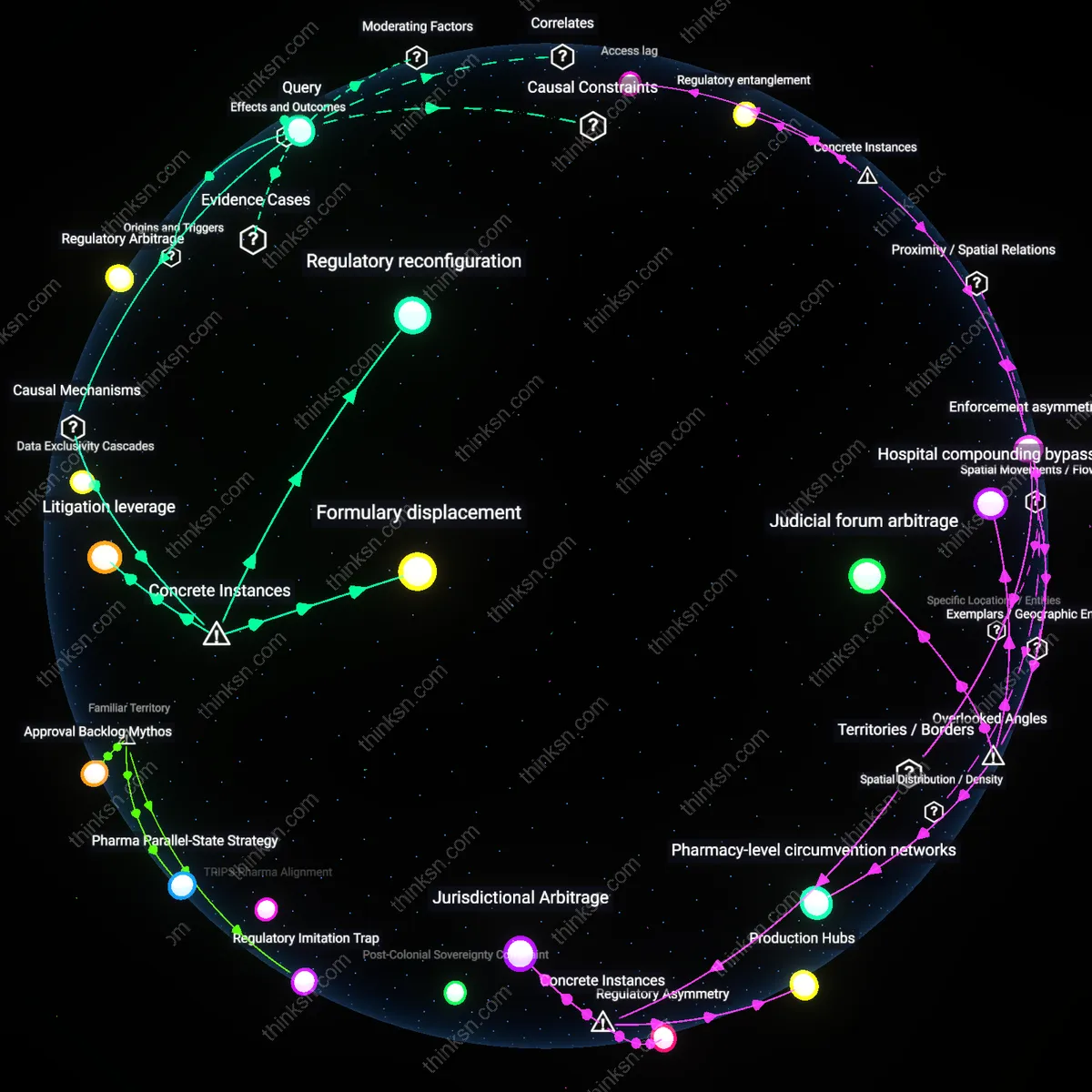
Regulatory Arbitrage
Patent evergreening restricts patient access to affordable generics by exploiting discrepancies between national patent standards and regulatory approval timelines. Pharmaceutical firms file secondary patents on minor modifications—such as dosage forms or combinations—that lack therapeutic innovation but trigger new exclusivity periods, delaying generic market entry under provisions like the U.S. Hatch-Waxman Act's linkage of patent status to FDA approval. This mechanism persists because regulatory bodies in high-income countries de facto outsource patent scrutiny to patent offices, allowing legally marginal claims to function as enforceable barriers, a dynamic underappreciated in access debates that focus solely on patent validity rather than procedural entanglement.
Data Exclusivity Cascades
Patent evergreening undermines access to affordable chronic disease medications by activating data exclusivity protections that operate independently of patent law, thereby blocking generic applications even when patents are invalid or expired. When originator companies submit clinical trial data to agencies like the EMA or FDA, they gain 5–10 years of exclusive use of that data, preventing generics from relying on it for abbreviated approvals—making evergreened product launches effective tools to reset the exclusivity clock. This linkage between evergreening strategies and data rights is a systemic enabler often overlooked because it functions silently within technical regulatory frameworks, not patent statutes, yet it extends monopolies even when secondary patents are legally frivolous.
Global Policy Asymmetry
Patent evergreening limits generic access in low- and middle-income countries by leveraging international trade agreements that embed strict intellectual property standards, such as TRIPS-Plus provisions in bilateral deals pushed by the U.S. Trade Representative. While national patent offices in countries like India may reject weak secondary patents on grounds of lack of novelty, these local decisions are circumvented when supply chains and financing are controlled through global regulatory harmonization—e.g., via the Pharmaceutical Procurement Mechanism’s reliance on WHO-prequalified products affected by delays in generic competition in reference markets. This transnational coordination of market control through standardized IP norms is a structural driver rarely acknowledged in national-level analyses of drug pricing.
Litigation leverage
Novartis's protracted legal challenges against India’s patent office decision in 2013 to reject a patent extension for the cancer drug imatinib mesylate enabled the company to delay market entry of low-cost generics by framing incremental modifications as novel innovations, a strategy sustained through forums like the WTO and bilateral trade pressure; this reveals how patent evergreening operates not only through domestic IP law but via international legal infrastructure that amplifies corporate legal capacity to obstruct generic competition, a mechanism often obscured by focus on national patent offices alone.
Regulatory reconfiguration
Pfizer’s submission of multiple supplementary data packages to the U.S. FDA to extend exclusivity for Lipitor through pediatric exclusivity and risk evaluation mitigation strategies delayed generic atorvastatin approval despite patent expiry in 2011, demonstrating how evergreening exploits regulatory pathways designed for safety to instead serve as procedural speed bumps; this shows that the mechanism is not merely intellectual property expansion but the strategic repurposing of public health regulations into tools of market protection, an underrecognized dimension of access barriers.
Formulary displacement
In Brazil, AbbVie’s introduction of the reformulated Humira version, adalimumab-atto, just before the original biologic’s patent expiry in 2016, led public health procurement systems to restructure tender contracts around the new version, effectively sidelining cheaper biosimilars tied to the original molecule; this illustrates how evergreening can operate through institutional purchasing logic rather than legal monopoly alone, where the mechanism is not patent enforcement but the engineering of clinical and administrative path dependency that renders generics 'incompatible' with existing care protocols.