Voice Assistants: Convenience or Privacy Risk on the Road?
Analysis reveals 6 key thematic connections.
Key Findings
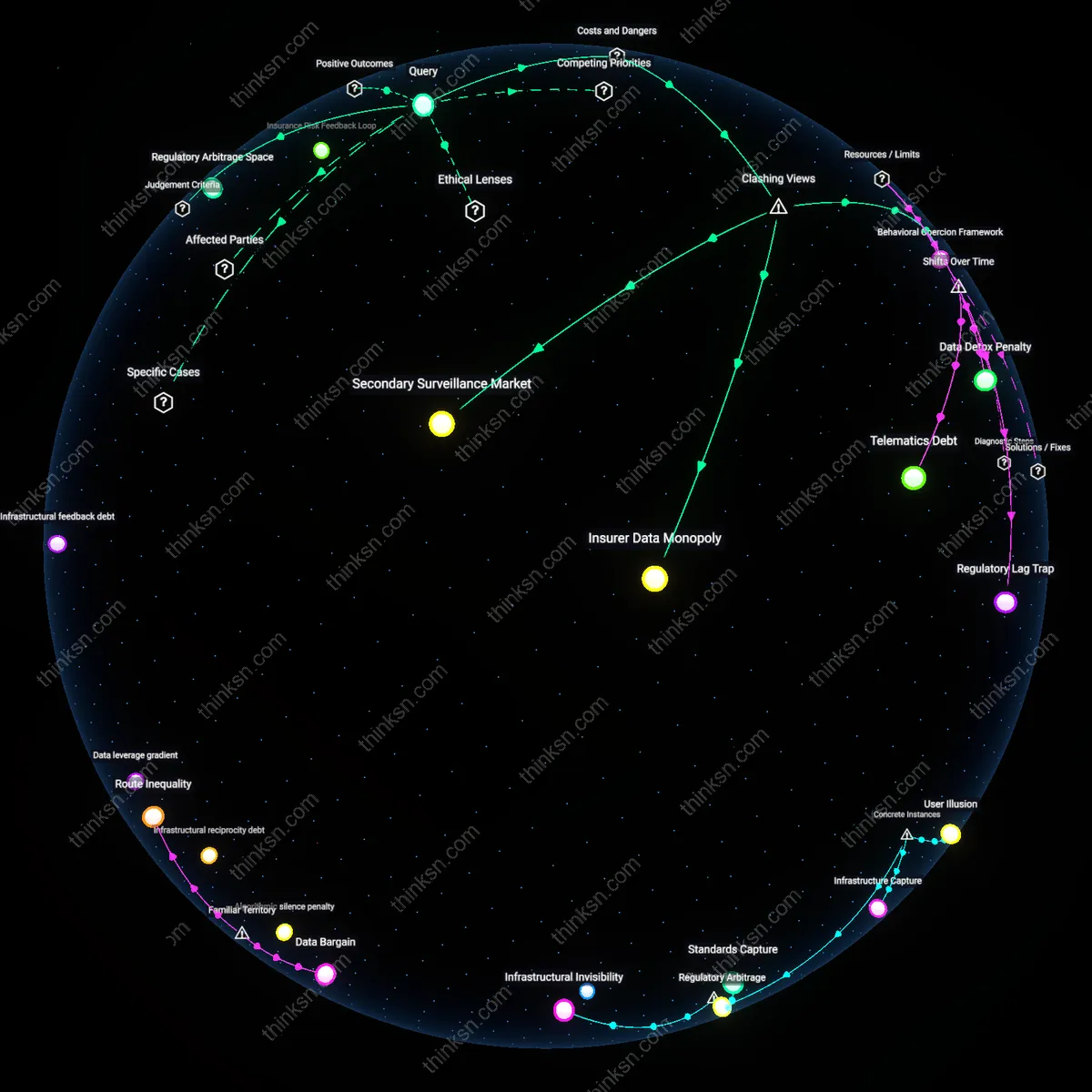
Data Consent Asymmetry
Individuals can weigh convenience against privacy by recognizing that default opt-in voice assistant settings exploit uneven bargaining power in service agreements, where users lack meaningful choice due to pre-ticked consents and opaque data clauses embedded in lengthy terms of service. Automakers and tech firms standardize data collection to maximize monetization via aggregated driving behavior sold to third-party insurers, creating a systemic imbalance where user autonomy is overridden by interface design that discourages informed consent. This reveals how interface architecture functions as a regulatory mechanism, normalizing surveillance under the guise of personalization—a dynamic rarely transparent to drivers evaluating 'convenience.'
Insurance Risk Feedback Loop
Individuals should evaluate the long-term cost of voice assistant convenience by anticipating how aggregated driving data sold to insurers can reshape risk models, leading to personalized premium adjustments that penalize behavior flagged as risky—even if legally or contextually justified. Insurers leverage real-time behavioral telemetry to refine actuarial tables, creating a feedback loop where data from convenience features alter the very conditions of coverage affordability. The unappreciated systemic consequence is that user data extracted for convenience becomes instrumental in constructing exclusionary risk categories, effectively turning in-car behavior into a self-incriminating audit trail.
Regulatory Arbitrage Space
People can better assess the trade-off by understanding that automakers deliberately locate voice data programs in jurisdictions with weak consumer data protection laws, minimizing compliance costs while maximizing data harvesting and resale opportunities to insurers. Companies like Tesla and GM structure data operations through subsidiaries in states like Delaware or Texas, where enforcement of privacy rights lags behind technological capability, enabling legal but ethically contested data commodification. This spatial fragmentation of governance creates a blind spot in individual risk assessment, as users weigh personal benefits against privacy threats that are institutionally amplified, not merely technical.
Insurer Data Monopoly
Individuals cannot meaningfully weigh privacy risks because insurers already purchase aggregated driving behavior data from automotive telematics firms, creating a de facto monopoly on risk assessment that nullifies personal consent. Insurance companies in states like California and Texas contract directly with vehicle-data brokers to access real-time inputs—voice commands, braking patterns, route history—routinely harvested by factory-installed assistants like GM’s OnStar or Ford’s Sync. This system operates through centralized data pooling managed by third-party analytics firms such as LexisNexis Risk Solutions, which repackage behavioral metadata into proprietary risk scores inaccessible to consumers. The non-obvious reality is that the decision to opt in or out of voice assistance has no practical impact on data exposure, as insurers treat driving behavior as a systemic commodity, not an individual bargaining chip.
Behavioral Coercion Framework
The convenience of voice-activated assistants functionally coerces drivers into data surrender by embedding essential safety and navigation functions within data-extractive platforms. Automakers like Tesla and BMW design voice systems as the primary interface for critical operations—climate control, emergency braking overrides, route recalibration—making disengagement impractical during active driving. This mechanism operates through interface monopolization in Level 2 autonomous vehicles, where disabling voice activation disables core functionality, thereby enforcing continuous data collection under the guise of usability. The underappreciated dynamic is that privacy trade-offs are not calculated choices but technologically induced compulsions, reframing consumer 'consent' as behavioral compliance engineered through operant design.
Secondary Surveillance Market
Driving data harvested via voice assistants is increasingly sold not to insurers but to unregulated secondary markets—including rental car firms, urban planners, and retail advertisers—rendering the insurer-focused privacy debate dangerously narrow. Companies like Smartcar Inc. and Otonomo broker access to granular driving records, enabling advertisers to correlate voice-searched destinations with geofenced promotions or allowing municipal agencies to penalize 'high-risk' zones based on aggregated driver behavior. This system thrives on legal loopholes in the Automotive Data Privacy Protection Act, which permits anonymized data resale without driver notification. The clash arises because public discourse centers on insurance discrimination, while the actual expansion of surveillance is occurring through decentralized, commercially driven actors with no accountability to the driving public.