Why Does Health Insurance Cover Scans More Than Counseling?
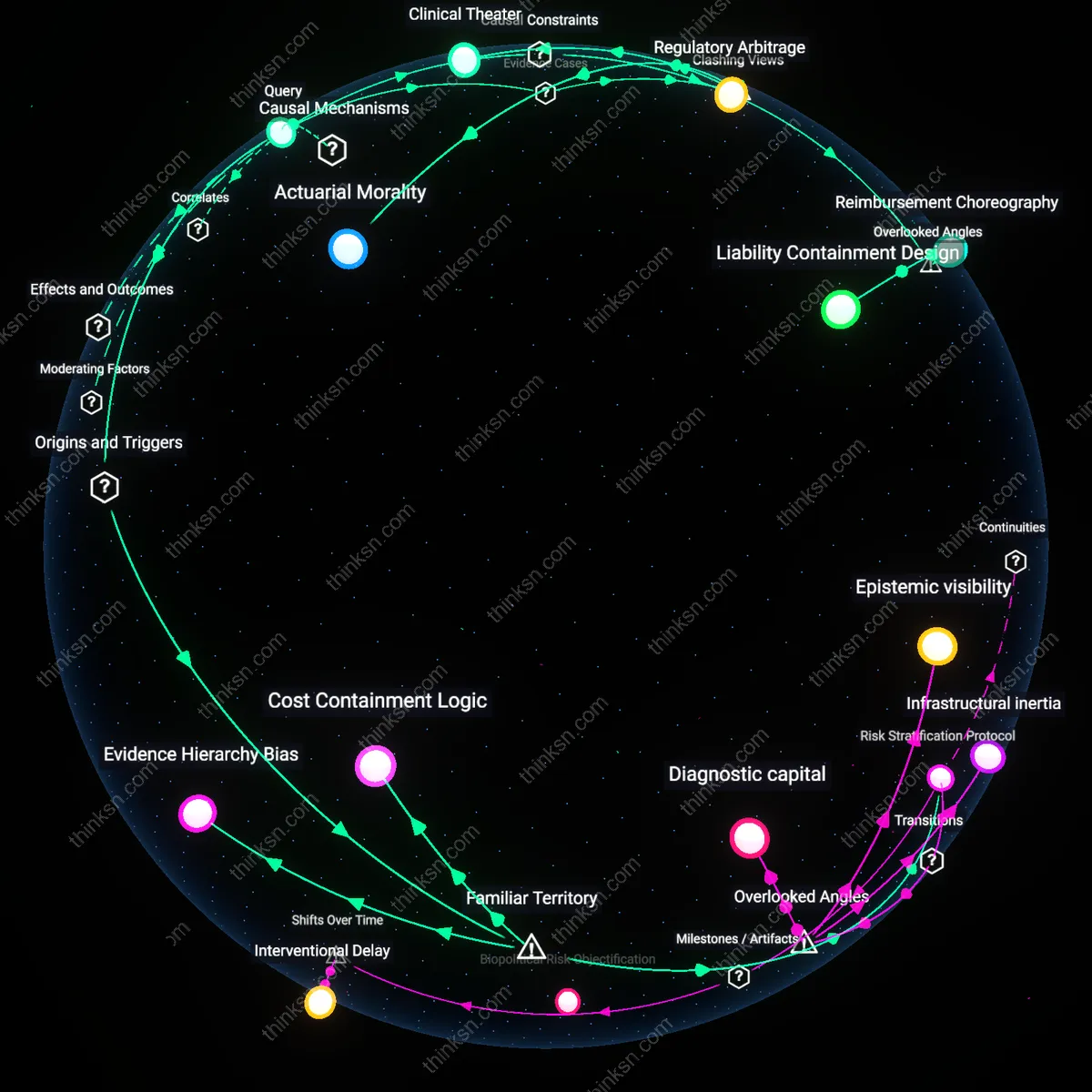
Analysis reveals 9 key thematic connections.
Key Findings
Cost Containment Logic
Insurers prioritize imaging over lifestyle counseling because imaging generates quantifiable, billable events with clear procedural codes, whereas lifestyle counseling is diffuse and harder to monetize. This reflects a systemic preference for interventions that align with fee-for-service reimbursement structures, which incentivize technical over relational care. The non-obvious implication is that the financial architecture of insurance—rooted in transactional volume—shapes what counts as legitimate preventive care, even when outcomes favor lower-tech interventions.
Evidence Hierarchy Bias
Medical legitimacy in insurance coverage decisions favors interventions validated by randomized controlled trials and objective biomarkers, which imaging provides but lifestyle counseling often lacks in high-intensity form. This adherence to a narrow epistemology of evidence privileges visual, anatomical data over behavioral change metrics, reinforcing a clinical culture that trusts machines more than conversations. The underappreciated effect is that prevention is only credible when it mimics disease detection, not when it prevents disease through sustained engagement.
Risk Stratification Protocol
Health systems deploy imaging as a risk triage tool because it enables categorical patient sorting—into 'diseased' or 'normal'—which streamlines management and justifies further intervention, while lifestyle counseling resists such binary classification. This operational need for administrative clarity elevates imaging as a gatekeeping function, embedding it into care pathways where subjective, continuous prevention is seen as inefficient. The unstated consequence is that prevention becomes valuable not for its effect but for its role in system throughput.
Reimbursement Choreography
Differential insurance coverage between lifestyle counseling and imaging prioritizes technically codifiable interventions because billing systems reward discrete procedural units over relational time. Medical coding frameworks like CPT anchor reimbursement to measurable, episodic services, making a 15-minute imaging scan easier to justify than 45 minutes of behavioral dialogue, even when the latter prevents more disease. This bottleneck in financial infrastructure—where payment algorithms privilege visibility, standardization, and defensibility—reveals that the system’s preventive logic is subordinated to administrative tractability, a dimension rarely acknowledged in policy debates that assume clinical value alone drives coverage. The overlooked reality is that prevention only counts when it is bureaucratically legible.
Liability Containment Design
Insurers restrict lifestyle counseling coverage more than imaging because ambiguous behavioral outcomes expose payers to long-term accountability risks that crisp diagnostic results neutralize. When a scan produces a definitive finding, responsibility shifts to the patient or treating physician; but funding counseling implies endorsement of sustained health outcomes, creating liability exposure for the insurer if interventions fail. This hidden contractual calculus—where risk deflection shapes preventive offerings—means that coverage gaps are not merely cost-control measures but structural efforts to manage legal and reputational exposure. The system thus prioritizes preventing blame over preventing disease, a motive rarely surfaced in discussions of preventive care rationing.
Clinical Authority Distribution
The preference for imaging over lifestyle counseling in coverage reflects a hierarchy of medical expertise that devalues non-physician-delivered care, as dietitians, social workers, and community health workers—who often provide counseling—are excluded from primary reimbursement loops. Because insurance architectures are designed around physician-centric models, services requiring team-based or decentralized delivery become ‘coverage orphans’ even when evidence supports their efficacy. This structural privileging of certain professional roles over others reveals that preventive care priorities are constrained not by health outcomes but by professional jurisdictional boundaries, a silent institutional bias that reshapes access without overt policy declaration.
Actuarial Morality
The U.S. private insurance system’s consistent underwriting of lifestyle counseling—compared to its routine coverage of high-cost imaging—reveals that preventive care is prioritized only when it aligns with financial risk mitigation, not health outcomes. Insurers like UnitedHealthcare and Aetna approve MRIs for early back pain far more readily than sustained behavioral interventions because actuarial models treat imaging as a liability-deflecting ritual, whereas counseling introduces unpredictable human variables that cannot be easily priced. This mechanism, embedded in risk-adjusted payment models, exposes a hidden calculus where prevention is valued not for its public health merit but for its function in minimizing actuarial exposure, making 'prevention' a financial category, not a clinical one.
Clinical Theater
The rapid coverage approval of cardiac CT angiograms over nutritional counseling by Medicare Administrative Contractors reflects a systemic preference for visually dramatic, technology-mediated reassurance over diffuse behavioral change, revealing that preventive legitimacy in public systems depends on performative objectivity. In regions like the Florida Medicare-8 jurisdiction, where imaging utilization spikes without mortality improvement, the ritualized use of scans satisfies both physicians and patients that 'something was done,' even when guidelines question their preventive utility. This dynamic treats imaging not as medical intervention but as institutional theater, exposing how preventive care becomes credible only when it is tangible, billable, and visibly technological—undermining the idea that prevention is fundamentally about upstream causality.
Regulatory Arbitrage
The stark difference in coverage between FDA-cleared digital therapeutics for diabetes prevention and routine coverage of low-dose CT lung screening stems from how regulatory classification—not clinical effectiveness—determines eligibility for reimbursement under CMS National Coverage Determinations. Entities like Pear Therapeutics, despite FDA approval for behavior-change apps, struggle under Category B Investigational Device rules, while imaging modalities exploit grandfathered indications that bypass contemporary evidence thresholds. This regulatory asymmetry allows the system to claim preventive commitment while evading accountability for behavioral interventions, revealing that prevention policy is shaped less by health impact than by institutional path dependency and coding convenience.