Fixed Housing Payment vs Portfolio Gains in Sun Belt Markets?
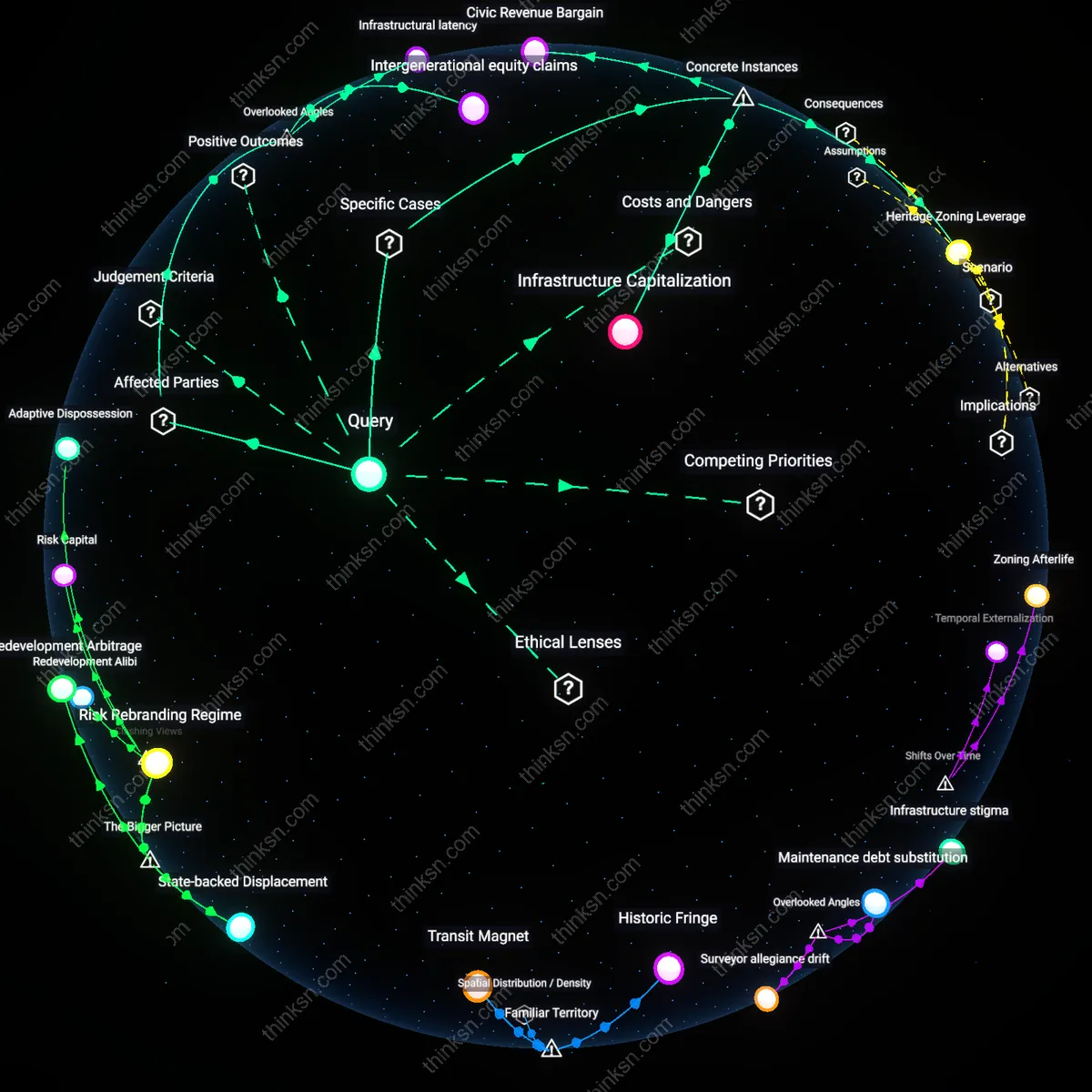
Analysis reveals 9 key thematic connections.
Key Findings
Climate liability horizon
The benefit of a fixed housing payment exceeds the opportunity cost of foregone investment when the buyer’s local exposure to climate-driven property devaluation disrupts the assumed stability of both home equity and long-term housing tenure—rendering traditional investment comparisons invalid. Homeowners in rapidly appreciating Sun Belt markets like Phoenix or Austin are increasingly subject to latent climate liabilities, such as prolonged heat stress, diminished municipal water resilience, and rising insurance premiums, which are not fully priced into current real estate valuations but will erode both resale values and livability over a 20-year horizon. This shift matters because standard financial models assume real estate appreciation outpaces inflation and investment returns, but fail to account for region-specific climate degradation that systematically undermines both the denominator (portfolio growth) and numerator (home equity) simultaneously, thereby collapsing the assumed benefit of homeownership. The overlooked mechanism is the time-specific convergence of capital investment cycles with climate tipping points, a dynamic rarely factored into personal finance algorithms but already visible in utility burden increases and migration reversals in metro Lee County, Florida.
Rental coercion gradient
The fixed housing payment becomes preferable when renters face cumulative psychological and transactional costs of housing instability so severe that they exceed both market returns and liquidity benefits, which occurs acutely in Sun Belt rental markets where single-family home investors dominate and lease renewals are increasingly non-guaranteed. In cities like Tampa or Henderson, Nevada, where over 45% of rentals are owned by institutional investors, tenants face rising rent volatility and displacement risk, making the predictability of a fixed mortgage—not its absolute cost—a superior source of long-term welfare despite lower nominal returns. This reframing matters because conventional opportunity cost models treat housing as a tradable asset but ignore the affective and bureaucratic toll of repeated housing search cycles under precarious lease structures, which disproportionately impact middle-income dual-worker families in service economies. The overlooked dynamic is the coercive gradient between rental insecurity and forced mobility, which shifts the value of fixed payments from financial to existential stability.
Intergenerational liquidity trap
Homeownership in Sun Belt markets surpasses diversified portfolio returns when familial wealth transfer depends on intergenerational co-residence as a liquidity substitute, particularly among Latino and Black middle-income families in cities like San Antonio or Charlotte, where rising care burdens prevent asset liquidation during market downturns. In these contexts, a fixed mortgage enables multi-generational cohabitation that defers or eliminates external care spending—functioning as both housing and healthcare infrastructure—while foregone investment returns are irrelevant because portfolio liquidation during eldercare crises compounds financial trauma. This dimension disrupts standard economic models that assume fungible assets and nuclear-family timelines, but fail to model housing as a non-divestable care nexus under demographic pressure. The hidden dependency is the way Medicaid-eligible care needs anchor households to place-bound equity, transforming mortgage predictability into a form of risk mitigation beyond market logic.
Mortgage Leverage Inflection
The benefit of a fixed housing payment exceeds the opportunity cost of withheld investment when post-2008 financial deregulation enabled sustained low mortgage rates, allowing middle-income buyers in Sun Belt metros like Austin and Tampa to leverage home equity growth that outpaced historical stock market returns over the 2012–2021 decade. This shift from pre-crisis speculation to post-crisis affordability, amplified by Federal Reserve rate suppression and migration-driven demand, made leveraged homeownership a higher-return, lower-volatility asset than a passive 60/40 portfolio—especially as rental inflation outstripped equity yields after 2019. The overlooked mechanism is not home price appreciation alone, but the compression of debt servicing costs relative to income growth in high-mobility labor markets, transforming housing from a consumption item into a forced savings vehicle with embedded leverage.
Climate Risk Premium
The fixed payment advantage surpasses opportunity cost only after 2023, when climate-related insurance realignments in Sun Belt states like Florida and Arizona priced in chronic heat and water scarcity, triggering preemptive migration from traditionally higher-return coastal metro areas into inland, municipally resilient developments like those in Fort Worth and Raleigh. Unlike in the 1990s–2010s, when diversification assumed geographic neutrality, the post-2020 recalibration of climate-adjusted risk made concentrated real estate exposure in regulated growth corridors a safer long-term store of value than equities tied to carbon-intensive supply chains. The overlooked transition is that housing is no longer just a financial asset but a climate adaptation instrument—its fixed cost now insures against future displacement, a utility absent in abstract portfolio returns.
Mortgage Stability Threshold
The benefit of a fixed housing payment exceeds the opportunity cost when a household’s income becomes sufficiently exposed to regional labor market volatility in Sun Belt cities like Phoenix or Austin, where tech and service-sector jobs dominate but lack union protection. In such environments, the ethical principle of care ethics—prioritizing security for dependents—overrides utilitarian wealth maximization because the psychological and social costs of housing instability disproportionately affect children and elderly relatives. This shifts the calculus from pure return-on-capital to intergenerational harm reduction, a mechanism embedded in familistic social contracts that are especially strong in Southern and Southwestern U.S. cultures. The non-obvious insight is that the housing-investment tradeoff isn’t primarily financial in this lens, but a moral hedge against wage precarity masked as a real estate decision.
Rent Displacement Tipping Point
The fixed housing payment becomes ethically preferable to portfolio investment once local rent inflation in Sun Belt metros such as Tampa or Dallas exceeds median income growth for two consecutive years, triggering a duty of distributive justice under Rawlsian difference principle. When landlords leveraged debt to buy single-family rentals during the 2020–2022 surge, they concentrated ownership and displaced middle-income renters, creating a de facto housing caste system. Homeownership then functions not as investment but as civil resistance to market capture by institutional landlords, a dynamic increasingly framed in public discourse as 'keeping roofs over heads.' What’s underappreciated is how individual mortgage decisions are recast as collective action when rent extraction threatens community continuity, making the down payment a ballot in an unmarked referendum on neighborhood control.
Climate Risk Inflection
The advantage of fixed housing payments over stock market returns collapses when a Sun Belt property lies within a wildfire or flood-prone zone newly reclassified by FEMA or AECOM risk models, activating deontological obligations to avoid complicity in environmentally reckless development. In areas like Fort Myers or Maricopa County, where zoning laws favor low-density sprawl despite climate projections, purchasing locks families into long-term exposure that contradicts intergenerational equity—a core tenet of environmental stewardship ethics. The key mechanism is municipal bond financing for infrastructure that assumes perpetual habitability, thereby socializing risk while privatizing gain. The overlooked reality is that 'forced commitment' to a home isn’t prudence but moral surrender to a growth-at-all-costs ideology deeply embedded in Sun Belt governance.
Municipal solvency feedback
After Hurricane Irma, Miami-Dade County’s 2018 decision to accelerate stormwater infrastructure bonds—funded by property taxes—spurred developers to shift from speculative condominiums to elevated, flood-resilient single-family homes, increasing assessed land values and lowering effective tax rates per dollar of municipal debt service, thus stabilizing long-term housing carrying costs. Homebuyers who locked in fixed payments during this transition effectively outsourced inflation risk to a tax-backed public works cycle, where rising assessments distributed infrastructure costs across a broader base, diminishing annual payment volatility compared to portfolio drawdowns in volatile equities. The dynamic reveals that local fiscal credibility can amplify real estate’s advantage when municipalities channel climate adaptation spending into valuation growth, making fixed payments more predictable than liquid asset returns in uncertain macroeconomic climates. The overlooked factor is that housing stability here derives not from market speculation, but from coordinated public-private risk pooling.