Tying Bonuses to Office Attendance in Hybrid Models?
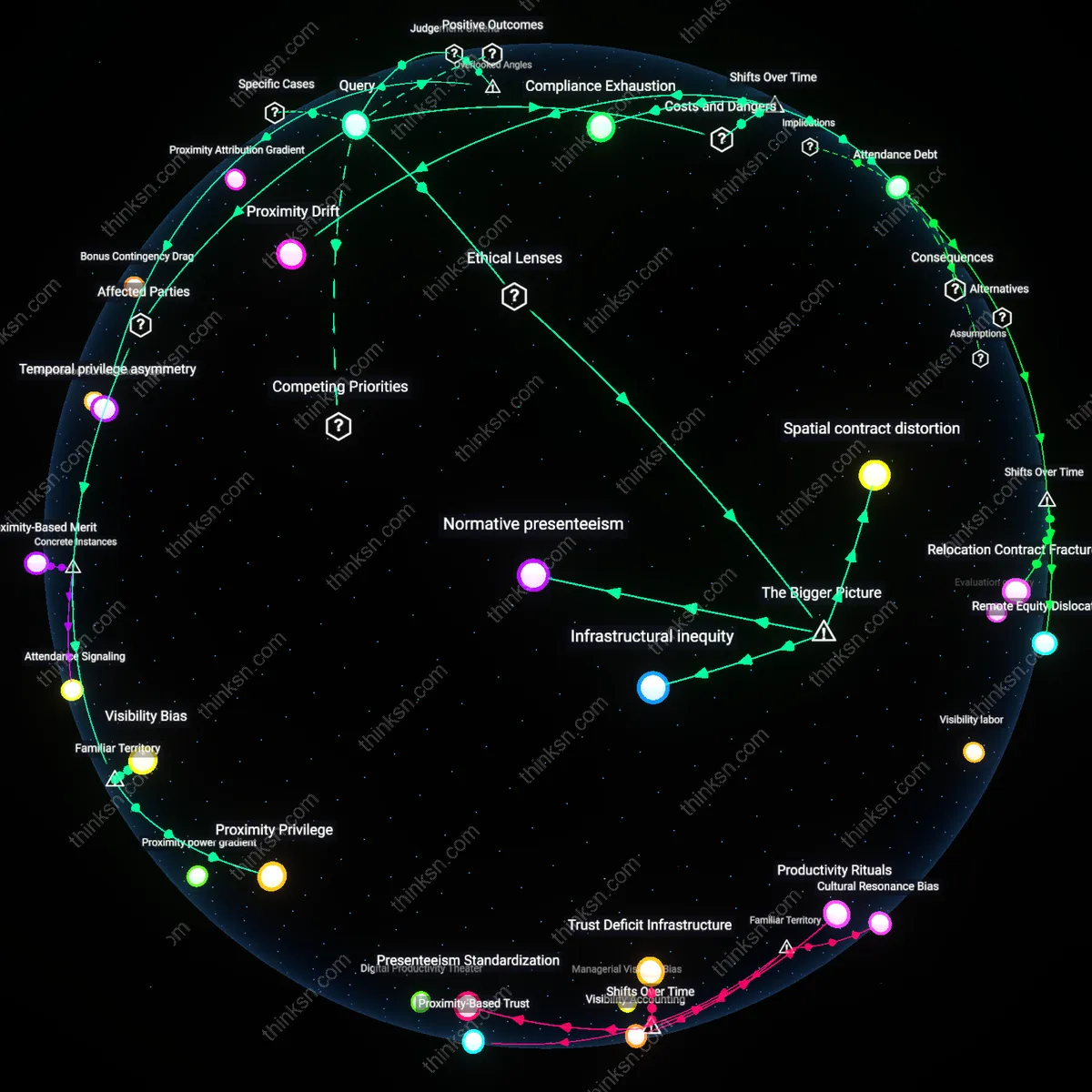
Analysis reveals 11 key thematic connections.
Key Findings
Proximity Privilege
Tying bonuses to office attendance disadvantages remote workers because it rewards physical presence over output, privileging employees who live near corporate hubs or can afford urban housing. This mechanism favors those already embedded in geographic centers of power, reinforcing class and regional inequities under the guise of performance incentives. The non-obvious consequence is that proximity becomes a proxy for commitment, distorting meritocratic expectations in hybrid environments.
Visibility Bias
Employee bonuses linked to office attendance amplify visibility bias, where managers disproportionately credit those they see regularly, often equating face time with competence or dedication. This dynamic systematically marginalizes remote workers, especially women and caregivers who may rely on flexibility, despite equivalent or superior productivity. The underappreciated reality is that human cognition defaults to rewarding observable effort, making remote contributions less memorable in evaluation cycles.
Policy Asymmetry
Organizations that tie bonuses to attendance create policy asymmetry, where formal performance metrics conflict with informal cultural norms that value bodily presence. Remote workers are penalized not by explicit rules but by the lived experience of exclusion from impromptu decision-making, mentorship, and social capital formed in-office. The overlooked issue is that hybrid policies often codify flexibility while preserving reward structures designed for pre-pandemic, co-located work.
Attendance visibility bias
Tying employee bonuses to office attendance in a hybrid work model is inequitable because it rewards physical presence over output, privileging employees whose roles allow for and afford easy commutes while disadvantaging those in different time zones or with caregiving responsibilities. This creates a visibility trap where managers, often subconsciously, associate office attendance with commitment, even when performance metrics are ostensibly objective—reinforcing proximity bias in evaluations. What’s overlooked is how spatial regularity becomes a proxy for trust in distributed teams, warping fairness not through overt policy but through perceptual heuristics embedded in supervision routines.
Temporal privilege asymmetry
Using office attendance as a bonus criterion is inequitable because it assumes a uniform capacity to align with centralized time norms, privileging employees in core time zones and penalizing those in peripheral regions who must attend in off-hours to meet ‘presence’ quotas. A worker in Singapore attending a hybrid meeting scheduled for New York peak time sacrifices sleep and personal time, accumulating chronic time debt unrecognized in performance assessments. The overlooked dynamic is temporal citizenship—the uneven distribution of temporal autonomy across geographies—which covertly embeds colonial time structures into modern work valuation.
Attendance Debt
Tying bonuses to office attendance creates a regressive labor tax that disadvantages remote-capable employees who bore the cost of relocating during the post-2020 remote work experiment. As companies like Twitter and Shopify normalized permanent remote roles between 2020–2022, employees traded urban rents for lower-cost regions with the implicit understanding that location would not penalize compensation—yet the 2023–2024 return-to-office mandates retroactively devalue that choice by reframing presence as productivity, effectively imposing a financial penalty on those who acted in good faith during a transformative phase of labor mobility. This mechanism exploits intertemporal inconsistencies in policy to extract compliance without overt rule changes, revealing how employers convert transitional trust into long-term leverage.
Proximity Drift
Linking bonuses to physical attendance accelerates the erosion of equitable performance evaluation by reintroducing proximity bias as a structuring principle in hybrid firms—a norm that was deliberately countered during the 2015–2019 corporate experimentation with bias-mitigating digital workflows. Platforms like Asana and Zoom, once leveraged to standardize output-based assessment regardless of location, are now being bypassed in favor of observational metrics tied to office visibility, which systematically advantage those who can or choose to attend while disadvantaging caregivers, immunocompromised workers, and neurodivergent staff who thrived in remote settings. This reversal, cemented after 2022 in firms like Google and JPMorgan, marks a quiet abandonment of diversity-as-efficiency logic in favor of cultural homophily, exposing how short-term managerial comfort can override hard-won inclusion gains.
Compliance Exhaustion
Rewarding attendance with bonuses transforms compliance into a performative currency, privileging visibility over value in ways that emerged distinctly during the 2023–2024 wave of 'productivity theater' mandates at firms such as Amazon and Barclays. Where earlier hybrid models (2020–2022) measured success by deliverables and asynchronous coordination, the newer model treats time-in-seat as a proxy for loyalty, disproportionately taxing remote workers who must now simulate presence through excessive communication or strategic in-person appearances to remain eligible for financial rewards. This shift institutionalizes a form of labor surveillance that evolved from pandemic-era flexibility, revealing how temporary adaptations can calcify into coercive norms when power reasserts control through symbolic rather than functional metrics.
Normative presenteeism
Tying employee bonuses to office attendance entrenches normative presenteeism by aligning reward structures with physical visibility, privileging proximity over productivity within corporate hierarchies. Managers in hybrid firms, influenced by traditional managerial ideologies that equate presence with diligence, disproportionately award bonuses to office-attending staff despite equivalent output from remote workers, thus institutionalizing an ethic of visibility that undermines equitable performance assessment. This dynamic reveals how organizational culture—shaped by post-industrial capitalist norms prioritizing observable labor—converts spatial compliance into career advantage, a shift that is often obscured by ostensibly neutral 'performance metrics'.
Spatial contract distortion
Linking bonuses to office attendance distorts the implicit spatial contract between employer and employee by unilaterally altering the terms of physical presence without compensatory benefit for remote workers. Under a liberal political framework that presumes mutual agreement over work conditions, employers in tech and finance sectors—particularly in the U.S., where at-will employment prevails—exploit legal permissibility to reweight incentives toward office return, effectively penalizing remote employees through foregone income while invoking operational flexibility. This reflects a power asymmetry wherein employers leverage structural control over compensation design to reshape work norms, normalizing geographic stratification within ostensibly meritocratic systems.
Infrastructural inequity
Conditional bonus structures based on office attendance exacerbate infrastructural inequity by disadvantaging remote employees who lack access to centralized office ecosystems, such as spontaneous networking or leadership visibility, that influence subjective performance evaluations. In global firms headquartered in cities like London or New York, employees in peripheral time zones or lower-cost regions face compounded disadvantages when informal office-based interactions—where credit and trust are built—become prerequisites for financial rewards. This exposes how hybrid models, despite promoting flexibility, replicate center-periphery dynamics akin to colonial economic formations, where value extraction relies on asymmetric access to decision-making nodes.