Is Reporting Overtime Worth It With Labor Board Budgets?
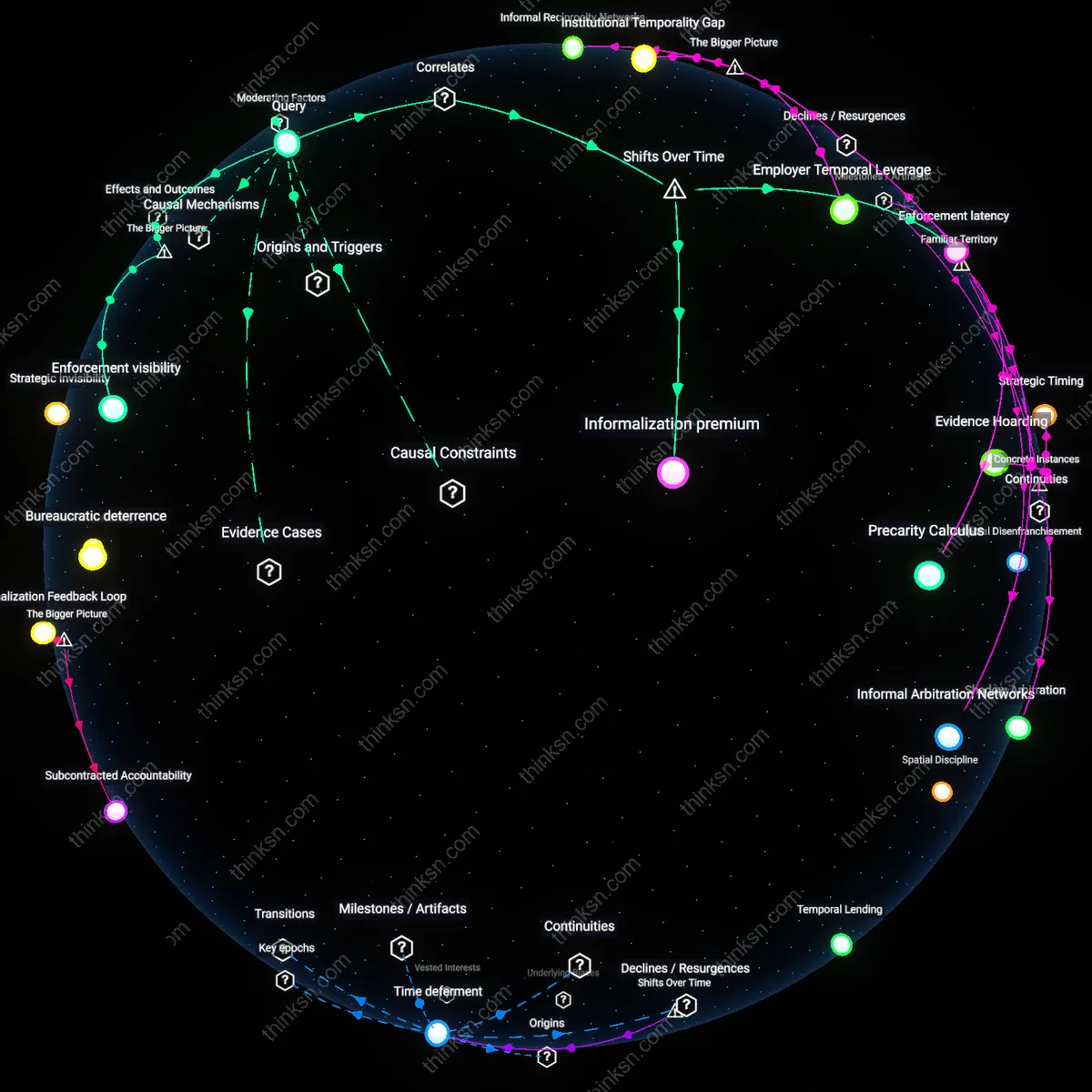
Analysis reveals 7 key thematic connections.
Key Findings
Enforcement visibility
Limited funding reduces the public footprint of state labor boards, making domestic workers less likely to report unpaid overtime because they perceive no viable enforcement pathway. Underfunded boards cannot sustain outreach, rapid response units, or visible adjudication, which erodes trust in the system’s capacity to act—especially among isolated or immigrant workers who rely on cues of institutional presence. This creates a feedback loop where low reporting is misinterpreted as low violation, further justifying budget austerity. The non-obvious consequence is that underfunding doesn’t just constrain capacity—it actively shapes worker perception by signaling institutional irrelevance.
Compliance deferral
Chronic underfunding of labor boards leads employers to defer compliance with wage laws, knowing that detection and penalty are improbable, which in turn dissuades domestic workers from reporting isolated violations like unpaid overtime. This deferred compliance emerges not from outright defiance but from rational adaptation to weak oversight—employers treat labor standards as negotiable rather than enforceable. Workers internalize this norm through repeated exposure to unchallenged infractions, normalizing non-payment. The key insight is that funding levels shape employer behavior systemically, which then structures worker expectations and reporting thresholds from below.
Bureaucratic deterrence
Limited funding of state labor boards deters domestic workers from reporting unpaid overtime not because enforcement is weak, but because understaffed boards deliberately slow-walk intake processes to manage caseloads, forcing workers to navigate labyrinthine appointment systems, automated phone trees, and incomplete multilingual support—especially in high-migration states like California and New York—where the procedural burden itself becomes a calculated filter that discourages claims before they are even filed. This reveals that austerity is not merely a constraint on enforcement capacity but an active administrative design that leverages bureaucratic friction to control claim volume, contradicting the common assumption that underfunding only reduces post-reporting follow-through rather than shaping the decision to report at all.
Strategic invisibility
Domestic workers forego reporting isolated unpaid overtime not out of fear or lack of awareness, but because they actively withhold claims to preserve informal accommodations—such as flexible scheduling or childcare access—that employers may revoke if formal scrutiny begins, especially in jurisdictions like New Jersey where labor boards, despite minimal funding, maintain data-sharing pipelines with immigration enforcement via state databases. This dynamic reframes non-reporting not as disempowerment but as tactical withdrawal, challenging the dominant narrative that weak oversight automatically leads to passive victimization, and instead reveals how under-resourced systems can still project enough coercive potential to induce preemptive self-censorship.
Normative displacement
In states with severely underfunded labor boards such as Alabama, domestic workers increasingly reinterpret isolated unpaid overtime not as a legal violation but as a standard occupational cost, because the absence of visible enforcement infrastructure—publicized rulings, outreach campaigns, or workplace posters—erodes the social salience of wage laws and allows exploitative practices to become codified through repetition, making non-reporting a function of normative adaptation rather than rational calculation. This contradicts the assumption that workers make cost-benefit analyses based on enforcement likelihood, revealing instead that chronic institutional absence reshapes perception, converting legal rights into ceremonial abstractions.
Enforcement latency
The shrinking ratio of state labor board investigators to domestic workers since the 1990s amplifies delays in case processing, making workers more likely to absorb isolated wage violations rather than initiate complaints that may yield responses years later. As state budgets stagnated post-2008, staffing at agencies like California’s Division of Labor Standards Enforcement fell below 1970s levels relative to workforce size, converting episodic underpayment into functionally unenforceable infractions. The non-obvious consequence is not underreporting per se but a temporal misalignment between violation and remedy—where the state’s procedural slowness becomes a structuring condition of informal compliance. This shift from immediate redress (pre-1980s) to deferred, uncertain resolution reframes non-reporting as a rational adaptation to time, not fear alone.
Informalization premium
Since the 1980s, as home-based care work expanded under Medicaid waivers and private payment systems, domestic workers increasingly accepted isolated unpaid overtime as a transactional hedge against total job loss in systems where formal reporting risks exclusion from opaque, cash-dependent labor circuits. The mechanism operates through interpersonal contracting norms in ethnic enclave economies—like Filipino eldercare networks in Los Angeles—where word-of-mouth referrals outweigh legal recourse, and funding levels for state boards become irrelevant because the work exists outside reported employment channels. The non-obvious shift is that limited funding did not create informality; rather, the growth of informal compensation agreements during deindustrialization made state enforcement structurally peripheral, turning underreporting into a stabilized market feature rather than a failure of public capacity.