When Are Therapist Check-Ins Too Little for Severe Disorders?
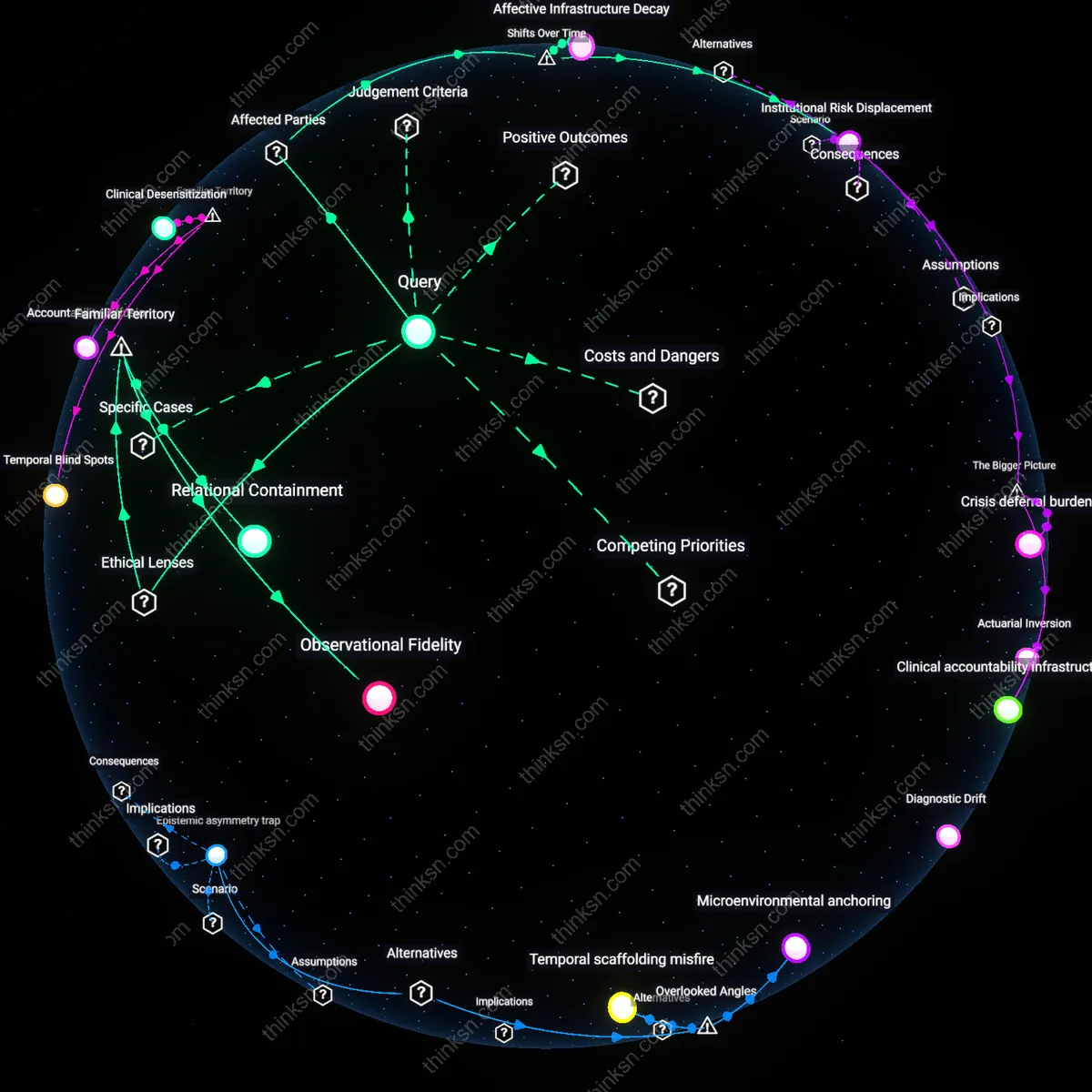
Analysis reveals 6 key thematic connections.
Key Findings
Therapeutic Containment Erosion
Brief check-in calls become insufficient when the patient's dysregulation exceeds the capacity of telephonic containment, a threshold that emerged prominently after the 2000s as community mental health systems increasingly adopted remote monitoring to manage borderline personality disorder cases post-deinstitutionalization; this shift transferred responsibility from inpatient units to overburdened outpatient clinicians, revealing how cost-driven care fragmentation undermines crisis prevention. The erosion is non-obvious because it manifests not as outright failure but as gradual attrition of affective attunement, where subtle behavioral escalations are missed without face-to-face observation, particularly in patients with identity diffusion and fear of abandonment.
Institutional Risk Displacement
Brief check-in calls cease to be adequate at the precise moment when liability for suicide risk migrates from hospitals to individual therapists—a transition accelerated by the 1996 Mental Health Parity Act and subsequent insurance reforms that shortened inpatient stays for patients with severe narcissistic and antisocial traits; this reallocation forced private practitioners into roles once held by multidisciplinary teams, without corresponding structural support. The non-obvious consequence is that check-ins, originally intended as continuity measures, became de facto risk management tools, exposing solo clinicians to catastrophic failure when nonverbal cues essential to assessing manipulative-acting-out or pseudocyesis go undetected remotely.
Affective Infrastructure Decay
Check-in calls lose clinical validity during late-stage personality disorder deterioration when patients require real-time co-regulation, a need that became systematically unmet after 2010 as public funding shifted toward digital mental health platforms, replacing consistent in-person contact with episodic telehealth for economically marginalized populations with histories of trauma and attachment disruption; this trajectory privileged scalability over relational depth, particularly in urban safety-net clinics. The overlooked effect is the quiet collapse of tacit therapeutic communication—such as micro-gestural feedback or spatial proxemics—whose absence in voice-only calls accelerates disengagement in patients dependent on embodied validation.
Crisis Threshold
Brief therapist check-in calls become insufficient when a patient with a severe personality disorder exhibits active self-harm or threats of violence, because such moments exceed the containment capacity of time-limited, low-context interactions. In these cases, emergency mental health protocols—mandated under duty-to-protect legal doctrines like the Tarasoff rule—require immediate, observable risk assessment only possible through in-person or hospital-based evaluation. The non-obvious insight is that the public associates check-ins with continuity of care, but they function more as triage triggers than therapeutic interventions once danger escalates.
Observational Fidelity
Check-in calls fail when nonverbal cues—such as motor agitation, grooming deterioration, or dissociative pauses—become critical diagnostic signals that in-person clinicians integrate into real-time clinical judgment under the ethical framework of beneficence in medical deontology. These cues, systematically undetectable via voice-only contact, ground therapeutic decisions in embodied presence, which regulatory standards from the American Psychiatric Association treat as essential during destabilization phases of disorders like borderline personality. The public rarely acknowledges that check-ins presume stable self-reporting, yet severe personality disorders often impair introspective accuracy—making external observation ethically indispensable.
Relational Containment
In-person sessions remain necessary when the therapeutic relationship itself acts as a psychological container for identity fragmentation or attachment dysregulation in patients with severe personality disorders, fulfilling a relational ethic rooted in narrative identity theory and Hegelian recognition dynamics. Unlike transactional check-ins, sustained face-to-face engagement creates a co-constructed field where disruptions in trust, transference, and consistency can be modeled and repaired—a process the lay public simplifies as 'talking,' but which clinically functions as structural emotional scaffolding. The underrecognized point is that check-ins assume stability in self-coherence, while in-person work actively builds it through embodied reciprocity.