When Does Fighting for Life Become a Violation of Natural Death Wishes?
Analysis reveals 5 key thematic connections.
Key Findings
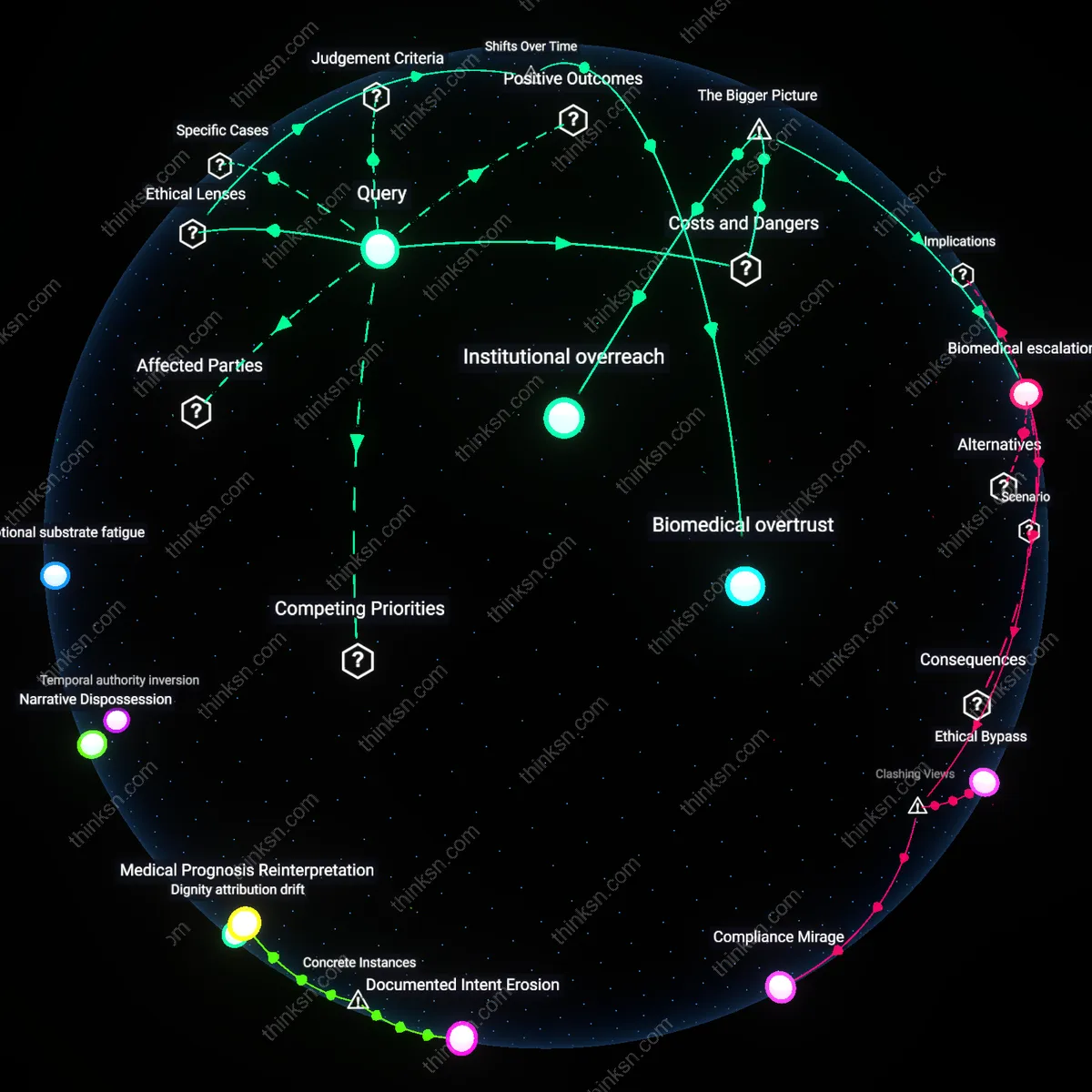
Institutional overreach
A spouse’s push for experimental treatments violates prior wishes when hospitals prioritize research enrollment over advance directives, enabling clinicians to frame refusal as abandonment of care. Academic medical centers under pressure to recruit for federally funded trials may subtly incentivize families to override living wills, particularly when patient eligibility aligns with grant-driven protocols. This dynamic distorts end-of-life decision-making into a conduit for institutional research agendas, exploiting familial hope as a vector for protocol compliance—what makes this significant is that it transforms personal grief into a systemic lever for clinical expansion, often bypassing ethical review calibrated for consent under duress.
Biomedical escalation
Spousal insistence on experimental therapies contravenes natural death directives when pharmaceutical sponsorship creates invisible momentum toward interventionist pathways, even in terminal decline. Drug developers fund ‘compassionate use’ programs that market access as moral duty, thereby positioning spouses as moral agents obligated to demand unproven therapies—this shifts end-of-life agency from patient autonomy to corporate patient pathways. The underappreciated mechanism is that these programs insert commercial timelines into intimate family decisions, turning palliative transitions into battlegrounds for post-market data acquisition, where the systemic cost is the erosion of death as a non-commercial event.
Fiduciary drift
A spouse's demand for experimental treatment undermines prior natural death wishes when long-term caregiving erodes their capacity to act as a neutral proxy, transforming care continuity into emotional dependency on medical intervention. As years of illness management cultivate identity around fighting disease, cessation equates to personal failure, leading caregivers to conflate their psychological survival with ongoing treatment. This creates a feedback loop wherein clinicians, seeking to avoid conflict, accommodate demands despite documented patient preferences—what sustains this is not ignorance of directives but systemic deference to perceived familial consensus, privileging present emotional intensity over earlier, calmer expressions of will.
Consent erosion
A spouse’s insistence on experimental treatments contravenes a patient’s prior wish for a natural death when medical authority shifts from patient autonomy to proxy agency under the stress of terminal decline, a transformation crystallized in U.S. hospital ethics protocols after the 1976 Quinlan decision. That case established the legal precedent for withdrawing life support but inadvertently normalized spousal override in the absence of formal advance directives, allowing affective bonds to retroactively destabilize previously sovereign patient consent. The non-obvious consequence is that consent does not vanish but erodes through institutional reliance on familial surrogates, revealing how bioethical frameworks designed to protect autonomy can dissolve it through procedural compassion.
Biomedical overtrust
A spouse’s insistence contravenes a patient’s death wish when the therapeutic imperative of post-1990s translational medicine reframes terminal illness as a delayable crisis rather than a natural outcome, privileging experimental intervention as moral duty. This shift, institutionalized in FDA expanded access programs and oncology care pathways after the 1992 Prescription Drug User Fee Act, repositions spouses as advocates of biomedical possibility, compelling action even against prior refusals. The underappreciated effect is the displacement of patient dignity by a culturally reinforced trust in science-in-progress, which transforms spousal insistence from emotional reaction into structurally sanctioned resistance against natural death.