Is Hospice Worth the Emotional Price for Family Peace?
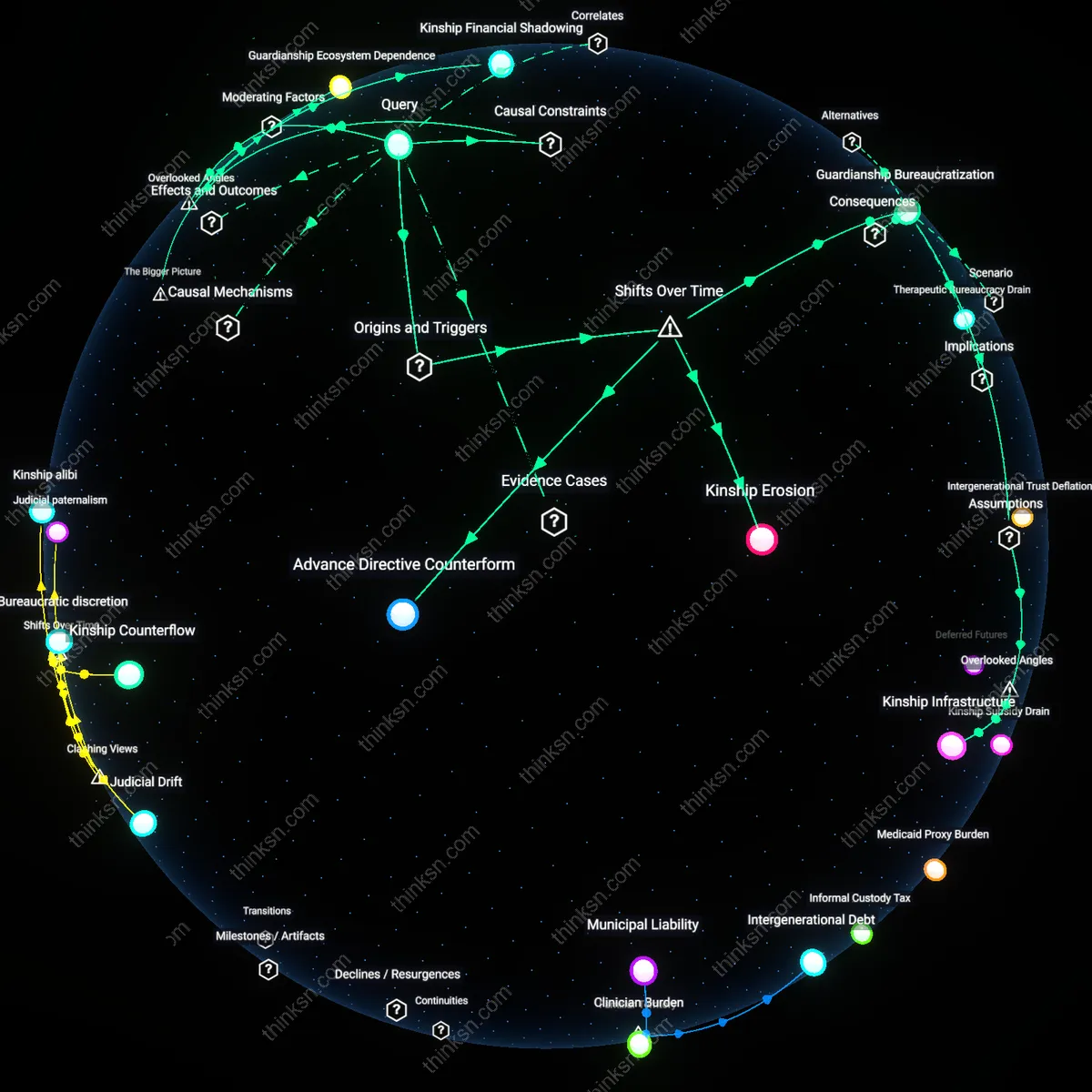
Analysis reveals 4 key thematic connections.
Key Findings
Moral Obsolescence
Families do not primarily weigh emotional burden against dignity but instead surrender to institutional timelines that redefine filial responsibility as compliance with medical discharge protocols. Hospitals in metropolitan areas like Detroit and Phoenix increasingly position hospice not as a choice but as a logistical necessity to free acute beds, shifting the moral weight from ethical deliberation to timely execution; this reframes the family's anguish not as grief but as resistance to system efficiency, exposing how dignity becomes a scheduling outcome rather than a human one. The non-obvious consequence is that emotional burden is not alleviated but displaced onto families who must absorb guilt for adhering to a process that prioritizes throughput over presence.
Dignity Debt
The pursuit of a 'dignified death' often functions as a retroactive justification for decisions driven by caregiver exhaustion, not anticipatory empathy, particularly in middle-income households managing elder care across states. When adult children in cities like Denver or Atlanta place parents in hospice, they are frequently repaying accumulated labor deficits from years of strained long-distance care, where the fantasy of dignity masks the reality of depletion; the system rewards this deferral of responsibility as emotionally mature, when it is often materially coerced. This reveals that the emotional burden is not weighed against dignity but amortized through it, turning dignity into a moral currency that legitimizes abandonment.
Grief Bypass
Hospice placement frequently operates as a sanctioned mechanism to compress mourning into administrative procedure, allowing families in suburban healthcare economies like those around Nashville or Orlando to outsource the visible work of dying to professionals. The emotional burden is not reduced but disqualified—families are told they are making a 'peaceful choice,' when in fact they are exiting a caregiving role that has become socially invisible and psychologically unsustainable; the ritual of dignified death thus serves to interrupt authentic grief by replacing it with curated closure. What remains unacknowledged is that this 'dignity' functions as a psychological deferral device, enabling families to avoid confronting their own complicity in systemic care abandonment.
Pastoral care bandwidth
In rural eastern Kentucky, families weigh hospice decisions based on the availability of church-affiliated chaplains who can visit homes weekly, because spiritual closure is often perceived as essential to a dignified death and depends more on sustained relational presence than medical symptom control. This dynamic reveals that the emotional burden of institutional placement is amplified when community-based spiritual infrastructure is thin, not because of religious doctrine per se, but because trust in strangers is low and pastoral continuity functions as emotional scaffolding. Most analyses focus on clinical or familial roles in hospice, missing how the distribution and intensity of local religious labor mediate perceptions of death’s dignity.
Deeper Analysis
Where do middle-income families most commonly place parents in hospice when managing care from cities like Denver or Atlanta, and how does that reflect the strain of long-distance caregiving?
Rural pullback
Middle-income families from Denver and Atlanta increasingly transfer elderly parents to hospice facilities in their parents’ rural hometowns across the Great Plains or Deep South, reversing mid-20th century urban migration patterns of retirees. This relocation leverages pre-existing kinship networks and lower care costs in regions like eastern Kentucky or western Nebraska, where aging-in-place infrastructure has quietly expanded since the 2010s. The shift crystallized after 2016, when Medicare’s hospice reimbursement reforms unintentionally disincentivized urban end-of-life stays, making geographically distant but familiar settings more financially viable—revealing a post-urban care logic shaped by fiscal triage rather than proximity.
Interstate triage circuit
Since the late 2000s, middle-income families in Denver and Atlanta have routinized the transport of parents to regional hospice hubs in cities like Albuquerque or Birmingham, constructing an invisible logistical pipeline managed by private medical transit firms. These corridors emerged as suburban hospice capacity stagnated amid rising land values, forcing families into cost-driven trade-offs between proximity and availability. The pattern marks a break from the 1990s model of local nursing home use, exposing a new era of care rationing where mobility compensates for fragmentation—transforming ad hoc transfers into a normalized, yet unseen, infrastructural flow.
Kinship time debt
Beginning in the 2010s, families from Denver and Atlanta began situating aging parents in hospice near long-distance relatives in secondary cities like Tulsa or Chattanooga, not for clinical reasons but to delegate hands-on oversight to cousins or siblings who remained in lower-cost regions. This spatial redistribution of caregiving labor reflects a breakdown in the 1980s ideal of the ‘involved nuclear family’ managing care collectively, replaced by a patchwork delegation system where time-zone proximity substitutes for blood proximity. The resulting asymmetry accumulates unacknowledged obligations—one sibling’s presence cancels another’s flight cost—making care continuity dependent on temporal compensation across households.
How did the idea of a 'peaceful choice' in hospice care start replacing hands-on family caregiving as the standard way to show love at the end of life?
Medicalized death economy
The professionalization of end-of-life care within hospital systems and Medicare reimbursement frameworks in the 1980s formally displaced familial duty by reclassifying caregiving as a clinical service, not a domestic one. This shift was institutionalized through the 1982 U.S. Medicare Hospice Benefit, which tied eligibility to forgoing curative treatment and accepting palliative care, thereby channeling patients into regulated care settings where emotional commitment was measured by consent to withdrawal of intervention rather than physical presence in care. The mechanism—federal financing conditioned on clinical oversight—converted moral obligation into compliance with medical protocols, making 'peaceful choice' a licensable standard of humane conduct. This move is underappreciated because it reframed withdrawal of care not as abandonment but as the highest expression of ethical responsibility, erasing the economic and labor value of unpaid family work.
Bureaucratic intimacy
The rise of advance directives and POLST (Physician Orders for Life-Sustaining Treatment) forms in the 1990s transformed personal love into documentable assent, replacing tactile care with legally witnessed decision-making as the benchmark of moral attention. This administrative shift was driven by liability-averse medical institutions and bioethics boards that required patient autonomy to be inscribed in standardized forms, effectively equating the act of signing with emotional fidelity. The system privileged procedural adherence over embodied presence, making the ‘peaceful choice’ legible and defensible in legal and clinical contexts while rendering hands-on caregiving invisible to institutional validation. The non-obvious consequence is that intimacy became measurable not by time spent or touch offered, but by the timeliness and clarity of consent documentation.
Empathy labor market
The expansion of paid hospice nursing and certified home health aides from the 2000s onward created a labor tier that absorbed the emotional and physical duties once expected of kin, enabling middle-class families to outsource caregiving while retaining the symbolic gesture of being 'present in spirit.' This substitution was made viable by wage segmentation in healthcare—the undervaluation of predominantly female, often immigrant labor—that allowed intimate bodily work to be offloaded at low cost, while the family retained moral credit for the 'decision' to 'allow peace.' The dynamic operates through a hidden redistribution of emotional labor from the private sphere to a racialized and gendered service workforce, whose invisibility sustains the myth that choosing hospice is a purely personal, non-material expression of love. This structural dependency remains unacknowledged in both policy and popular narratives.
Legal deflection
The 1976 Karen Ann Quinlan case in New Jersey established a judicial precedent that the withdrawal of life support constituted a constitutionally protected expression of dignity and familial love, effectively redefining caregiving as the right not to intervene. The New Jersey Supreme Court’s recognition of Quinlan’s parents’ decision to remove her from a ventilator recast non-action as a morally justified, legally sanctioned form of care—an act of restraint honored as responsibility. This decision catalyzed the proliferation of advance directives and medical power of attorney forms, codifying 'peaceful choice' into law and shifting the burden of decision-making from domestic labor to procedural consent. The non-obvious outcome was that legal frameworks began treating family love not as sustained presence but as the capacity to relinquish control, embedding ethical weight in abstention.
Pharmaceutical domestication
The 1996 FDA approval of oral morphine sulfate formulations for outpatient palliative use enabled terminally ill patients to manage pain at home under clinical supervision, reducing the physical demands on families while reinforcing the idea that love meant ensuring comfort over direct bodily care. Drug distribution systems—such as the MS Contin access program by Purdue Pharma—created infrastructures where pharmaceutical management replaced hands-on nursing as the primary expression of care, shifting emotional labor from tactile engagement to treatment compliance. This transformation turned symptom control into a proxy for affection, allowing families to fulfill obligations through medication schedules rather than sleepless vigils. The overlooked effect is that pharmacology, not philosophy, operationalized the 'peaceful choice' by making detachment clinically safe and emotionally permissible.
What would it take for a community without strong church-based support to create a trusted network that helps families feel spiritually and emotionally supported when choosing hospice?
Secular Ritual Architects
A trusted non-church-based hospice support network emerges only when municipal public health departments partner with licensed clinical social workers to design standardized, repeatable end-of-life rituals that replace religious rites with civic ceremonies grounded in psychological closure and communal witnessing. These rituals—such as community-led memory assemblies or legacy-documenting workshops—are administered through city-funded wellness hubs and integrate licensed therapists, school art programs, and neighborhood liaisons to create emotionally resonant, spiritually non-theistic experiences; their power lies not in replacing belief but in institutionalizing grief as a public health ritual, undermining the assumption that spiritual support requires faith-based infrastructure. The non-obvious insight is that scalability and trust in secular communities emerge not from informal mutual aid but from bureaucratic ritualization—a dissonant finding because it opposes the progressive preference for organic, decentralized care models.
Emotional Franchise Models
Trusted emotional support networks form in churchless communities only when franchised non-medical caregiving cooperatives—modeled on chain systems like credit unions or Montessori schools—standardize interpersonal practices across neighborhoods, enabling families to access consistent, brand-recognized emotional guides during hospice transitions. These cooperatives train local elders and unemployed teachers as 'compassion stewards' through accredited curricula, using reviewed checklists and feedback loops akin to hospitality service standards, thereby replacing moral authority with procedural reliability; this mechanism reveals that emotional trust thrives not on personal connection alone but on institutional predictability—an assertion that clashes with the dominant narrative privileging intimate, ad hoc caregiving circles. The underappreciated reality is that scalability demands depersonalization, and belonging is sustained not through kinship but through recognizable, repeatable service interfaces.
Death Literacy Bureaucrats
A community sustains spiritually meaningful hospice engagement without churches only when public school districts embed mandatory death literacy courses that train adolescents to facilitate family end-of-life dialogues using state-certified frameworks, thereby turning students into intergenerational emotional conduits who normalize grief processing before crisis hits. This system transforms schools from knowledge factories into emotional infrastructure, where curriculum mandates create a civic pipeline of empathetic intermediaries who reduce isolation by institutionalizing vulnerability in youth; this challenges the unspoken assumption that emotional and spiritual support must come from voluntary adult networks rather than compulsory educational programming. The dissonance lies in recognizing that trust is cultivated not in moments of need but through years of pedagogical repetition, revealing that emotional resilience is a bureaucratized outcome, not an organic byproduct.
Ritual Infrastructure
Establish neighborhood-based spiritual stewards who are trained in end-of-life witnessing and light ritual design to fill the symbolic role churches often occupy. These stewards—local elders, retired teachers, or culturally respected figures—operate through block-level pods that co-create personalized, secular-sacred moments (like twilight readings or memory lanterns) during hospice transitions, anchoring emotional support in tangible, repeatable acts rather than doctrine. The non-obvious insight is that spiritual trust often derives not from belief systems but from reliably structured symbolic actions—what is typically overlooked is that ritual itself, decoupled from religion, functions as infrastructure for communal meaning-making.
Emotional Kinship Weaving
Design a reciprocal caregiving exchange where non-familial members commit to small, codified emotional duties—like weekly check-ins or holding vigil phone trees—during hospice, transforming abstract solidarity into durable relational accountability. Unlike volunteerism, this system leverages peer-to-peer pledges modeled on time-banking, where participation builds social equity and implicit obligation, creating trust through mutual vulnerability rather than institutional authority. The overlooked reality is that emotional support networks fail not from lack of goodwill but from absence of enforced mutuality—what's missing is not faith but a mechanism that treats emotional labor as a circulating, binding currency among equals.
How do families figure out who should move closer when no one can afford to quit their job for caregiving?
Primary Wage Anchor
Families decide who moves by identifying the earner with the highest job stability and income. This person’s employment typically resists relocation due to specialized labor markets, benefit structures, or seniority, making their job the immovable reference point around which caregiving logistics are arranged. The non-obvious insight is that movement isn't negotiated equally—it's dictated by which job society has made harder to replace, revealing a silent hierarchy where economic immobilism overpowers familial need in decision-making.
Kinsh.parent Ledger
Families default to the person historically closest in emotional or physical proximity to the care recipient when assigning relocation duties, often a sibling raised in the same household or a daughter who has previously assumed caregiving roles. This pattern draws from a widely shared cultural expectation that caregiving is repaid in kind, forming an informal debt system where past efforts justify future burdens. The underappreciated reality is that this 'moral accounting' often overrides financial logic, as people move despite job penalties because obligation feels like restitution.
Housing Leverage Point
Relocation decisions pivot on whichever family member owns their home outright or has the most flexible housing contract, typically making renters or those in low-cost areas the presumptive movers. Homeownership creates a structural inertia—mortgages, property taxes, and neighborhood ties—that makes selling difficult, thus transferring the burden of mobility to those without real estate stakes. The overlooked mechanism is that housing, not income or affection, often serves as the actual fulcrum of the decision, exposing how property economies silently distribute caregiving sacrifice.
Transit Corridor Leverage
Families prioritize mid-point resettlement along high-frequency transit corridors to minimize job displacement and caregiving strain. This strategy depends on access to reliable rail or bus networks that connect disparate urban labor markets—such as the Northeast Corridor between Philadelphia and New York—enabling one member to maintain employment while reducing daily caregiving distance; the overlooked mechanism is how regional transit infrastructure, not just familial bonds or income levels, structures relocation decisions by making certain midpoint cities functionally viable despite lack of direct economic benefit. Most analyses assume job portability or sacrifice, but fail to account for how transportation geometry silently governs feasible compromise locations.
Digital Care Scaffolding
Families increasingly coordinate hybrid caregiving models using synchronized digital tools—shared cloud calendars, GPS-monitored medication dispensers, and telehealth platforms—that reduce the necessity of full-time physical presence. The key enablers are interoperable software systems like Google Health and Apple Family Sharing paired with low-cost IoT devices, which permit distant members to manage aspects of care remotely; this shifts the calculus of relocation by making 'distributed caregiving' viable across state lines, a dynamic largely ignored because it does not fit traditional binaries of 'present' versus 'absent' caregiving. The residual enabler is not emotional commitment but data continuity across digital interfaces.
Housing Option Arbitrage
Families identify secondary housing markets with low entry costs and convert accessory dwelling units (ADUs) or basement apartments to co-house caregiving relatives without requiring job relocation. Success depends on local zoning codes that permit such conversions—like Oregon’s Senate Bill 10 enabling 'cottage clusters'—combined with off-the-shelf modular construction kits; the overlooked factor is how municipal land-use policy, typically seen as a background condition, becomes an active tool when families weaponize housing flexibility to absorb caregiving demands. Most solutions assume income or proximity adjustments, missing how regulatory granularity in specific cities creates pockets of spatial opportunity.
Geographic compromise mapping
Families resolve caregiving proximity by jointly analyzing commute times, housing costs, and job portability to identify a midpoint location that minimizes financial and emotional strain. In the 2018 King County, Washington, case of dual-income parents managing eldercare for aging parents in Tacoma and pediatric care for a child with chronic illness in Seattle, the family used GIS-based commute modeling and employer remote-work policies to relocate to Renton—reducing both partners’ effective workweek travel while maintaining employment. This method reveals that negotiated resettlement is less about sacrifice than spatial optimization, a dynamic often overlooked in favor of narratives of unilateral responsibility.
Employer-care coordination
Families retain employment while closing caregiving distance when one member leverages workplace infrastructure to shift location without career disruption. When Toyota implemented its intra-company transfer program for U.S. plant workers in 2006, a Tennessee-based couple with a parent entering hospice in Kentucky used the policy to reassign the lower-wage earner to a nearby Georgetown facility, maintaining income and access. This case shows that caregiving proximity can be institutionally enabled through internal labor mobility, an underrecognized alternative to job exit or resignation.
Multigenerational cohabitation retrofitting
Families achieve geographic caregiving alignment not by moving adults, but by modifying existing homes to accommodate intergenerational living, as seen in Montgomery County, Maryland’s 2020 Aging in Place retrofit initiative, where 317 households converted garages or basements into ADA-accessible units for elders, allowing adult children to remain employed full-time nearby. This shift demonstrates that proximity is structural as much as behavioral—physical adaptation of housing stock functions as a de facto relocation, revealing home modifiability as a silent determinant in care logistics.
Explore further:
- How do family members reconcile the person with the 'untouchable' job keeping everyone else from moving with the emotional toll of handling care for a dying parent?
- Where are the people managing remote care from, and how does that reshape who ends up making the big decisions about hospice?
- When companies don't offer transfer options, how often do families end up choosing between quitting a job or going without pay just to stay near a dying parent?
Who ends up doing the hands-on care work in hospice when families decide they can't do it themselves?
Labor Substitution Cascade
Hospice nurses and certified nursing assistants (CNAs) perform direct care when families cannot, due to institutional protocols that mandate professional coverage in the absence of available family caregivers. This shift is driven by Medicare’s Condition of Participation for hospices, which requires skilled staff to deliver hands-on care if informal networks fail, thereby activating a formal labor replacement mechanism within fixed reimbursement structures. The non-obvious consequence is that systemic cost-containment pressures incentivize hospices to recruit just enough paid staff to meet regulatory thresholds while maximizing reliance on unpaid family labor whenever possible, making the paid workforce a secondary layer activated only when the primary informal system collapses.
Moral Licensing Structure
Social workers and chaplains are often indirectly responsible for enabling hands-on care by mediating family guilt and legitimizing the delegation of intimate tasks to paid staff, thereby preserving the family’s sense of moral adequacy. This occurs through structured family conferences where emotional absolution is formally conferred, allowing institutions to reassign bodily care without triggering family withdrawal or conflict. The underappreciated dynamic is that professional staff manage not just clinical needs but moral economies—transforming what appears to be a labor gap into a socially sanctioned transfer of duty, sustained by routinized rituals of permission-giving.
Geographic Care Arbitrage
Home health aides from neighboring lower-income regions or rural communities end up providing the majority of hands-on hospice care in suburban and urban settings, where local labor shortages and burnout limit availability. This spatial redistribution of care labor is enabled by regional wage differentials and staffing contracts between national hospice chains and peripheral workforce agencies, which draw workers from areas with fewer employment options. The overlooked systemic feature is that hospice care continuity depends on a hidden geography of labor extraction, where proximity-based access to vulnerable workers becomes a critical infrastructure for maintaining care delivery in high-cost areas.
Labor Substitution
The hands-on care work in hospice is performed by certified nursing assistants (CNAs) recruited through understaffed home health agencies, whose labor absorbs the vacuum left by family refusal. These workers, typically women of color earning near minimum wage, operate under rotating shift schedules across multiple patients, delivering intimate care such as bathing, toileting, and repositioning—tasks families decline due to emotional strain or physical incapacity. This arrangement is structurally sustained by Medicare’s reliance on part-time, episodic home health aide labor, which displaces familial obligation onto a hidden workforce excluded from end-of-life decision-making circles. The non-obvious reality is that family 'inability' functions less as personal limitation than as a social transfer mechanism, rerouting intimate labor to a marginalized occupational stratum.
Moral Outsourcing
Hospice care work is delegated to contracted private-duty caregivers hired directly by families using out-of-pocket funds, bypassing formal hospice agency staffing altogether. These caregivers, often immigrants without standardized training or benefits, are selected through informal networks or staffing apps, operating in legal gray zones where accountability and continuity of care are minimal. The dominance of this informal market reveals that families do not truly 'abdicate' care but instead outsource its moral burden to invisible third parties who absorb stigma and emotional residue while remaining excluded from clinical discourse. This challenges the assumption that institutional systems absorb family withdrawal—it is instead an ad hoc, ethically insulated privatization of dying work, sustained by social denial rather than systemic provision.
Institutional Absorption
When families disengage, hospice nurses—specifically registered nurses (RNs) with clinical case management roles—routinely expand their duties to include direct hands-on tasks like wound care, medication administration, and even feeding, despite these falling outside their intended scope. This role creep occurs due to staffing shortfalls, patient acuity, and the imperative to maintain continuous care coverage, transforming RNs into de facto personal care providers during home visits that stretch beyond scheduled time. The phenomenon reveals that the hospice model depends on professional overextension as a structural feature, not an anomaly—where clinical expertise is sacrificed to fill gaps in bodily maintenance, exposing a systemic reliance on the elastic exploitation of skilled labor to preserve the illusion of seamless end-of-life support.
Professionalized Care Corps
Private hospice agencies staffed by certified nursing assistants and home health aides now perform intimate care tasks once reserved for family, especially after the 1982 Medicare hospice benefit incentivized institutional over domestic caregiving. This shift transferred responsibility from kinship networks to wage-based laborers operating under clinical protocols, revealing how federal reimbursement structures quietly outsourced moral obligations to a feminized, low-wage workforce. The non-obvious insight is that what appears as compassionate end-of-life care is often a product of economic realignment rather than familial failure.
Relational Delegation Chains
When families decline hands-on care, responsibility falls incrementally to rotating neighbors, church volunteers, or paid friends—not formal staff—particularly in rural or culturally tight-knit communities where institutional distrust persists. Since the decline of centralized hospice outreach in the 2000s, grassroots networks have re-emerged as shadow infrastructures, sustaining care through informal debt and reciprocity rather than credentials. This reveals how pre-professional models of care never fully disappeared but resurfaced under policy gaps, operating through unrecorded social economies.
Bureaucratized Kinship Substitutes
Hospice social workers now routinely assign surrogate decision-makers and emotional stewards from community rosters when familial withdrawal occurs, a practice formalized after the 1990s deinstitutionalization wave exposed elder abandonment in urban clinics. These designated non-relatives, trained in procedural intimacy but not medical tasks, embody a legal-familial hybrid role, absorbing care mandates through state-sanctioned frameworks rather than blood ties. The underappreciated shift is that the state now constructs ersatz families not to provide physical care but to legitimize care’s absence.