Referral Gravity
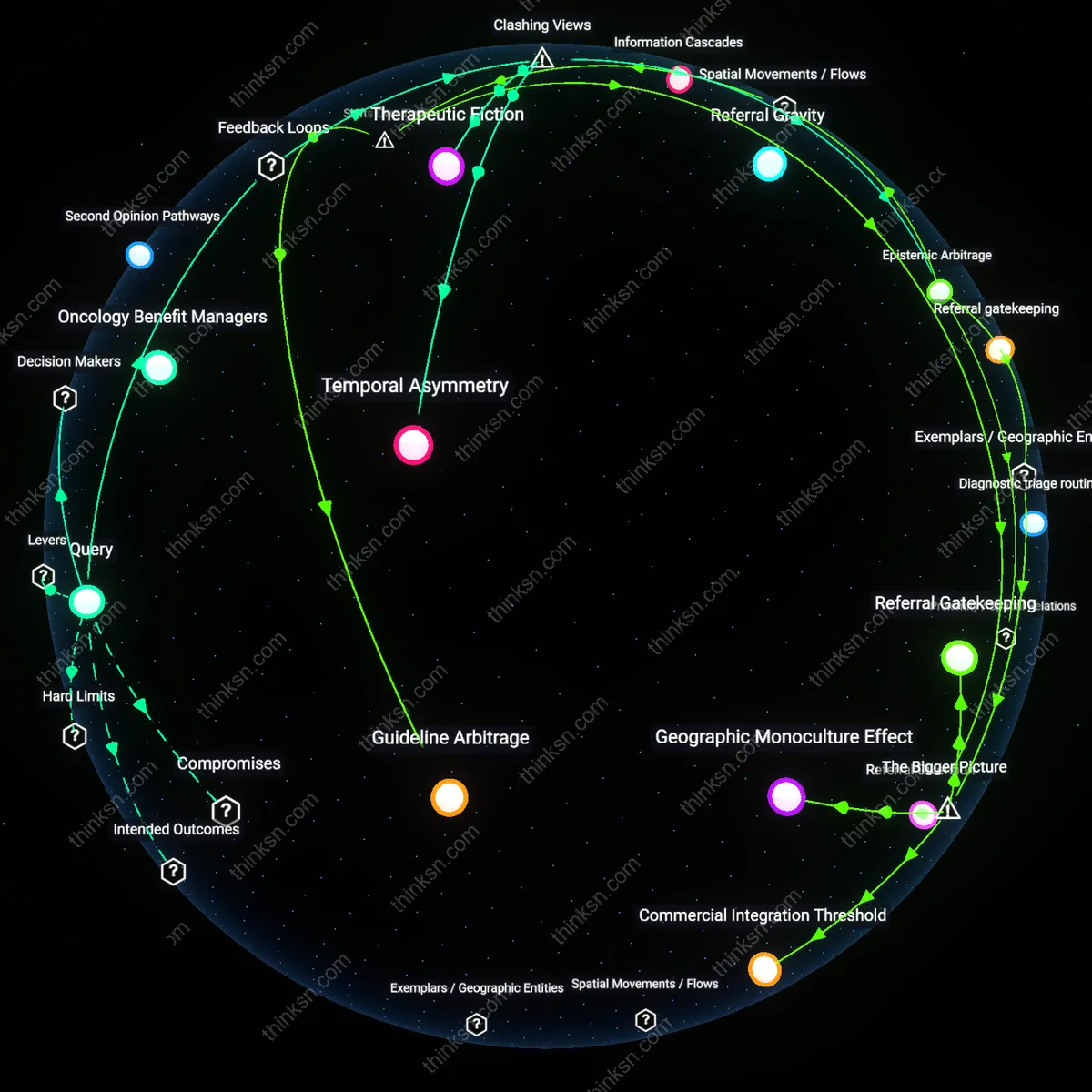
Patients gravitate toward academic medical centers when treatment recommendations conflict because these institutions serve as trusted arbiters in moments of clinical uncertainty. Oncologists and primary care providers routinely steer patients to comprehensive cancer centers—particularly NCI-designated facilities—where multidisciplinary tumor boards and access to clinical trials convey authority in contested decisions. This pattern reflects a hierarchical spatial distribution, with high-density patient flows converging on a small number of urban, research-intensive hubs, reinforcing their role as default validators of care. The non-obvious insight within this familiar reliance on prestige is that it perpetuates a self-reinforcing spatial monopoly, where clinical ambiguity, rather than disease severity, triggers centralized capture of care.
Community Anchoring
Patients default to local community cancer centers for treatment despite conflicting recommendations because continuity with known clinicians and proximity to social support systems outweigh perceived benefits of seeking discordant expert opinion. These centers—often embedded in regional hospitals—leverage established patient-provider relationships and logistical familiarity, forming dense clusters of care utilization even when guidelines diverge. The mechanism operates through trust in routine and minimized disruption, which dominates decision-making more than access to cutting-edge protocols. The underappreciated reality is that spatial density here reflects emotional and logistical resilience, not clinical hierarchy, revealing how habitually prioritized 'familiar care' reshapes the map of actual treatment pathways.
Information Cascades
Patients follow recommendation trails shaped by peer networks and media visibility, concentrating treatment uptake at cancer centers that have entered public discourse as 'top-ranked' or 'celebrity-treated,' irrespective of clinical consensus. This clustering emerges from social transmission rather than geographical proximity or provider referral, generating skewed spatial distributions where a few centers experience disproportionate inflow during periods of uncertainty. The dynamic functions through imitative decision-making, where ambiguous medical choices amplify reliance on socially validated signals. The overlooked aspect is that in familiar narratives of 'choosing the best,' the patient's path is less a search for expertise than an alignment with culturally legible success stories, producing hotspots of care that mirror perception, not prevalence.
Referral gatekeeping
At MD Anderson Cancer Center, patients with conflicting treatment recommendations often default to nearby academic medical centers when primary oncologists lack affiliation with distant specialty institutions, because referral networks controlled by local providers filter access based on institutional partnerships and insurance alignment, revealing that physical proximity is mediated by bureaucratic access rather than geographic distance alone—a dynamic overlooked when analyzing patient flow as a purely spatial phenomenon.
Infrastructure anchoring
In rural Nebraska, patients referred to both regional community hospitals and the University of Nebraska Medical Center for colorectal cancer treatment consistently chose the latter despite longer travel, because integrated telehealth nodes and mobile outreach units embedded within county clinics created continuous care pathways tied to the academic center, demonstrating that spatial proximity is redefined by distributed clinical infrastructure rather than clinic-to-clinic distance—an underappreciated force in decentralizing high-acuity care.
Diagnostic triage routing
At Harlem Hospital in New York, low-income breast cancer patients receiving conflicting guidance between surgical intervention and watchful waiting were more likely to enroll in trials at Memorial Sloan Kettering when diagnostic biopsies were performed onsite through a shared pathology pipeline, because pre-established specimen referral protocols automatically channeled complex cases toward specialized academic centers, exposing that clinical decision points are geographically steered by invisible diagnostic workflows rather than patient choice or travel convenience.
Referral Diversion
Patients flow from community clinics to specialized academic cancer centers when conflicting treatment recommendations arise, particularly after the mid-2000s integration of genomic tumor boards into oncology practice. As molecular profiling introduced discordant therapeutic options—such as targeted versus chemotherapy regimens—community physicians increasingly deferred to academic centers equipped with multidisciplinary interpretation teams, shifting referral patterns from proximity-based care to expertise-anchored migration. This rerouting, institutionalized through telemedicine-linked tumor boards post-2015, reveals how diagnostic complexity, not geographic access, began structuring patient flows, exposing an underappreciated hierarchy in oncology care shaped by interpretive capacity rather than clinical authority alone.
Therapeutic Itinerancy
Patients navigate serial migrations across regional cancer centers when initial treatments fail amid conflicting guidelines, a pattern that intensified during the immunotherapy expansion phase (2012–2018). As checkpoint inhibitors introduced divergent response trajectories across cancer types, patients—especially those with melanoma or non-small cell lung cancer—began cycling through multiple institutions, seeking centers with trial access or favorable risk-benefit framing, often moving along corridors connecting urban academic hubs and satellite research affiliates. This emergent itinerant behavior reflects a shift from singular treatment episodes to protracted therapeutic quests, underscoring how trial availability, not definitive diagnoses, became a spatial determinant of care pathways, revealing cancer treatment as a process of navigational persistence rather than destination adherence.
Guideline Arbitrage
Patients gravitate toward NCI-Designated Comprehensive Cancer Centers when national guidelines conflict, particularly following the 2016 update cycles that fragmented hormone therapy recommendations for prostate cancer. Faced with contradictory expert panels—such as those from ASCO versus AUA—patients and referring physicians selectively migrated to centers known for protocol leadership, where alignment with influential trial networks conferred perceived legitimacy, thus concentrating referrals in a subset of institutions that could assert interpretive dominance. This strategic alignment, amplified by patient advocacy group referrals post-2018, demonstrates how guideline ambiguity incentivizes spatial sorting toward epistemic hubs, exposing a hidden economy of credibility in which geographic choice becomes a mechanism for resolving clinical uncertainty.
Referral Gatekeeping
Patients default to NCI-Designated Cancer Centers when conflicting recommendations arise because specialty referral networks act as arbiters of clinical legitimacy, filtering access through institutional reputation rather than patient preference. At centers like MD Anderson or Memorial Sloan Kettering, multidisciplinary tumor boards standardize treatment protocols, creating de facto authority that overrides discordant community oncologist advice; this mechanism is reinforced by insurers who privilege referrals to these hubs. The non-obvious consequence is that patients don’t simply choose quality—they are structurally steered, revealing how clinical autonomy is redistributed from individuals to gatekeeping institutions within referral hierarchies.
Commercial Integration Threshold
Patients receiving conflicting advice increasingly migrate to vertically integrated cancer centers like those within the Intermountain Healthcare system, where diagnostic, pharmaceutical, and treatment services are co-located under one financial and operational umbrella. These systems reduce decision friction by aligning incentives across specialties, allowing rapid consensus formation that resolves contradictions in real time. The underappreciated dynamic is that integration doesn’t just improve coordination—it actively shapes patient pathways by dissolving the boundaries where conflicting recommendations would otherwise stall choices, turning financial consolidation into a clinical steering mechanism.
Geographic Monoculture Effect
In rural regions like eastern Kentucky or the Mississippi Delta, patients follow conflicting recommendations to regional medical centers such as the University of Kentucky Markey Cancer Center because local providers lack subspecialty depth, making any referral—regardless of alignment—de facto final. The systemic scarcity of oncologic sub-specialists creates a monoculture of treatment authority where a single institution absorbs all patient flow, not due to superiority but proximity and credentialing. This reveals how geographic isolation transforms institutional capacity into a coercive force, where choice is eliminated not by patient decision but by the absence of competing epistemic centers.