CDN Blocks and the Thin Line of Global Censorship?
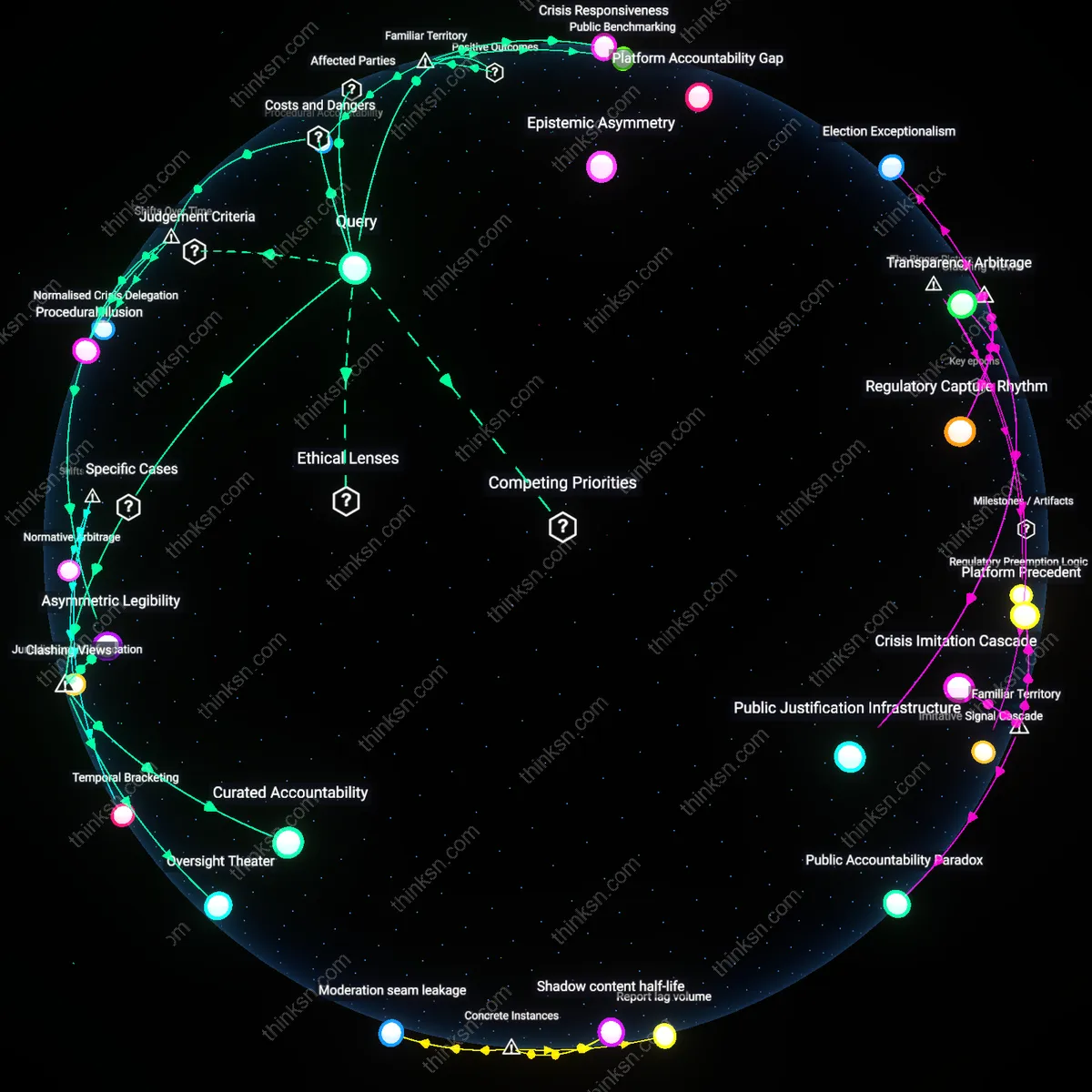
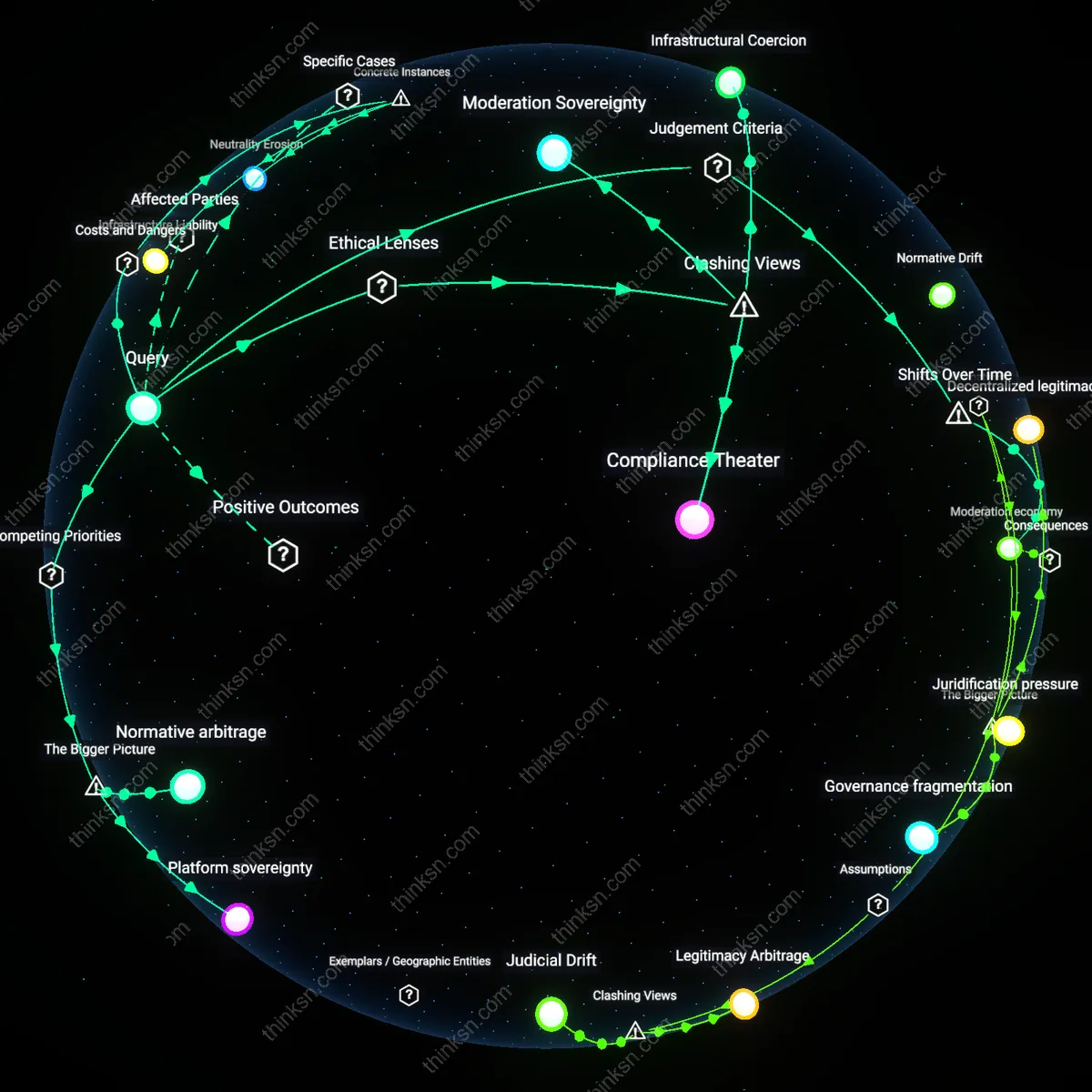
Analysis reveals 12 key thematic connections.
Key Findings
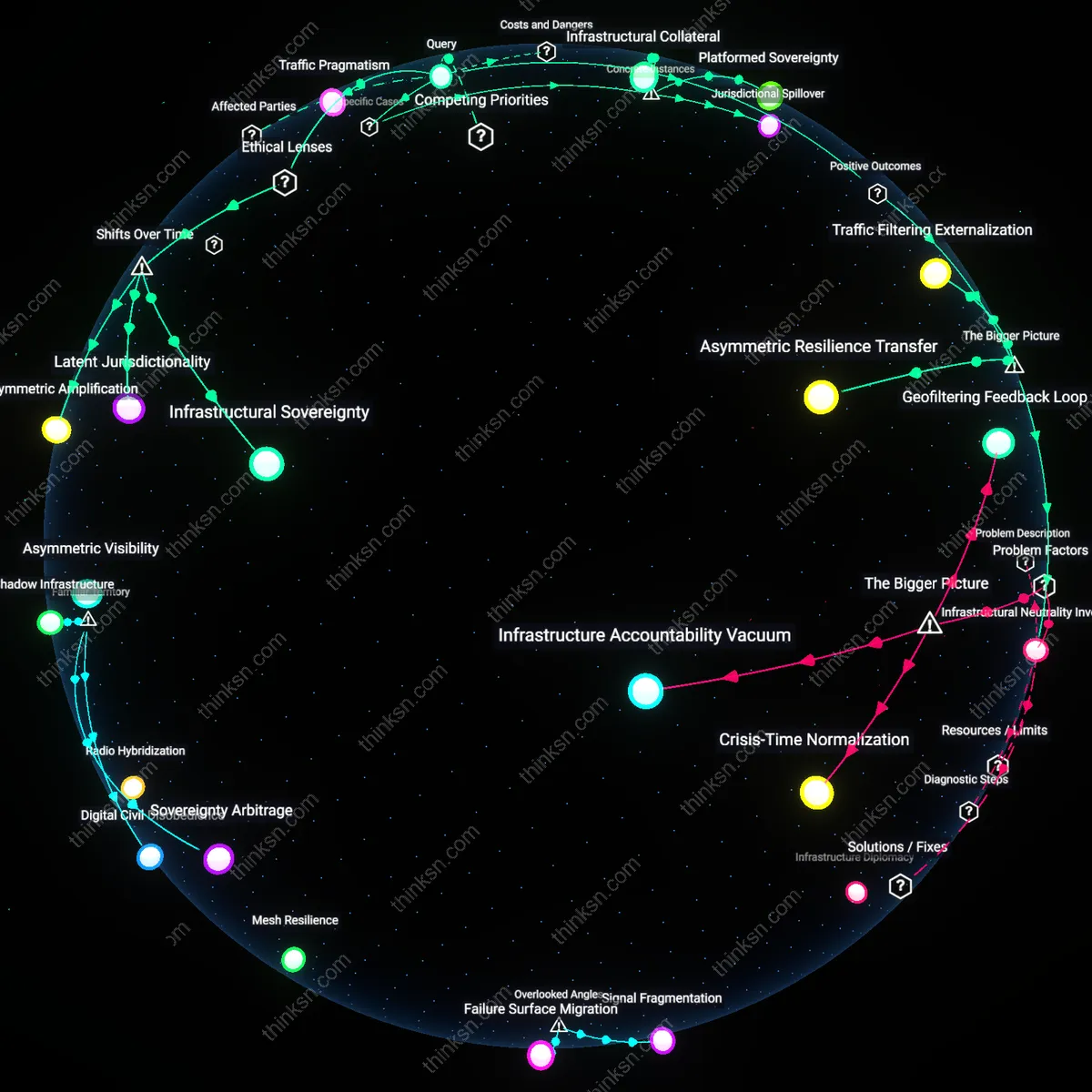
Traffic Pragmatism
A CDN blocks traffic not to suppress dissent but to maintain service integrity against state-engineered DDoS attacks originating from regimes that monopolize domestic media; the filtering is a network-level response calibrated to bandwidth thresholds and packet origin, not content ideology. This mechanism prioritizes platform availability over speaker inclusion, grounding judgment in technical resilience and user access continuity rather than free speech absolutism. The non-obvious element is that the censorship-like effect emerges from traffic engineering norms, not editorial intent, exposing how distributed infrastructure decisions reframe geopolitical speech constraints through operational necessity.
Asymmetric Visibility
Blocking a country’s IP ranges disproportionately silences dissidents whose sole digital outlet depends on foreign-hosted platforms, while state media internally remains unimpeded and better resourced, thus entrenching information asymmetry under the guise of cybersecurity. Here, the moral principle of epistemic justice is violated not by the CDN’s intent but by the structural advantage authoritarian systems gain when neutral tools are weaponized through scale and deception. The friction lies in recognizing that content delivery networks, designed to be ideologically passive, become vectors of discursive marginalization when their protocols interact with asymmetrical information ecosystems.
Jurisdictional Arbitrage
CDNs operate under legal compulsion in their home jurisdictions but extend filtering beyond their sovereign mandate when complying with de facto demands from states that threaten local infrastructure or market access, effectively outsourcing speech regulation. This reflects a distortion of corporate autonomy, where profit preservation overrides transnational expressive rights despite no formal legal obligation to block. The underappreciated dynamic is that private actors, shielded by contractual opacity and technical justifications, absorb regulatory aggression from authoritarian regimes—normalizing extraterritorial censorship through risk-averse operational logic rather than overt policy decree.
Traffic Filtering Externalization
When a CDN blocks traffic from a country with state-run media, it enables democratic governments to indirectly suppress disinformation campaigns without direct censorship, by shifting technical enforcement to private intermediaries who operate under legal immunity in their home jurisdictions. This occurs because CDNs—such as Cloudflare or Akamai—act as borderless infrastructure providers that can apply geolocation-based access controls at scale, allowing them to disrupt state-aligned propaganda flows while insulating foreign policymakers from accusations of overreach; the non-obvious systemic function is that sovereign actors outsource politically sensitive filtering to globally positioned platforms, thereby converting geopolitical pressure into technical routing decisions under commercial discretion.
Infrastructural Neutrality Inversion
A CDN’s blockade of traffic from a nation with state-run media enhances media pluralism in target democracies by weakening the reach of foreign adversarial narratives, particularly during electoral or geopolitical crises, because the CDN’s global cache distribution system inherently privileges speed and stability over content origin, leading it to deprioritize or drop connections from high-risk IP ranges associated with bot-driven amplification; the overlooked dynamic is that the very design logic of content delivery networks—to optimize efficiency—becomes a vector for indirect content governance when integrated with threat intelligence feeds, transforming performance protocols into quiet filters that reduce information pollution without explicit editorial judgment.
Asymmetric Resilience Transfer
Blocking traffic from countries with state-controlled media through CDN infrastructure strengthens civil society actors in autocratic states by forcing domestic dissidents to adopt more secure, decentralized communication tools that are less detectable by authoritarian regimes, because when CDNs restrict access, exiled media outlets must migrate to peer-to-peer networks or encrypted platforms like Matrix or IPFS to maintain audience reach, inadvertently hardening their operational security; what’s underappreciated is that foreign technical restrictions on mainstream infrastructure create adaptive spillovers that benefit domestic resistance ecosystems by accelerating the diffusion of anti-surveillance practices originally developed in exile communities.
Infrastructural Sovereignty
A CDN blocking traffic from a country with state-run media constitutes indirect censorship when it aligns with post-2010 corporate risk mitigation strategies that prioritize regulatory compliance over access, as seen in Cloudflare and Akamai’s selective de-peering in Russia after 2022; this mechanism transforms neutral infrastructure into a border-enforcing actor, revealing how privatized network governance has supplanted state-centric censorship models. The shift from state-monopolized control (pre-2000s) to distributed, market-mediated denial embeds political exclusion within technical uptime decisions, making corporate network policy the de facto regulator of speech flow—what is underappreciated is that the ethical burden migrates from governments to firms without corresponding accountability structures.
Asymmetric Amplification
Indirect censorship occurs when CDNs suppress access to dissident content by adopting geofencing protocols originally designed for copyright enforcement—such as those refined during the 2010s EU Digital Single Market debates—thereby reconfiguring legal frameworks meant for intellectual property into tools that silence marginalized voices under the guise of neutrality. This shift from content-specific takedowns to systemic traffic shaping reveals how technical standards developed in liberal democracies are repurposed to serve authoritarian ends, an unintended consequence made possible by interoperability norms that assume benign state behavior; the non-obvious insight is that ethical liberalism, embedded in protocol design, becomes complicit in repression when transplanted into adversarial contexts.
Latent Jurisdictionality
CDN-based traffic blocking becomes indirect censorship in the post-Snowden era when extraterritorial data governance, exemplified by U.S. CLOUD Act pressures and GDPR territorial reach, incentivizes infrastructure providers to preemptively restrict access from high-risk jurisdictions to avoid regulatory entanglement, effectively outsourcing geopolitical compliance. This marks a departure from Cold War-era jamming or firewall models—where suppression was overt and state-operated—toward a diffuse, anticipatory regime in which legal uncertainty produces self-imposed silence; what is underrecognized is that the ethical calculus shifts from intentional suppression to risk-averse abstention, normalizing censorship as collateral damage in global service provision.
Infrastructural Collateral
When Cloudflare restricted access to Russian state media sites for EU users under GDPR enforcement pressure, it simultaneously blocked independent journalists in Russia accessing the same platforms through shared IP ranges, demonstrating how content filtering for regulatory compliance can inadvertently silence domestic dissidents reliant on foreign-hosted infrastructure. The mechanism—automated geo-IP blocking at CDN scale—lacks granularity to distinguish state from anti-state actors, rendering dissent invisible not by design but by infrastructural sweep. This reveals the underappreciated risk that compliance-driven traffic management can produce unintended censorship effects beyond its jurisdictional intent.
Jurisdictional Spillover
When Akamai enforced Indian government takedown orders on platforms like Telegram during the 2020 farmers' protests, it applied regional blocks that also prevented diaspora-based activists from sharing organizing materials hosted on the same CDN nodes, showing how CDNs internalize local legal demands into technical constraints with global reach. The systemic issue lies in the centralized decision-making within CDNs to prioritize market access over differential access, which collapses political plurality into compliance binaries. This exposes how jurisdictional enforcement, when mediated through private global infrastructures, mutates into transnational speech suppression.
Platformed Sovereignty
When Amazon CloudFront blocked access to the Belarusian independent outlet NEXTA during the 2020 post-election protests, citing Belarusian government claims of 'extremism,' the CDN effectively endorsed a state's speech regime as authoritative, thereby disabling distribution channels for exiled journalists reliant on Western cloud infrastructure. The mechanism here is not state coercion but voluntary enforcement by private platforms assuming sovereign-like authority to adjudicate legitimacy. This illustrates how CDNs, in positioning themselves as neutral conduits, become de facto arbiters of political legitimacy—out-sourcing censorship not through state orders but through governance-by-inference.