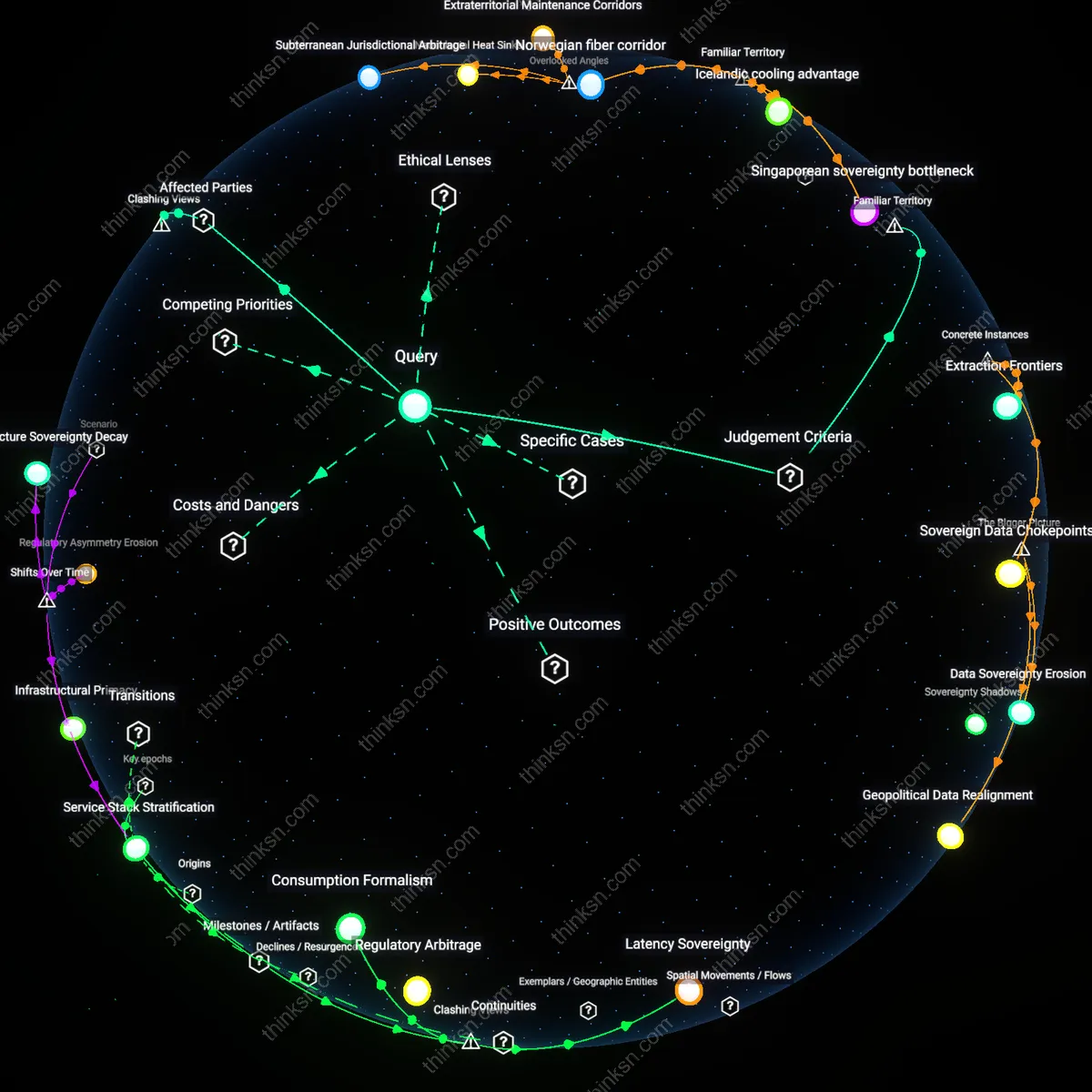
Semantic Network

Interactive semantic network: When a major cloud provider lobbies for clearer cross‑border data flow rules, is the push driven by consumer data‑rights advocacy or by an effort to cement its dominance over competing regional services?
Copy the full link to view this semantic network. The 11‑character hashtag can also be entered directly into the query bar to recover the network.

Q&A Report

Is Big Cloud Lobbying for Data Flow to Serve Users or Consolidate Power?

Analysis reveals 3 key thematic connections.

Key Findings

Compliance Capital Asymmetry

Cloud providers benefit from lobbying for clearer cross-border data rules because standardized regulations convert legal complexity into a fixed cost, which global firms can amortize across markets, while regional competitors face it as a variable, existential burden. This asymmetry turns compliance into a form of capital that is accumulated through scale, not innovation or service quality. The dynamic plays out in markets like Southeast Asia and Latin America, where national data localization laws emerge in fragmented, overlapping forms that favor centralized legal teams capable of pre-emptive harmonization strategies. The underappreciated reality is that regulatory clarity, often framed as a public good, functions as a weaponization of predictability—enabling the dominant firm to externalize governance costs onto smaller players who lack the infrastructure to anticipate or absorb rule changes.

Autonomy Theater

The lobbying effort is framed as advancing consumer data rights, but serves instead to position the provider as a steward of individual autonomy amid geopolitical data fragmentation. By championing interoperable privacy standards—like GDPR equivalence or data portability mandates—firms recruit public trust to legitimize their global reach. The familiar link between 'data protection' and 'freedom' hides the reality that these standards are designed for implementability across vast networks, not local empowerment. The moral yardstick here is autonomy, but its application is aspirational, shaped more by brand necessity than structural change.

Jurisdictional Arbitrage

Clearer cross-border data rules enable dominant providers to optimize data routing and storage in ways that exploit regulatory differentials between nations. For instance, a U.S.-based cloud giant benefits from regimes that allow data to flow to low-surveillance or tax-advantaged jurisdictions while maintaining access under FISA or CLOUD Act provisions. The practical yardstick is systemic control—how legal clarity reduces operational risk for those who already command architectural dominance. The underappreciated insight is that 'clarity' often means 'predictable asymmetry' where powerful actors gain leverage over both states and smaller firms.

Relationship Highlight

Service Stack Hegemonyvia The Bigger Picture

“By vertically integrating foundational technologies—such as Kubernetes, serverless compute, and global load balancers—cloud providers redefined data control as a function of orchestration rather than storage location, beginning notably in the mid-2010s with the open sourcing of containerization tools that cemented de facto standards around their architectures; this created a path-dependent dominance where enterprises ceded strategic autonomy not through ownership of infrastructure, but through entanglement in interoperability networks that abstracted physical storage into orchestrated workflows, revealing a non-obvious power shift where technical abstraction layers became the true locus of governance.”