Why Insurance Plans Punish Treatment-Resistant Depression?
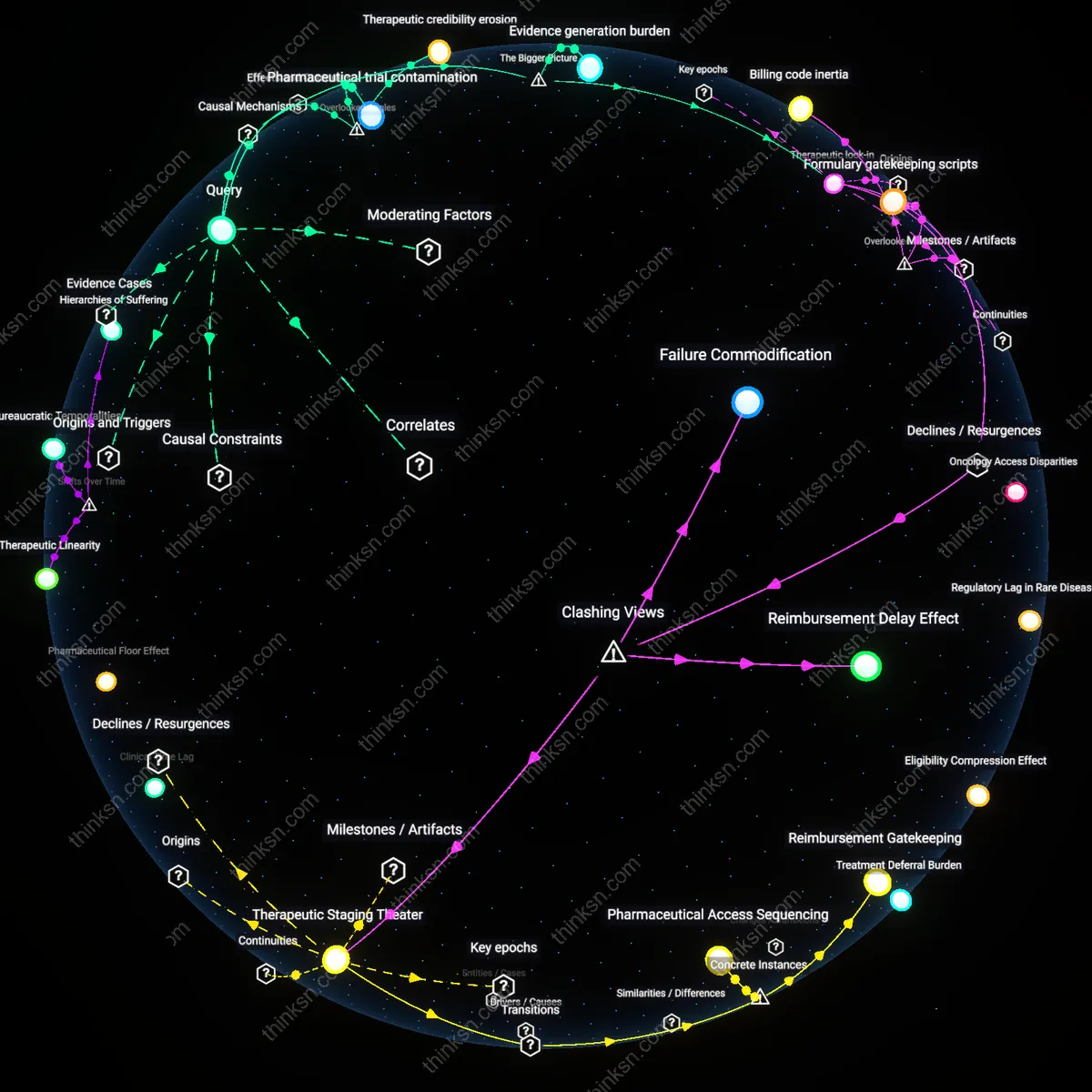
Analysis reveals 6 key thematic connections.
Key Findings
Therapeutic lock-in
Insurance mandates requiring first-line therapy failure enforce a sequential treatment pathway that delays access to effective interventions for treatment-resistant depression. This mechanism operates through payer-controlled authorization protocols, where clinicians must document inadequate response to lower-cost antidepressants before accessing newer or more expensive options like ketamine or TMS. The system prioritizes cost containment over clinical urgency, creating a structural delay that embeds trial-and-error into care delivery, often prolonging suffering despite known resistance patterns. What is underappreciated is that this process institutionalizes a form of therapeutic inertia, where the logic of financial risk management overrides personalized treatment trajectories, effectively locking patients into ineffective regimens.
Evidence generation burden
Payers shift the evidentiary burden onto patients and clinicians by requiring documented failure of first-line therapies before approving alternative treatments for depression. This functions through a retrospective justification system in which therapeutic inadequacy must be proven via observed clinical deterioration or lack of improvement over weeks or months, even when early biomarkers or treatment history suggest resistance. The dynamic reflects a misalignment between clinical judgment and insurance risk assessment, where the requirement becomes a tool for deferring high-cost care rather than a medically grounded step. The underappreciated consequence is that insurers effectively outsource the production of justificatory data to patients' worsening symptoms, turning individual suffering into a necessary input for coverage eligibility.
Clinical pathway distortion
The requirement of first-line failure distorts standard clinical decision-making by inserting payer-mandated steps that override individualized treatment plans based on patient history or rapid cycling risk. This occurs through prior authorization systems that treat all patients as statistically average, disregarding subpopulations with documented poor response to SSRIs or SNRIs identified via pharmacogenomic testing or past treatment records. The systemic pressure to conform to algorithmic pathways—designed for population-level cost efficiency—undermines precision psychiatry, pushing clinicians to adhere to sequences that may exacerbate relapse or suicide risk in resistant cases. The overlooked reality is that insurance policy functions as an invisible hand shaping treatment protocols, not merely restricting access, thereby altering the very definition of 'standard of care' in practice.
Therapeutic credibility erosion
Requiring first-line therapy failure degrades patients' perceived legitimacy in clinical interactions, because repeated insurance rejections teach providers to interpret persistent symptoms as signaling poor adherence or low motivation rather than biological resistance. This shift occurs through the subtle recalibration of clinician expectations during treatment planning, where gatekeeping protocols indirectly reframe diagnostic uncertainty as patient deficit. What is overlooked is that insurance mandates don’t just delay care—they actively reshape diagnostic empathy, altering how clinicians metabolize patient reports of suffering when prior treatment failures become administrative prerequisites rather than clinical observations.
Pharmaceutical trial contamination
First-line failure requirements distort real-world evidence generation for novel antidepressants by forcing inclusion of patients with artificially prolonged symptom duration and polypharmacy histories, which skews cohort phenotypes in post-marketing studies. This happens because insurers mandate exposure to older, less effective regimens, thereby altering neurobiological baseline states before access to innovation—contaminating efficacy signals in observational datasets used for safety and effectiveness monitoring. The underappreciated consequence is that regulatory and commercial assessments of next-generation treatments are systematically biased, not by clinical design, but by the hidden selection pressure imposed by reimbursement hierarchies.
Household affective infrastructure
Insurance-mandated treatment sequencing redistributes care burden onto family networks by extending the period during which patients remain functionally impaired, compelling informal caregivers to sustain emotional, logistical, and financial support far beyond clinical timelines. This dependency emerges not from illness severity alone, but from the deferral of effective intervention, transforming episodic care into chronic household labor often invisible to health systems. The overlooked mechanism is that payer policies indirectly institutionalize unpaid familial labor as a subsidy to cost containment, making family emotional capacity a de facto component of mental health infrastructure.