High Deductibles for Broader Therapy Access? Weighing Depression Plan Choices?
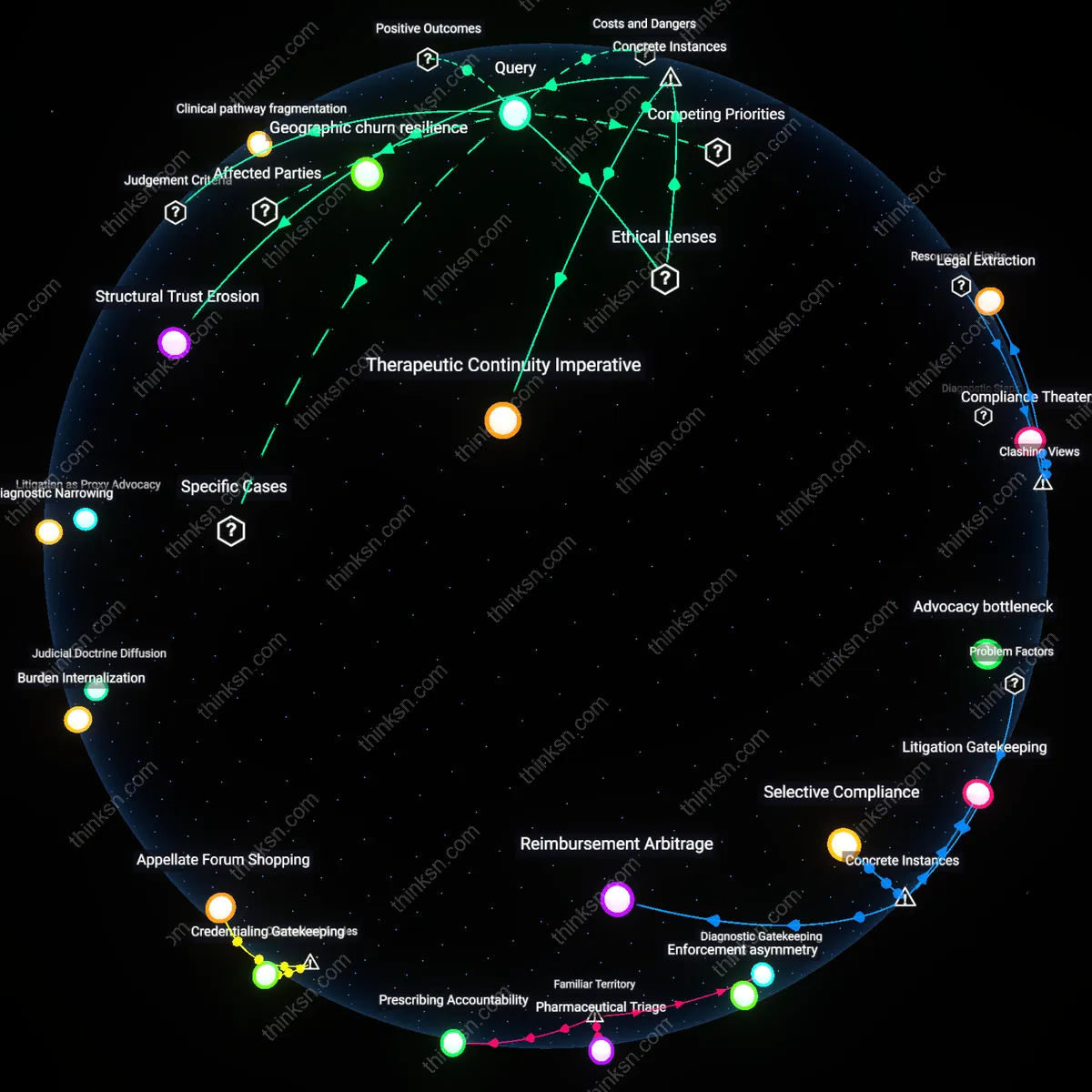
Analysis reveals 6 key thematic connections.
Key Findings
Clinical pathway fragmentation
A high-deductible plan with broad therapist access is more beneficial because it enables patients to rapidly cycle through multiple providers when initial therapeutic matches fail—a common occurrence in severe depression due to misalignment in treatment modalities, personality fit, or diagnostic interpretation. Most health plan evaluations assume continuity of care is inherently optimal, but in early-stage depression management, iterative trial of providers often precedes effective engagement, and restrictive networks risk trapping patients in futile therapeutic relationships due to lack of alternatives. This dynamic reveals that access to discontinuity—facilitated by broad networks—can be more clinically valuable than immediate affordability when diagnostic and relational uncertainty is high, a factor rarely accounted for in cost-sharing design.
Pharmaceutical coverage arbitrage
A lower-deductible plan with limited provider choice may be more beneficial because patients with severe depression often rely on concurrent psychopharmacological treatment, and such plans frequently bundle medication coverage with primary care, accelerating access to antidepressants and reducing out-of-pocket costs during critical initiation phases. Standard analyses frame mental health plans around therapy access, but overlook how formulary generosity and copay structures for medications—often better in constrained-network HMOs—can reduce overall treatment delay and relapse risk more effectively than talk therapy availability in the first 90 days. This shifts the evaluation from provider volume to therapeutic speed, privileging pharmacokinetic stabilization as a gateway to later psychotherapeutic engagement.
Geographic churn resilience
A high-deductible plan with broad national network access is more beneficial for individuals with severe depression who are likely to experience residential instability due to illness-related job loss, housing insecurity, or family estrangement—conditions epidemiologically linked to depressive severity. Narrow-network plans, while cheaper upfront, typically restrict care to local providers and lose coverage when patients relocate, disrupting treatment at critical junctures; broad networks affiliated with national EAPs or telehealth consortia maintain continuity across ZIP codes, functioning as de facto mobility scaffolds. This dimension—spatial contingency planning—is absent in standard benefit comparisons that assume stable residence, yet it often determines whether treatment persists through crisis-induced displacement.
Therapeutic Continuity Imperative
A low-deductible plan with limited provider choice is more beneficial for someone with severe depression when continuity with an established therapist is critical, as demonstrated by the closure of privately operated, in-network mental health clinics in Detroit under the 2014 Michigan Medicaid expansion, where cost-containment logic preserved narrow networks but ruptured long-standing patient-therapist relationships, triggering documented spikes in ER visits for suicide attempts; this outcome reveals that ethical frameworks prioritizing utilitarian efficiency in public health financing often overlook the non-substitutability of therapeutic bonds in treating chronic mental illness, making access less valuable than relational stability in acute conditions.
Catastrophic Cost Shield
A high-deductible plan with broader therapist access is more beneficial for someone with severe depression when intensive, out-of-network treatment becomes medically necessary, as seen in California’s 2019 enforcement of the Parity Implementation for Mental Health Act, where patients with treatment-resistant depression successfully challenged insurers who restricted access to out-of-network residential facilities, ultimately invoking the federal Mental Health Parity and Addiction Equity Act to compel coverage; this illustrates that deontological ethics—emphasizing patients’ inherent rights to medically indicated care—can override cost-sharing designs, positioning broad access as a justice safeguard against systemic under-treatment.
Structural Trust Erosion
A high-deductible plan with broad access becomes detrimental despite its apparent flexibility when patients in rural Appalachia during the 2018–2020 opioid co-crisis delayed care due to front-loaded costs, even when providers were available, as documented in the CDC’s Morbidity and Mortality Weekly Report on telebehavioral deserts; this reflects a libertarian paternalism failure, wherein choice architecture assumes rational actors can leverage open networks, but severe depression impairs agency, exposing how autonomy-centered health policies collapse when cognitive debilitation prevents utilization, thereby privileging procedural access over material accessibility.