Is a Cheaper Drug Worth Risking Your Health?
Analysis reveals 6 key thematic connections.
Key Findings
Cost-Benefit Threshold
Individuals must compare the incremental health benefit of expensive drugs against out-of-pocket costs by estimating personal financial risk tolerance and disease progression odds. This calculation occurs within household budgeting systems, where medical expenses compete with housing, food, and transportation—forcing trade-offs that formal insurance models rarely acknowledge. The non-obvious insight is that patients are de facto actuaries, using rough heuristics to set implicit thresholds for how much risk they can absorb per unit of health gain.
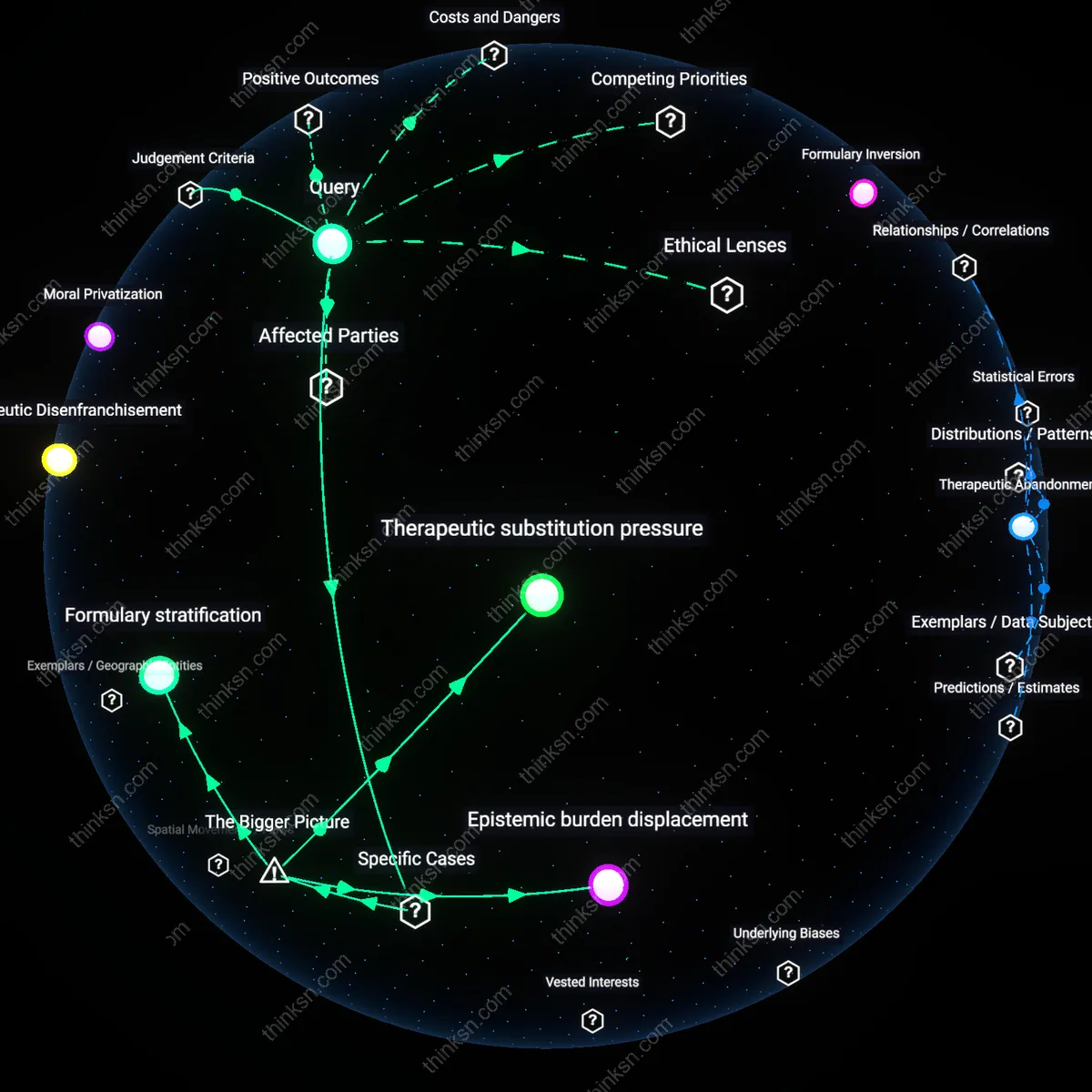
Therapeutic Disenfranchisement
Patients with limited insurance experience diminished agency in treatment selection because formulary restrictions and prior authorization processes privilege institutional cost control over individual clinical needs. These administrative barriers are concentrated in Medicaid and marketplace plans, where patients defer to providers who navigate constrained networks—often resulting in delayed or substituted therapies. What remains underappreciated is how systemic gatekeeping normalizes suboptimal care as an expected condition of low-income status, not a failure of access design.
Moral Privatization
Choosing between drug efficacy and affordability shifts ethical responsibility from health systems to individuals, framing health outcomes as personal moral choices rather than structurally determined realities. In this logic, skipping prescriptions or rationing medication becomes a sign of poor discipline instead of a rational response to underinsurance. The unexamined dynamic is how public discourse blames patient behavior while obscuring the policy decisions that produce inequitable drug pricing and coverage gaps.
Formulary stratification
Insurers structure drug coverage tiers to shift cost burdens onto patients, making cheaper drugs financially incentivized even when less effective. In Medicare Part D plans, for example, pharmaceutical companies negotiate with Pharmacy Benefit Managers (PBMs) to position more profitable or branded drugs on higher tiers with greater patient cost-sharing, while older generics occupy lower tiers. This pricing architecture forces individuals with limited insurance to trade clinical efficacy for out-of-pocket affordability, reinforcing health disparities through design rather than accident. The non-obvious consequence is that insurance formularies don't merely reflect drug value—they actively shape perceived medical necessity through financial coercion.
Therapeutic substitution pressure
Clinicians in safety-net hospitals, such as those in the Harris Health System in Houston, frequently prescribe less-effective alternatives due to prior authorization requirements and institutional formularies constrained by pharmaceutical budgets. These restrictions emerge from federal funding caps on 340B Drug Pricing Program entities, which allow discounted drug acquisition but mandate cost containment. As a result, physicians become de facto cost arbiters, normalizing suboptimal treatments despite clinical guidelines. The underappreciated dynamic is that provider autonomy erodes not from individual bias but from systemic budget enforcement embedded in public health financing.
Epistemic burden displacement
Patients managing chronic conditions like rheumatoid arthritis on limited insurance must interpret complex trade-offs between TNF inhibitors and older disease-modifying agents without clinical training, often relying on crowdsourced information from forums like MyHealthTeams. This shift occurs because insurance literacy and therapeutic decision-making are increasingly privatized—neither clinicians nor insurers provide decision-support tools calibrated to individual socioeconomic context. The hidden mechanism is that risk assessment is offloaded onto patients, transforming structural uncertainty into personal responsibility. The result is a knowledge gap weaponized by asymmetry, where survival depends on navigating misinformation as much as biology.