Should DACA Recipients Risk Protection for Graduate Education Abroad?
Analysis reveals 10 key thematic connections.
Key Findings
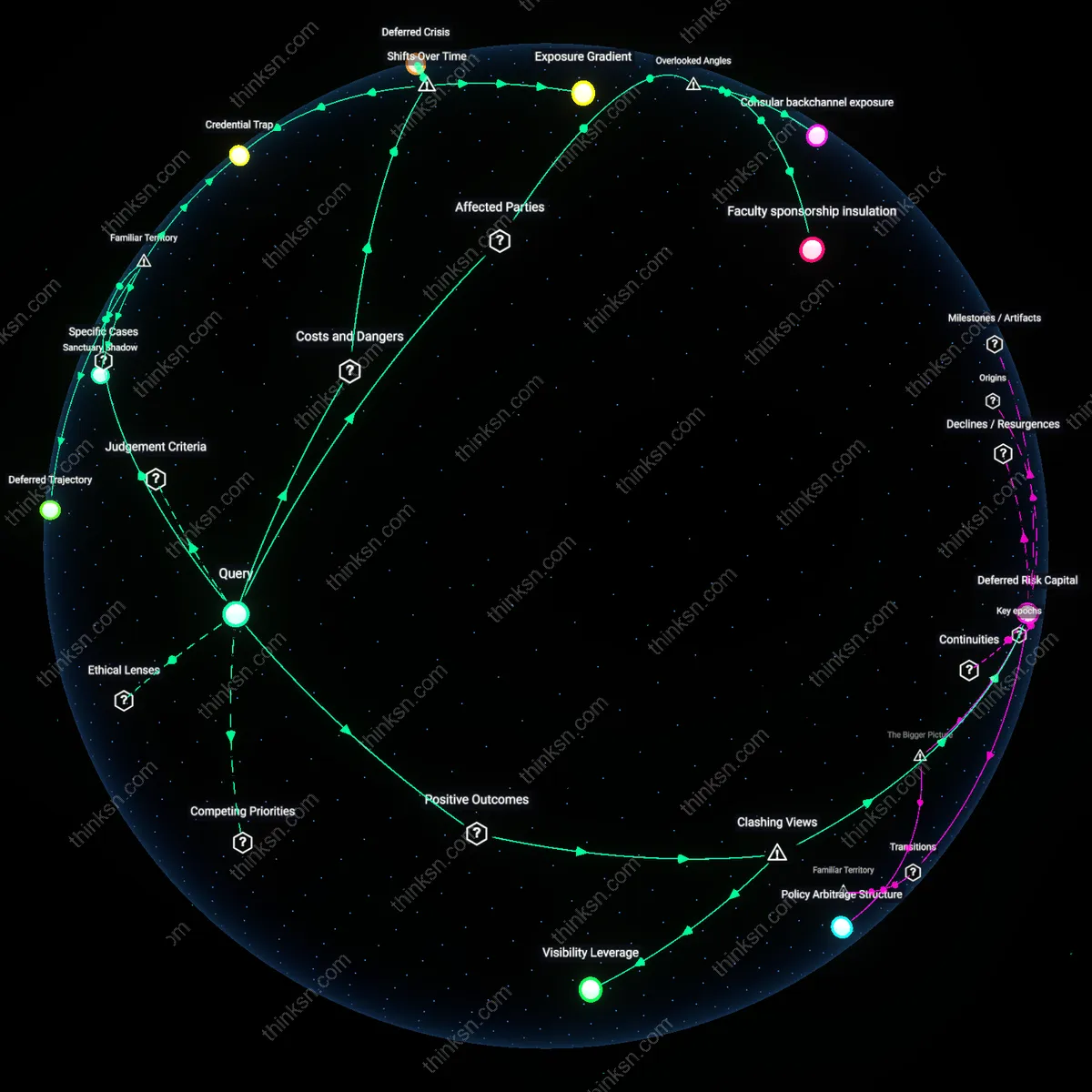
Consular backchannel exposure
A DACA recipient in a non-sanctuary state risks unintended immigration enforcement through consular engagement triggered by graduate school international partnerships. Universities frequently collaborate with foreign governments on research or student exchange programs, funneling biometric and biographic data through diplomatic channels; if a recipient’s home country consulate receives such data—even peripherally—it may activate preemptive notification protocols to U.S. immigration authorities under bilateral memoranda that remain opaque to public oversight. This silent data pipeline is rarely considered in risk assessments because it operates beneath the visibility of campus legal aid offices and relies on intergovernmental information-sharing agreements not disclosed in institutional privacy policies, thereby transforming academic participation into an inadvertent exposure vector.
Faculty sponsorship insulation
The most underutilized protective asset for DACA recipients in restrictive states is the informal but powerful academic sponsorship of senior faculty with federal research portfolios. Professors leading federally funded labs or projects often possess unspoken leverage with agency program officers who, in turn, influence immigration discretion during enforcement fluctuations—particularly in STEM fields where visa exceptions are routine. This insulation emerges not through formal policy but through the quiet prioritization of research continuity over immigration compliance, a dynamic overlooked because it depends on personal credibility and scientific capital rather than institutional statements, making it invisible in official risk matrices yet decisive in moments of adjudication.
State judicial asymmetry
DACA recipients miscalculate risk when assuming uniform enforcement across non-sanctuary states, failing to recognize that local federal district court precedents—such as those in Western District of Texas versus Eastern District of Virginia—produce divergent administrative behaviors in ICE field offices due to varying judicial receptivity to immigration stays. Because graduate programs bind individuals to specific jurisdictions for years, the recipient’s physical presence may place them under the jurisdiction of a court district hostile to deferred action, where even non-criminal status changes can trigger referral protocols that would be dismissed elsewhere. This spatial legal fragmentation is ignored in national advisories that treat 'non-sanctuary' as monolithic, yet it materially determines whether routine address updates become enforcement triggers.
Deferred Risk Capital
Pursuing graduate education in a non-sanctuary state converts temporary legal vulnerability into a strategic asset by binding institutional self-interest to the recipient’s presence. Universities with significant out-of-state tuition revenue become reluctant enforcers of immigration crackdowns, as mass attrition of DACA students would damage both budgetary stability and national reputation—turning financial dependency into a quiet shield. This dynamic is underappreciated because it reframes institutional complicity not as a liability but as a stabilizing force that emerges precisely where state hostility is strongest, revealing that risk concentration can catalyze protection through economic entrenchment rather than mitigate it.
Visibility Leverage
Enrolling in graduate programs in non-sanctuary states increases a DACA recipient’s public footprint in ways that deter targeted enforcement, as removing high-visibility students from accredited programs generates negative media attention and institutional backlash—even from politically conservative administrations. University press offices, alumni networks, and academic freedom norms create ambient protective pressure that law enforcement agencies often preemptively avoid to preserve order and public image. This counters the intuitive belief that anonymity equals safety, revealing instead that strategic exposure in politically adverse environments can invoke third-party defense mechanisms that are indifferent to immigration ideology but fiercely protective of institutional stability.
Deferred Crisis
A DACA recipient risks immediate exposure to deportation by pursuing graduate education in a non-sanctuary state because the 2017 rescission of DACA under the Trump administration—though partially blocked in court—shifted the operational reality from one of predictable administrative protection to a condition of legal fragility dependent on jurisdictional policy and federal enforcement discretion; this transition dismantled the earlier assumption, held from 2012 to 2016, that deferred action conferred stable de facto status, exposing recipients to new layers of institutional risk when enrolling in state universities that share data with federal immigration authorities. This mechanism reveals how the erosion of executive non-enforcement policies destabilizes long-term life planning, particularly for those relying on unevenly protected rights embedded in administrative law. The non-obvious consequence is not just legal vulnerability, but the temporal dislocation of aspirations once considered viable under a prior federal posture of restraint.
Credential Trap
Graduate education in a non-sanctuary state poses the long-term risk of accumulating significant financial and social capital in a credential that may never be legally deployable in the U.S. workforce, a danger intensified after 2018 when federal courts allowed the government to cease new DACA applications, halting work authorization renewal cycles; this shift transformed advanced education from a potential pathway to professional integration into a speculative investment vulnerable to retroactive invalidation. The mechanism operates through the interdependence of F-1 or in-state tuition eligibility with DACA status, which, when withdrawn, leaves degrees unmonetizable in a labor system that mandates legal employability. The underappreciated reality is that the value of education is no longer tied solely to knowledge acquisition but to the temporal continuity of a policy shield that has proven increasingly intermittent.
Exposure Gradient
The act of relocating to a non-sanctuary state for graduate study increases a DACA recipient’s risk exposure due to the post-2020 normalizing of inter-agency data sharing between public universities and ICE, a practice that escalated after Texas v. United States (2018) declared DACA unlawful and incentivized state institutions to distance themselves from perceived harboring liabilities; this shift marked a departure from the earlier period (2012–2016) when educational institutions operated with greater autonomy in protecting migrant students, and instead embedded immigration enforcement into routine administrative functions like student registration, housing, and campus policing. The resulting system produces a geographical stratification of risk—where the physical location of study now dictates the intensity of surveillance—revealing an evolving spatial politics of containment masked as bureaucratic compliance.
Deferred Trajectory
A DACA recipient in Texas should expect heightened risk of disrupted legal status to directly deter enrollment in graduate programs at public universities, because state-level policies like SB 4 empower local law enforcement to collaborate with ICE, making campuses less insulated from federal immigration enforcement; this creates a chilling effect even when enrollment is legally permissible, revealing how the perception of threat—fueled by politically charged enforcement landscapes—can function as a de facto barrier more potent than legal prohibition itself.
Sanctuary Shadow
A DACA student considering graduate school in Georgia will find that private institutions like Emory University advertise supportive policies, but the absence of statewide sanctuary protections means campus assurances exist in tension with county-level cooperation with federal immigration databases, exposing how institutional goodwill becomes a precarious shield when local jurisdictions actively participate in immigration surveillance, a dynamic most visible in metro Atlanta’s patchwork of municipal compliance and non-compliance.