Does Framing Foreign Interference Mask Elite Capture in Politics?
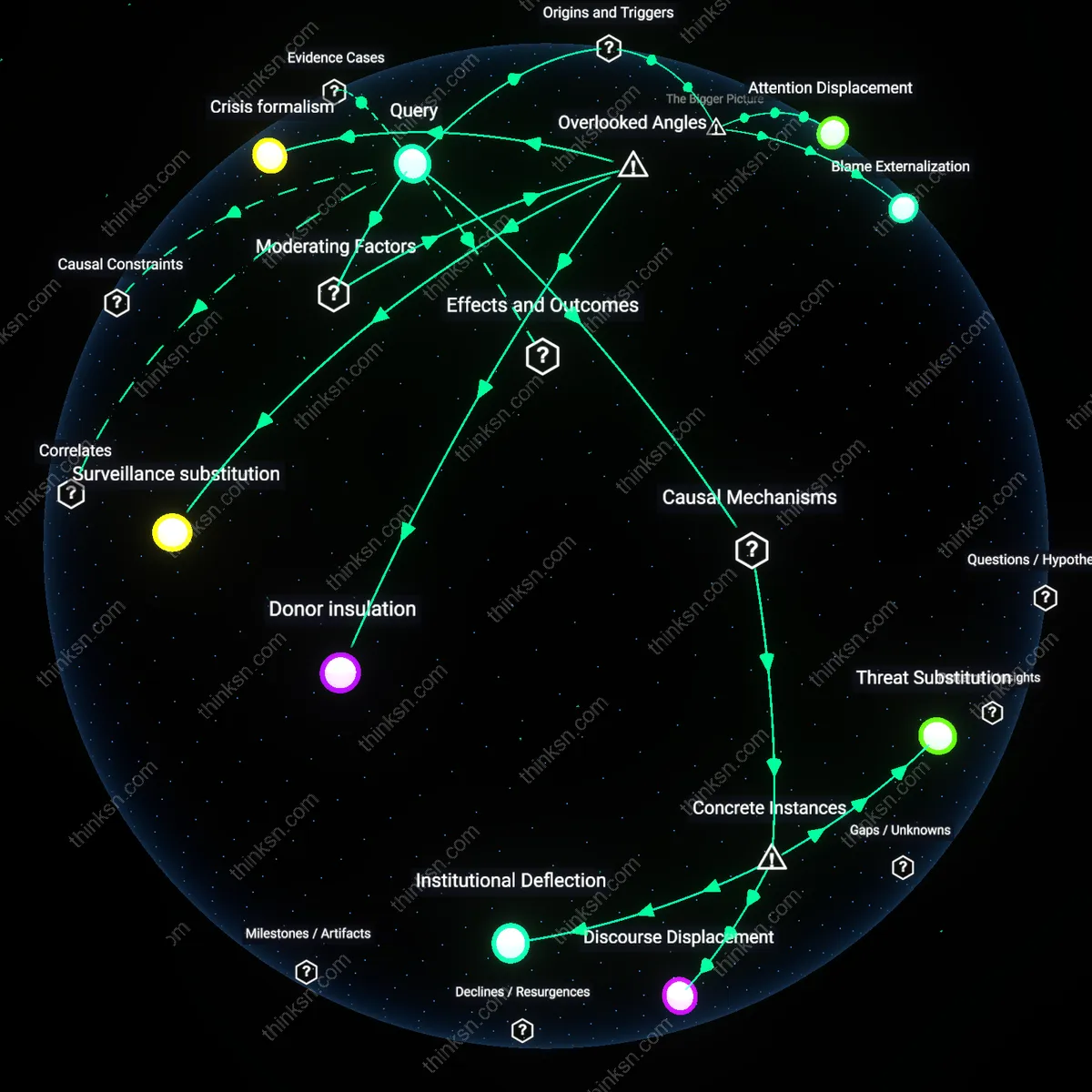
Analysis reveals 9 key thematic connections.
Key Findings
Attention Displacement
Emphasizing foreign interference redirects public scrutiny from internal power concentrations to external actors, enabling domestic elites to avoid accountability. Intelligence agencies and political leaders amplify threats like election hacking or disinformation campaigns to justify centralized responses, which in turn expand surveillance and control mechanisms that disproportionately affect domestic dissent. This shift masks how party fundraising dependencies and closed candidate pipelines perpetuate elite dominance, making systemic inequality appear as strategic vulnerability rather than structural design. The non-obvious effect is that national security framing turns democratic deficits into security necessities, legitimizing opacity under the guise of defense.
Crisis Legitimation
The invocation of foreign interference functions as a crisis trigger that justifies emergency governance practices, allowing party leaderships to sideline grassroots factions in favor of technocratic or security-aligned insiders. In moments of alleged external threat, procedures like fast-tracked legislation, restricted primary access, or centralized messaging are normalized as protective measures, even though they consolidate power among a few unelected officials. This dynamic is amplified by media institutions that treat national security claims as inherently credible, thus validating elite coordination under the mantle of patriotism. The underappreciated mechanism is that crisis perception, not actual infiltration, enables institutional capture by empowering gatekeepers who control threat narratives.
Blame Externalization
Political elites attribute declining public trust and electoral volatility to foreign manipulation rather than policy failures or exclusionary practices, thereby insulating party establishments from reform demands. When protests or primary upsets are framed as outcomes of disinformation operations, the underlying grievances—such as economic marginalization or representational gaps—are dismissed as inauthentic or weaponized. This attribution pattern relies on symbiotic relationships between security bureaucracies and party leaderships, who mutually benefit from expanded threat domains that require coordinated, top-down management. The overlooked consequence is that legitimacy is preserved not through responsiveness but through deflection, transforming domestic dissent into foreign subversion.
Threat Substitution
Focus on Russian election interference in the 2016 U.S. presidential election redirected institutional scrutiny toward external actors, insulating Democratic Party leadership from accountability for strategic miscalculations and internal gatekeeping that marginalized insurgent candidates like Bernie Sanders; this mechanism operates through the attribution of political disruption to exogenous threats rather than endogenous power structures, thereby preserving elite control under the guise of national defense. The non-obvious insight is that the amplification of foreign interference served not just as a security narrative but as a discursive tool that redefined the source of democratic instability, suppressing internal critique within party governance structures.
Discourse Displacement
In the UK, the Labour Party’s characterization of Brexit-era concerns about Russian infiltration as a primary political vulnerability diverted attention from entrenched factional dominance by centrist MPs over party policy direction, particularly in sidelining Jeremy Corbyn’s anti-austerity platform; this functions through the institutional prioritization of counterintelligence narratives that reframe internal ideological conflict as external subversion. The significance lies in how the invocation of foreign threat transforms debates over economic justice and party democracy into matters of national security, rendering elite resistance to leftward shifts appear as necessary vigilance rather than political bias.
Institutional Deflection
Following the 2020 U.S. elections, Republican leaders in Arizona cited alleged foreign influence in mail-in voting systems to challenge election legitimacy, deflecting from their own failure to adapt to demographic and voter engagement shifts that undermined their dominance; this operates through the mobilization of state-level election review mechanisms as performative investigations that externalize blame while avoiding accountability for strategic stagnation within the party apparatus. What is underappreciated is that claims of foreign interference became a tactical alibi for maintaining incumbent influence amid internal pressures for renewal, converting organizational decline into a narrative of external siege.
Donor insulation
Emphasizing foreign interference as a national security threat strengthens elite dominance by diverting investigative scrutiny away from domestic financial influencers within party structures, particularly large non-transparent donors whose contributions are rarely subject to the same forensic attention as foreign-linked entities. The mechanism operates through federal agencies and media framing, which prioritize cross-border vectors of influence while normalizing high-dollar domestic donations as lawful political participation. This selective focus reinforces donor insulation—where wealthy domestic actors exploit legal loopholes and soft-law norms to shape policy outcomes without triggering institutional alarms—effectively shielding elite capture from public challenge, a dynamic rarely acknowledged in discourse centered on external threats.
Surveillance substitution
Elevating foreign interference redirects intelligence and regulatory oversight toward digital surveillance and counterintelligence operations, which functionally replace internal party accountability mechanisms that would otherwise monitor elite self-dealing or undemocratic conduct. This shift empowers institutions like the FBI and DHS to act as political hygiene proxies, allowing party leadership to outsource vigilance to national security apparatuses that are structurally unable to address corruption by design. The substitution enables a stealth legitimation of internal hierarchies, where threats to party integrity are only recognized when externally coded, thereby erasing scrutiny of how closed-door patronage networks consolidate power—a phenomenon buried beneath the spectacle of cyber-espionage.
Crisis formalism
The institutionalization of foreign interference as a perpetual crisis reinforces rigid proceduralism within party governance, privileging hierarchical control and centralized decision-making in the name of 'security continuity.' This dynamic manifests in the expansion of unaccountable compliance units and internal risk assessments that mimic national security protocols, effectively freezing out bottom-up initiatives or reformist factions lacking access to clearance-level information. Crisis formalism thus codifies elite dominance not through overt repression but through bureaucratic path dependency, where deviations from established chains of command are treated as systemic vulnerabilities—an insight obscured in debates that treat foreign threats as purely operational rather than constitutive of party political theology.