Reskill or Preserve Reputation in an Automated Industry?
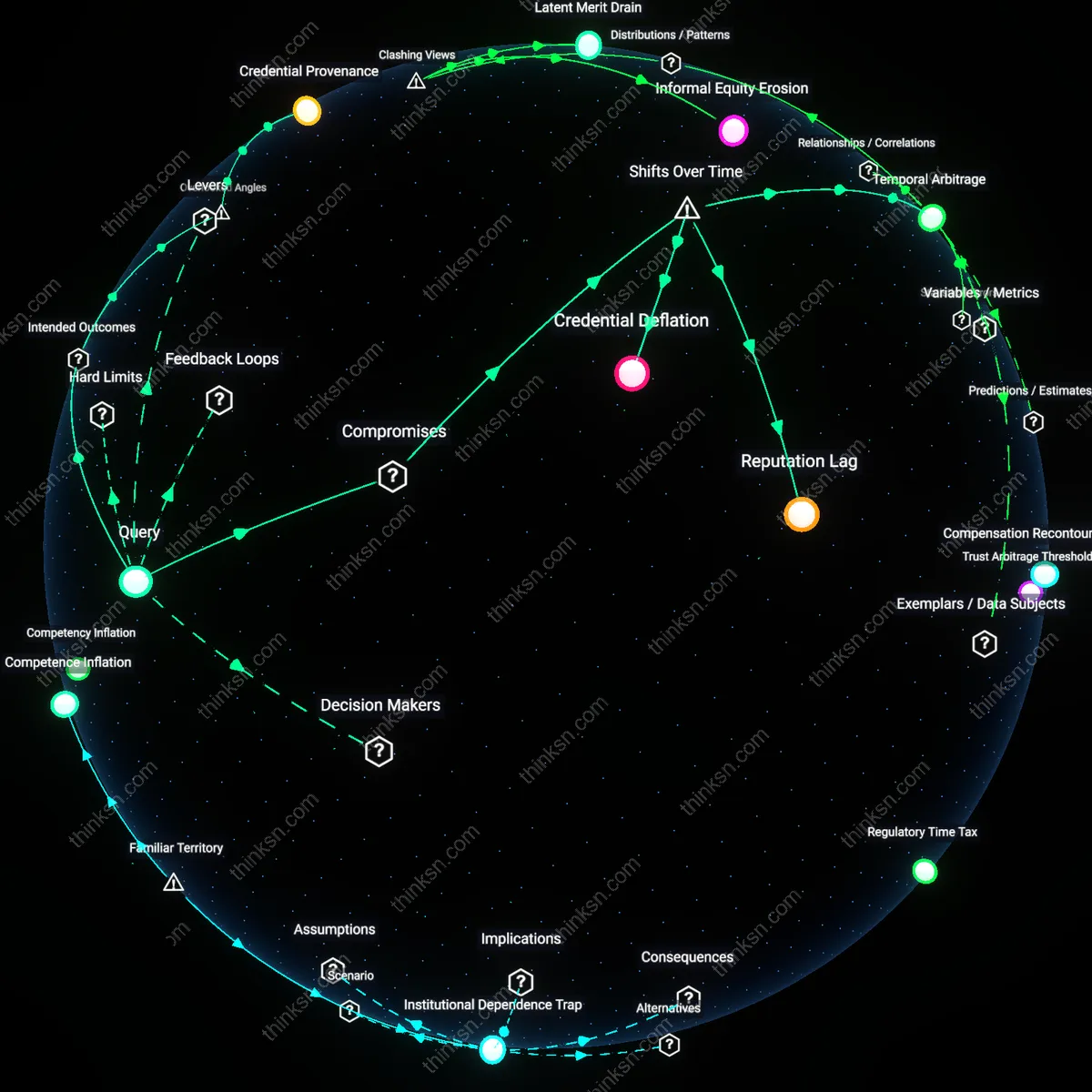
Analysis reveals 5 key thematic connections.
Key Findings
Reputation Lag
Individuals compromise the depth and credibility of newly acquired skills to re-skill rapidly, resulting in a temporary dissonance between their updated capabilities and their established professional standing. In the post-2008 automation surge, especially in manufacturing and logistics, mid-career workers adopted accelerated training in robotics and data systems through short-term certifications—often replacing multi-year mastery trajectories—but these condensed pathways carried less validation weight among peers and employers, delaying the recognition of competence. This shift from apprenticeship-based legitimacy to credential-light upskilling reveals how the compression of skill acquisition erodes trust accumulation, producing a transient period where reputation fails to track technical readiness—a phenomenon most visible in regions like the U.S. Rust Belt undergoing structural economic transitions.
Credential Deflation
Professionals maintain reputation by aligning new skills with legacy expertise, but the rapid devaluation of traditional qualifications under digital disruption forces a strategic retreat into hybrid roles that tether automation proficiencies to older, respected domains. Since the mid-2010s, as AI integration accelerated in finance and law, individuals re-skilled in machine learning not by becoming data scientists outright—which would risk undermining their authority as specialists—but by repositioning as 'compliance analysts with algorithmic auditing,' preserving institutional credibility while absorbing new tools. This adaptive framing reveals a historical pivot from discrete occupational identities to fungible, layered expertise, where reputation is sustained not through mastery alone but through the symbolic linkage of old and new, a dynamic increasingly embedded in professional association guidelines and promotion criteria.
Temporal Arbitrage
Workers exploit divergent rates of change between technological adoption and institutional recognition, re-skilling in ways that are immediately functional but deliberately under-signaled to avoid reputational whiplash. In India’s IT sector after 2015, engineers rapidly internalized cloud infrastructure and DevOps tooling through informal peer networks—well ahead of formal certification systems or managerial acknowledgment—so they could deploy skills operationally without triggering perceived obsolescence of their previous roles in monolithic software development. This strategic timing, which anticipates and bypasses institutional inertia, exposes a growing gap between actual competence and officially recognized expertise, where individuals gain leverage by mastering new systems in the shadow of older reputational regimes, turning elapsed time itself into a tactical resource.
Credential Provenance
Individuals should prioritize re-skilling through institutions or platforms that embed verifiable lineage in digital credentials, because the credibility of new skills is increasingly tied not just to content mastery but to the trustworthiness of the issuing source. In fields disrupted by automation, hiring managers are overwhelmed by claims of rapid upskilling, making reputation maintenance dependent on credential transparency—such as blockchain-verified learning records from employers or accredited labs—rather than self-asserted competencies. This shifts the focus from learning speed alone to the traceability of skill acquisition, a factor rarely discussed in re-skilling debates that typically assume all certifications carry equal weight. The non-obvious insight is that reputation continuity under disruption depends on the *provenance infrastructure* of new credentials, not just their currency or relevance.
Temporal Bandwidth
Individuals must negotiate explicit time-release agreements with employers or professional networks to publicly disclose re-skilling milestones at strategic intervals, because abrupt skill transitions signal instability while delayed disclosures risk irrelevance. The dynamic of 'temporal bandwidth'—the constrained social attention span for professional identity updates—means that reputation maintenance during rapid learning requires choreographed visibility, such as staggered announcements of certifications aligned with project completions or industry events. Standard guidance treats re-skilling as a private accumulation of abilities, ignoring how the *timing* of visibility shapes peer and employer perception; premature exposure invites skepticism, while late disclosure erases competitive advantage. The underappreciated dependency is that reputation resilience depends not only on *what* is learned but on *when* it is socially acknowledged.