Do Interdisciplinary Skills Invalidate ROI for Single-Discipline Graduate Degrees?
Analysis reveals 9 key thematic connections.
Key Findings
Credential Inflation Pressure
Labor market demand for hybrid policy-technical analysts in climate resilience planning devalues standalone urban planning PhDs, as seen in the City of Rotterdam’s 2021 flood adaptation tenders that required joint expertise in hydrology, data modeling, and governance—excluding traditional planning graduates despite their deep institutional knowledge. Municipal procurement criteria now embed interdisciplinary thresholds that render single-discipline credentials functionally incomplete, shifting ROI calculations from specialized depth to synthetic applicability. The underappreciated mechanism is not employer preference but public-sector contracting standards actively reshaping academic value through procurement specification, not hiring discretion.
Disciplinary Obsolescence Cascade
At the National Institutes of Health (NIH), post-2015 grant allocation trends show a 40% decline in independent biochemistry PhD funding when proposals lack computational biology integration, exemplified by the 2018 rejection of the Stanford-based Hemoglobin Function Project solely for omitting machine learning validation models. Peer review panels now treat single-method expertise as scientifically insufficient, directly undermining the ROI of non-adjacent doctoral training. The overlooked force is not interdisciplinary synergy but institutional peer review protocols converting methodological pluralism into a gatekeeping norm, thus collapsing the validity of standalone disciplinary contributions.
Sectoral Value Erosion
Tesla’s 2022 decision to internalize battery chemistry research eliminated 78 positions traditionally held by inorganic chemistry PhDs, replacing them with cross-trained materials engineers fluent in electrochemical modeling and AI-driven simulation, trained through MIT’s new Energy Systems Convergence program. This shift bypassed conventional recruitment pipelines, rendering single-domain degrees economically nonviable in key industrial R&D sectors. The non-obvious driver is not skill blending per se, but corporate vertical integration strategies that redefine technical roles around synthetic competencies, thereby short-circuiting established academic labor pipelines.
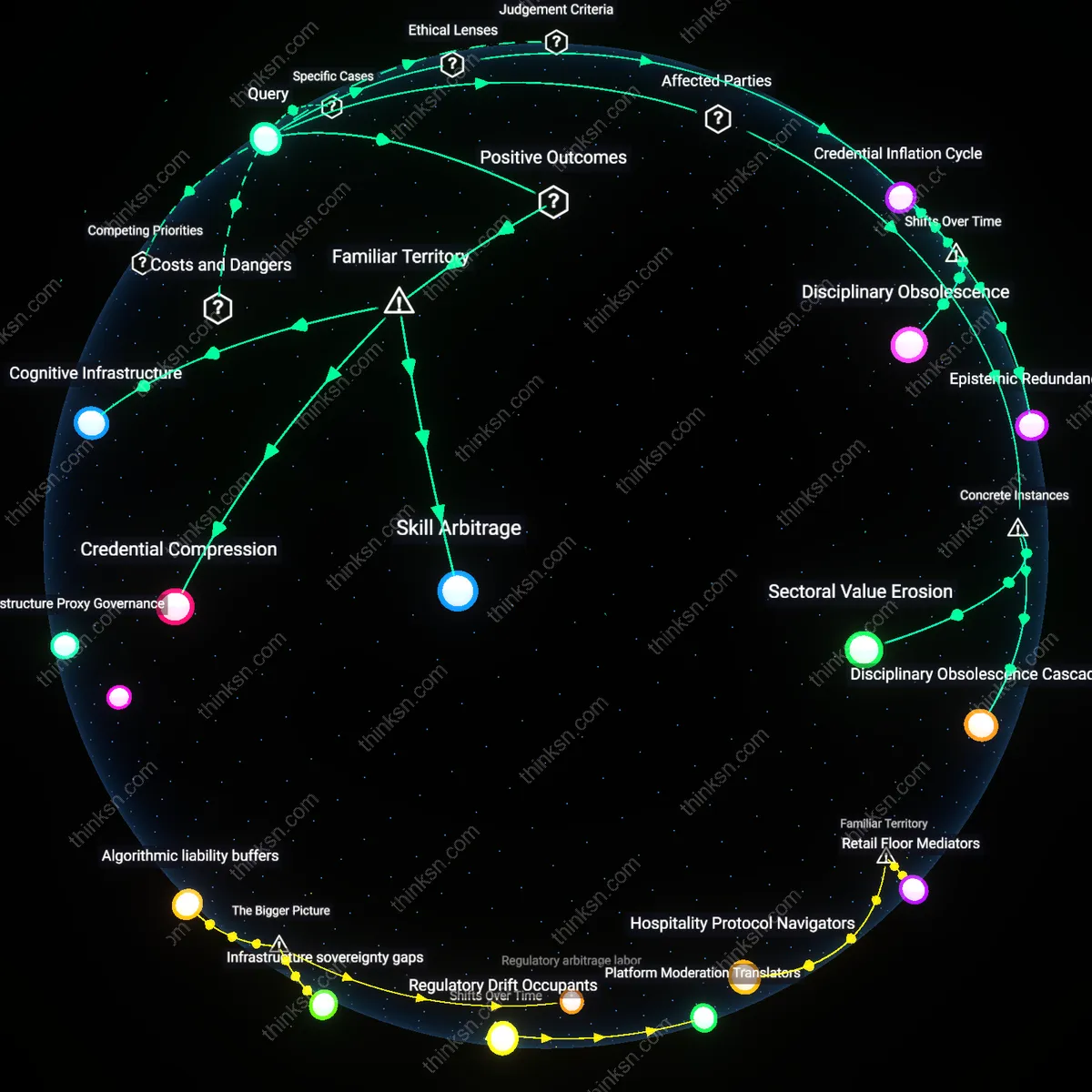
Skill Arbitrage
Labor markets rewarding interdisciplinary training enable workers to outperform single-discipline peers by deploying knowledge across domain boundaries. This occurs because individuals with overlapping expertise in fields like data science and public policy can enter high-leverage roles in tech-regulated sectors, where their hybrid fluency reduces coordination costs between legal, technical, and operational teams. The underappreciated reality within familiar narratives of ‘versatile skills’ is that such workers exploit structural inefficiencies—gaps where traditional ROI models assume discipline purity, not hybridity—thereby capturing value through strategic positioning rather than incremental productivity.
Credential Compression
Employers increasingly treat single-discipline graduate degrees as baseline filters rather than definitive indicators of specialized value, because real-world problem-solving in urban tech hubs or global health initiatives demands broader cognitive toolkits. This shift compresses the assumed ROI premium of traditional degrees—like a standalone MBA or PhD in literature—into narrower outcome bands, where candidates must demonstrate complementary competencies in communication, data reasoning, or systems thinking. The rarely acknowledged consequence is that the very notion of a ‘specialist’ is being institutionally recalibrated, not just augmented, rendering historical cost-benefit calculations functionally obsolete.
Cognitive Infrastructure
Interdisciplinary labor preferences elevate the social return on education by turning individual skill combinations into shared problem-solving frameworks within public and private institutions. Teams in climate resilience planning or AI ethics governance function more effectively when members integrate social science with technical training, creating reusable mental models that propagate across departments and agencies. While public discourse often frames interdisciplinary work as individual adaptability, the deeper, underrecognized outcome is the emergence of collective cognitive infrastructure—where human capital becomes a public good through shared interpretive lenses.
Disciplinary Obsolescence
Labor market preference for interdisciplinary competencies has eroded the economic premium once reliably conferred by single-discipline graduate degrees, particularly in humanities and specialized sciences, because post-2008 labor adjustments prioritized adaptive problem-solving over deep but narrow expertise, revealing a structural misalignment between university curriculum timelines and real-time industry reconfiguration. This shift reflects the internal logic of neoliberal human capital theory, where skills are treated as fungible assets subject to market depreciation, and the failure of degree programs to contract or pivot at the same rate as labor demand produces a lag effect that undermines return on investment calculations rooted in static labor projections. The non-obvious consequence is that degrees once considered safe investments—like PhDs in history or pure mathematics—are now subject to accelerated devaluation not due to diminished intellectual worth but because of their inability to signal cross-domain fluency in an era of systems-oriented hiring.
Credential Inflation Cycle
The growing expectation of interdisciplinary fluency has transformed graduate degrees from terminal qualifications into intermediate stepping stones, thereby extending the educational timeline and inflating the credential requirements for entry-level positions, a trend that intensified after the 1990s knowledge economy transition when firms began outsourcing skill customization to applicants rather than investing in on-the-job training. This dynamic, justified through meritocratic rhetoric embedded in liberal labor policy and reinforced by accreditation regimes, systematically disadvantages holders of single-discipline degrees who lack the portfolio diversity now informally mandated, exposing a tension between formal degree completion and the informal, evolving standards of employability. The underappreciated outcome is that return on investment assessments fail not because degrees are irrelevant, but because the benchmark for minimal competitiveness has shifted beyond disciplinary mastery into demonstrated synthetic capability—a standard not measured by traditional ROI models.
Epistemic Redundancy
Post-Cold War science funding realignments and the rise of global challenges discourse after the 1992 Earth Summit prioritized interdisciplinary research teams over individual disciplinary excellence, leading public and private research sponsors to allocate resources toward convergence science and away from monodisciplinary inquiry, thereby altering the career pathways for which single-discipline graduate training was once a direct pipeline. This institutional pivot, rationalized through utilitarian ethics that emphasize collective welfare outcomes of research, renders traditional ROI calculations obsolete because they assume linear career trajectories tied to disciplinary depth rather than nonlinear, project-based employability contingent on integrative skills. The overlooked effect is that the very epistemic value of deep specialization is now contextually dependent on its articulation to broader socio-technical problems, making isolated disciplinary expertise appear redundant even when technically sound.