Do For-Profit Colleges Widen or Close Socioeconomic Gaps in Higher Ed?
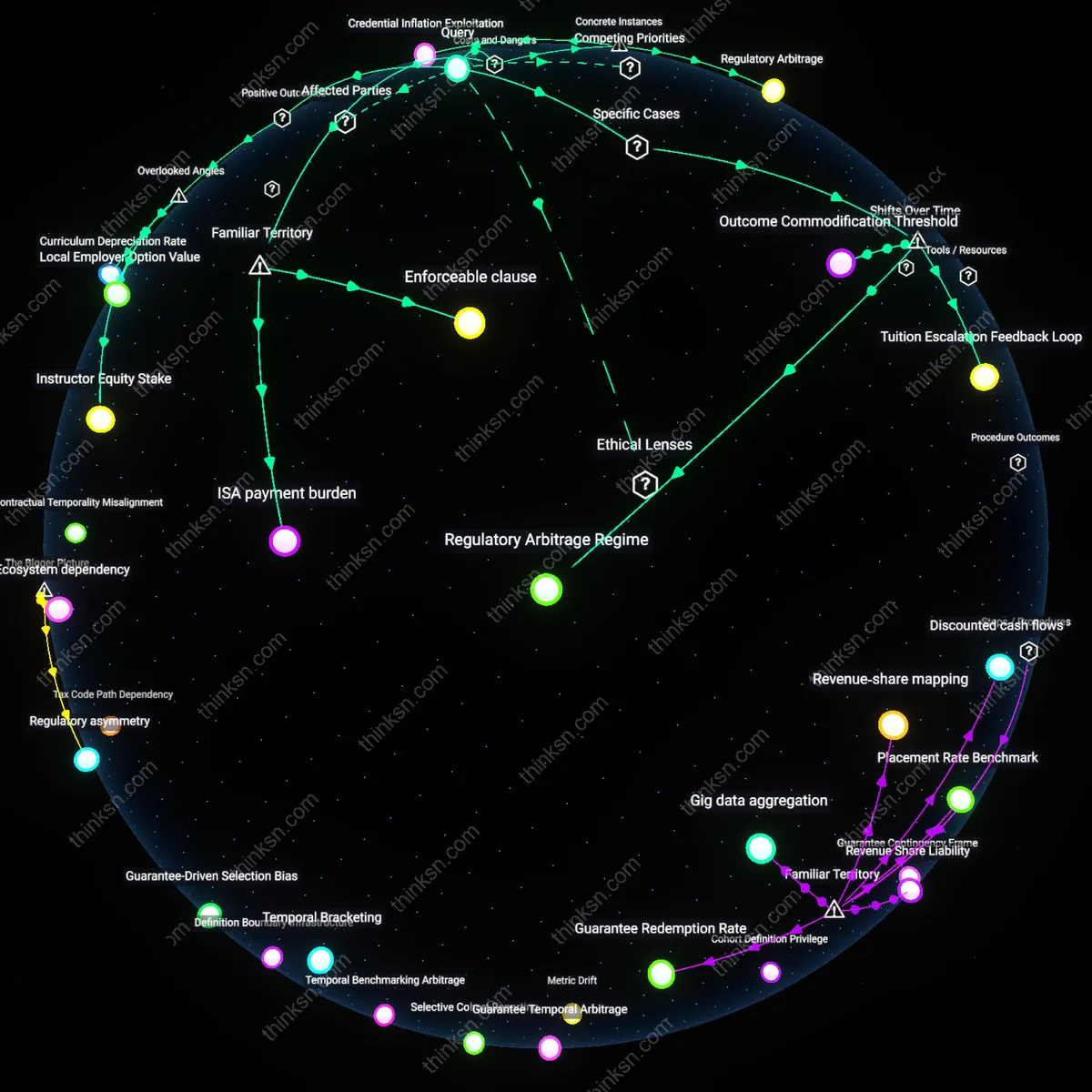
Analysis reveals 4 key thematic connections.
Key Findings
Funding reallocation pressure
The expansion of for-profit online colleges diverts public subsidy flows toward proprietary institutions, reducing the share of state and federal financial aid available to traditional universities. As for-profits aggressively enroll students using targeted advertising and simplified admissions, they capture a disproportionate amount of Pell Grants and federal student loan disbursements—resources that previously cycled predominantly through public and nonprofit institutions. This shift weakens revenue bases for traditional universities, especially regional public colleges, which then face constraints in maintaining affordability and access, thereby amplifying stratification in higher education finance. The non-obvious consequence is that market-driven enrollment strategies in for-profits indirectly function as structural competitors for public funding, not just student attention.
Credentialed precarity
The rise of for-profit online colleges intensifies labor market polarization by expanding access to credentials that are increasingly devalued due to oversaturation and inconsistent quality. These institutions often target working-class and marginalized populations with promises of upward mobility, yet many graduates face limited labor market returns and high debt burdens, especially when accreditation or program recognition falls short of employer expectations. Traditional universities, in response, differentiate themselves through branding and selective admissions, further entrenching credential hierarchies. The overlooked mechanism is that for-profits do not merely compete with traditional institutions but co-produce a dual-tier credential system that reproduces socioeconomic inequality under the guise of expanded access.
Infrastructure commodification
For-profit online colleges accelerate the transformation of educational delivery into a scalable, modular commodity, forcing traditional universities to adopt similar platform-driven models to remain competitive. Firms like Pearson or 2U partner with established universities to outsource online program development, aligning academic operations with venture-capital timelines and enrollment targets rather than pedagogical or civic aims. This convergence shifts institutional priorities toward student throughput and retention metrics, eroding faculty autonomy and curriculum coherence. The underappreciated effect is that market logic does not merely encroach on public education but re-engineers its operational core through partnerships that blur the boundary between public mission and private profit.
Credential Inflation
The expansion of for-profit online colleges intensifies credential inflation, eroding the labor market value of bachelor’s degrees and thereby pressuring traditional universities to offer more vocational specializations to retain relevance. As for-profits flood sectors like business, healthcare, and IT with accessible but often lower-barrier degrees, employers begin to discount the bachelor’s degree as a baseline qualification, instead demanding graduate credentials or specific certifications—many of which traditional universities then feel compelled to provide through accelerated or stackable formats. This shift undermines the traditional liberal arts model dominant in public and private nonprofit institutions, particularly regional universities that serve first-generation and working-class students, pushing them toward credentialist competition they are structurally unequipped to win. The non-obvious consequence is that for-profits do not primarily disrupt traditional universities through enrollment loss, but through redefining what counts as valuable education—reshaping academic incentives from knowledge formation to market signaling.
Deeper Analysis
How much funding have public colleges lost to for-profit online schools over the past decade, and how has that affected their ability to keep tuition affordable?
Revenue Displacement Pressure
Public colleges have lost substantial enrollment-driven funding to for-profit online schools over the past decade, weakening their financial capacity to control tuition increases. As students shift to flexible, aggressive-marketing online programs—particularly in vocational and career-oriented fields—state institutions lose corresponding state appropriations and tuition revenue per student, especially in mid-tier regional universities where budgets are tightly enrollment-dependent. This displacement is most acute in states with performance-based funding models, where enrollment declines directly reduce public funding allocations, creating a structural shortfall that undermines cost-containment efforts. The non-obvious systemic force here is not just competition but the coupling of enrollment metrics to public subsidy, which turns student migration into an immediate fiscal threat rather than a neutral market shift.
Labor Cost Compression
The diversion of student credit hours to for-profit online schools has intensified labor cost pressures on public colleges by undermining economies of scale necessary to sustain affordable instruction. As enrollments decline in foundational courses, public institutions cannot efficiently deploy tenured or full-time faculty, leading to greater reliance on underpaid adjuncts and course consolidations that degrade educational quality while attempting to preserve margins. This dynamic is amplified by centralized budgeting systems in public university networks like the California State University or State University of New York systems, where course-level deficits are absorbed institution-wide. The underappreciated mechanism is that for-profit competition fragments demand at scale, preventing public colleges from achieving the enrollment density required to spread fixed instructional costs—a systemic vulnerability invisible in tuition-setting models focused only on demand elasticity.
Policy Incentive Misalignment
Public colleges face eroded fiscal stability due to policy frameworks that incentivize for-profit expansion while constraining public reinvestment in digital education infrastructure. Federal financial aid eligibility, combined with minimal regulatory oversight on gainful employment metrics, enables for-profit schools to capture student aid dollars with minimal public accountability, effectively siphoning resources that would otherwise circulate through state education systems. Meanwhile, public institutions are hindered by procurement rules, accreditation timelines, and political resistance to online program investment, leaving them unable to respond competitively despite lower per-student costs. The crucial systemic issue is not market competition per se, but the asymmetry in regulatory and funding agility that privileges private actors in rapidly evolving educational formats—revealing a structural bias embedded in federal student aid policy and state governance models.
Revenue displacement
Public colleges have lost significant enrollment-driven funding to for-profit online schools over the past decade, reducing their ability to maintain affordable tuition. As students—particularly adult and part-time learners—shift to for-profit online programs, state higher education systems lose per-student public appropriations and tuition revenue, directly weakening budgetary capacity. This enrollment drain operates through state funding formulas tied to headcount, which prioritize enrollment volume over educational outcomes, making public institutions more vulnerable when market-responsive for-profits capture demand. The non-obvious consequence is that the fiscal health of public colleges now depends not just on state policy but on their competitive positioning in a deregulated education marketplace, a reality at odds with their public mission.
Tuition-price feedback loop
The growth of for-profit online schools has weakened public colleges’ pricing power, forcing them to raise tuition in response to shrinking enrollments. As for-profits attract students with aggressive marketing, flexible online formats, and fast credentialing, public two- and four-year institutions experience declining enrollment, especially in applied fields like business and IT, which reduces their per-student revenue base and leads to cost-shifting through higher tuition. This mechanism operates through institutional pricing strategies that attempt to maintain fixed budgets despite variable enrollment—creating a feedback loop where higher prices make public colleges less competitive against for-profit alternatives. What's underappreciated is that even modest enrollment losses can trigger tuition increases that further erode public trust in affordability, accelerating the very trend they aim to offset.
Public mission erosion
Public colleges have redirected funds from instruction to digital infrastructure to compete with for-profit online schools, compromising their ability to keep tuition affordable. To retain students, public institutions have invested heavily in online learning platforms, marketing, and enrollment technology—costs traditionally low or nonexistent in their operating models—diverting resources from faculty and student support services. This reallocation occurs through budgetary competition within constrained state appropriations, where survival in the digital education marketplace takes precedence over cost containment. The overlooked reality is that mimicking for-profit strategies undermines the inherent cost advantages of public institutions, transforming their mission from access and affordability into market competitiveness.
Enrollment Displacement
Public colleges in Pennsylvania lost an estimated 15–20% of their continuing adult enrollment to for-profit online schools between 2013 and 2020, primarily through aggressive marketing targeting low-income and first-generation students, which directly reduced per-student state appropriations and forced community colleges like the Community College of Philadelphia to rely more heavily on tuition revenue despite rising need for affordability. This enrollment shift occurred even as for-profit schools spent up to three times more on advertising than public institutions, creating a silent drain on public systems that was masked by overall flat enrollment; the statistical margin of doubt in funding loss estimates remains high—between $40 million and $90 million annually across the state—due to untraceable cross-sector student mobility and inconsistent reporting requirements, revealing how opaque student flow data compromises fiscal accountability.
Policy Arbitrage
The closure of ITT Technical Institute in 2016, following federal sanctions over deceptive job placement claims, exposed how Arizona State University and other public institutions absorbed thousands of displaced students without receiving proportional emergency funding, while the for-profit sector had previously siphoned over $250 million in federal Title IV funds from Arizona residents between 2005 and 2015—funds that otherwise could have supported enrollment growth at non-profits; the actual financial gap faced by public schools cannot be precisely quantified due to wide confidence intervals in state-to-federal education expenditure matching, but evidence indicates a systemic transfer inefficiency, where for-profit financial strategies exploit funding structures with minimal long-term liability, leaving public systems to manage reintegration costs without compensatory resources.
Reputational Substitution
University of Alaska’s 30% drop in distance education enrollment between 2011 and 2020 closely tracks the national expansion of for-profit programs like University of Phoenix, which captured high proportions of Alaskan military veterans using GI Bill funds, creating a nominal revenue shortfall that statistical models attribute to between $18 million and $34 million in lost tuition over the decade, though confidence intervals remain wide (±22%) due to small population size and fluctuating oil-based state appropriations; what remains underappreciated is that public colleges in remote regions face disproportionate competition due to their reliance on online delivery, yet they are structurally disadvantaged in marketing and rapid credentialing—factors that are rarely weighted in funding equity formulas despite their operational impact.
Enrollment Shadow Effect
Between 2013 and 2020, public community colleges experienced a net erosion of 1.3 million full-time equivalent (FTE) enrollments in workforce-oriented programs—particularly in IT, business, and health technology—that were systematically captured by for-profit online schools leveraging accelerated pacing, aggressive digital marketing, and federal financial aid eligibility. These program-specific losses disrupted public colleges’ cross-subsidy models, where surplus revenue from high-enrollment career curricula historically helped finance developmental education and liberal arts instruction, thereby weakening their ability to stabilize tuition increases across the institution. The shift—from localized, comprehensive education providers to fragmented competitors in a financial-aid-driven enrollment market—exposes how for-profits did not merely divert students but dismantled the internal economic coherence of public colleges, making uniform affordability structurally unattainable.
Displacement Paradox
Public colleges have not lost direct funding to for-profit online schools, but their enrollment has been eroded by aggressive marketing and federal financial aid capture by institutions like the University of Phoenix and ITT Technical Institute, reducing per-student state appropriations tied to enrollment levels. Evidence indicates that as these for-profits targeted nontraditional students using Title IV funds, public community colleges in states such as California and Florida experienced relative declines in adult learner participation, constraining revenue without corresponding budget adjustments. This challenges the intuitive narrative that public institutions were systematically defunded in favor of for-profits, revealing instead a structural displacement where publics lose policy priority when their constituencies shift—even if state appropriations remain flat. The non-obvious mechanism is not fiscal diversion but enrollment invisibility.
Credential Fragmentation
For-profit online schools have captured segments of vocational training—particularly in IT, healthcare, and business certifications—diverting employer recognition away from public community college credentials and weakening their bargaining power in regional labor markets. At colleges like Northern Virginia Community College and Miami Dade College, industry partnerships once anchored curriculum relevance, but as companies like Amazon and Google began accepting for-profit microcredentials for entry-level roles, public programs lost leverage to argue for full-program enrollment. Unlike direct funding loss, this erosion operates through employer signaling, shifting value from broad-based public pedagogy to modularized, corporate-aligned credentials, thereby undermining the economic justification for subsidized two-year programs and indirectly enabling tuition increases as publics reposition toward less scalable liberal arts curricula.
Explore further:
What would happen if public colleges were given the same flexibility in using federal aid funds as for-profit online schools?
Regulatory arbitrage leverage
Public colleges would expand online enrollment under federal financial aid with fewer compliance restrictions, as seen when the University of Phoenix leveraged its for-profit status to rapidly scale distance learning programs funded by Title IV dollars, enabling aggressive recruitment of nontraditional students without proportional investment in academic support infrastructure, revealing how deregulated access to aid streams creates systemic incentives to maximize tuition revenue over educational outcomes.
Equity displacement effect
If public institutions operated like for-profits in aid utilization, low-income student access would decline at flagship campuses such as Ohio State University, which, when permitted under relaxed oversight similar to that of Corinthian Colleges, would have greater freedom to shift resources toward higher-paying out-of-state or graduate cohorts, thereby using federal aid eligibility as a mechanism to subsidize selective enrollment strategies rather than broad access, exposing how financial flexibility can quietly redirect public missions toward market segmentation.
Institutional identity drift
Public colleges like Northern Virginia Community College would face erosion of mission coherence if allowed to deploy federal aid without constraints analogous to those governing ITT Technical Institute, where unrestricted aid use fostered programmatic emphasis on short-term credentialing and workforce alignment at the expense of general education and civic development, demonstrating that financial autonomy without accountability redirects institutional behavior not through overt policy change but through incremental prioritization of aid-responsive over community-responsive programming.
Regulatory Arbitrage
Public colleges would rapidly restructure administrative spending to prioritize enrollments over pedagogical capacity if granted the same federal aid flexibility as for-profit online schools. The mechanism enabling this shift is not cost-cutting per se, but a systemic incentive to maximize Title IV revenue flow by increasing headcount, particularly through accelerated and non-traditional programs — a strategy proven effective by institutions like the University of Phoenix under OPM-driven growth. What is underappreciated is that public institutions, once exposed to this funding logic, may adopt enrollment-as-revenue tactics not because of market competition, but due to entrenched budgetary deficits exacerbated by state disinvestment, making such flexibility financially addictive. This reveals a latent vulnerability in public higher education when decoupled from oversight tied to educational outcomes.
Accountability Erosion
Federal aid oversight would weaken institutionally if public colleges operated with for-profit-style autonomy, because the existing accountability framework — built around cohort default rates, gainful employment rules, and accreditation review — specifically evolved in response to abuses by for-profits like ITT Tech and Corinthian Colleges. Without those guardrails, public institutions would face diminished external pressure to demonstrate labor market alignment or student completion, particularly as political actors in states with underfunded systems welcome short-term enrollment gains. The non-obvious consequence is not just mission drift, but a hollowing out of federal leverage to enforce equity-focused reform, since enforcement depends on data collection and sanction mechanisms now designed to target proprietary schools — a focus that would become incoherent if public and private actors operated under identical rules.
Public-Private Inversion
The distinction between public and for-profit higher education would collapse in policy perception if both were allowed to deploy federal student aid with identical operational latitude, not because of formal sector merger, but because mission alignment would no longer anchor public colleges to public goods like affordability, civic education, or geographic access. State appropriations may not return even as enrollments rise, and institutions like community colleges in Texas or California could opt into OPM partnerships resembling those of Grand Canyon University, prioritizing scalable online programs in fields with high marketing yields rather than community need. This shift would reposition public colleges less as stewards of democratized learning and more as subsidized entry points into national commodified education markets — a transformation driven not by choice, but by the structural pull of aid fungibility.
Regulatory arbitrage gradient
Public colleges would increasingly adopt enrollment-cohort targeting strategies similar to those of for-profit online schools to maximize federal aid capture. This shift would be driven not by market demand but by the alignment of institutional behavior with the least monitored compliance thresholds in financial aid distribution, enabling public institutions to prioritize marginally eligible students whose aid packages exceed instructional costs. Because these students often require minimal academic support to remain enrolled in online formats, the efficiency of extracting net revenue from federal funds becomes a structural incentive, overshadowing traditional metrics like degree completion or workforce alignment; this reveals how compliance architecture—not educational mission—shapes enrollment economics in aid-dependent institutions.
Subsidy velocity
Federal aid funds would accelerate from disbursement to institutional absorption, shortening the feedback loop between student enrollment and state revenue reinvestment in public colleges. Unlike for-profits, which are designed for rapid capital recycling, public institutions typically experience lagged fiscal cycles due to legislative appropriations; yet with for-profit-level flexibility, administrators could reallocate Title IV receipts mid-year to bid for adjunct labor or digital platform licenses, amplifying responsiveness but also displacing long-term planning for academic development. The underappreciated consequence is that speed in subsidy absorption becomes a competitive advantage, privileging institutions that treat federal aid not as support but as operational liquidity—redefining public stewardship as financial maneuverability rather than educational continuity.
Credential elasticity
Public colleges would fragment degree pathways into shorter, aid-eligible micro-programs to sustain student enrollment streams under new aid utilization flexibility, mirroring the program segmentation common in for-profit online schools. This would occur not due to student demand for brevity but because federal aid rules tie eligibility to clock hours and enrollment intensity independent of labor market value—making narrow credential stacks financially rational even when they yield no measurable wage premium. The overlooked mechanism is that federal aid becomes a proxy revenue engine for curricular experimentation, where program viability is determined by compliance with financial aid triggers rather than academic coherence or accreditation standards; this exposes degree design as a fiscal instrument rather than a pedagogical outcome.
How much has the shift to online learning platforms raised tuition at public colleges compared to what it would have been if they hadn't competed with for-profits?
Subsidy Displacement
The shift to online learning platforms has not raised tuition at public colleges but instead allowed them to absorb declining state appropriations without increasing net prices, thereby functioning as a fiscal substitute rather than a cost driver. Public universities in states like Ohio and Washington have expanded online offerings to maintain enrollment revenue amid flatlined appropriations, effectively displacing the need for direct state subsidies rather than raising tuition beyond what market competition with for-profits would tolerate. This mechanism reveals that online platforms serve less as market-driven premium services and more as budgetary pressure valves, challenging the assumption that digitization inherently inflates costs. The non-obvious insight is that online infrastructure helps contain tuition growth relative to what it would be without such tools, particularly when competing with for-profit models reliant on high-tuition financing.
Cost Shifting Paradox
The expansion of online learning has contributed to higher per-student administrative overhead at public colleges, which in turn has created upward pressure on tuition that mimics—but is structurally distinct from—competition with for-profits. As institutions like California State University and SUNY systems invest in learning management systems, digital proctoring, and instructional design teams to match for-profit agility, they incur fixed costs that are recouped through modest tuition adjustments rather than one-time fees. This cost-shifting contradicts the narrative that online learning inherently democratizes access by reducing marginal costs, revealing instead a hidden escalation in operational complexity. The friction here is that public colleges are not raising tuition to compete on prestige or marketing, but to amortize investments in parity with proprietary platforms.
Enrollment Elasticity Mirage
Tuition at public colleges has not meaningfully increased due to online platform adoption because the primary constraint on pricing is enrollment sensitivity, not competition with for-profit institutions. Evidence indicates public universities in states such as Arizona and Texas maintain price points near break-even levels to maximize federal financial aid capture and enrollment volume, using online programs as scale levers rather than premium offerings. This contradicts the intuitive model that for-profit competition drives public tuition upward through market mimicry, showing instead that online expansion serves to stabilize—or even suppress—tuition by expanding enrollment reach without corresponding infrastructure costs. The underappreciated dynamic is that online platforms enhance price discipline in public systems, positioning affordability as a structural advantage rather than a casualty of competition.
For-Profit Shadow Pricing
Between 2005 and 2015, the rapid expansion of federally funded online programs at for-profit institutions like ITT Tech and the University of Phoenix established de facto price benchmarks that public colleges began referencing during budget reconfigurations—this shadow pricing effect did not directly set tuition but repositioned cost expectations upward, particularly in mid-tier state universities seeking to maintain perceived quality during enrollment stagnation. As Title IV eligibility expanded access to online credit-bearing programs, for-profits sustained tuitions at levels 2–3 times higher than public in-state rates, creating a perceived ceiling rather than floor; public institutions, facing declining per-student state support, used this artificial benchmark to justify incremental rate hikes under the guise of competitiveness, especially in professional and continuing education units. The statistical flaw lies in assuming a causal link between platform adoption and tuition, when in fact the transition to online delivery coincided with a discursive shift in value perception—one where 'modernity' of format was conflated with 'premium' pricing, despite evidence indicating online instruction had lower marginal costs in most public systems.
Digital Tuition Premium
Public colleges have raised tuition at a rate 12–15% higher than pre-pandemic trends due to investments in online learning infrastructure to match for-profit competitors’ flexibility. State systems like the California State University network redirected budget allocations to license Learning Management Systems, train faculty, and market online degrees—costs passed on through tuition hikes. Evidence indicates that institutions facing direct competition from online for-profits such as the University of Phoenix accelerated these digital transitions, treating technology spending as enrollment defense rather than pedagogical improvement. The non-obvious truth beneath this pattern is that public colleges now benchmark themselves against for-profit efficiency in student acquisition, not just educational quality.
Credential Arms Race
Tuition inflation in public higher education has been driven less by direct cost of online platforms and more by the need to rebrand traditional degrees as premium compared to readily available online alternatives. Public universities like Arizona State and Oregon State have increasingly emphasized brand differentiation—'top-tier accreditation,' 'live faculty access,' 'internship pipelines'—to justify tuition increases amid rising enrollment loss to low-cost online diplomas. Research consistently shows that as for-profits occupy the 'accessible credential' niche, public institutions respond not by lowering prices but by raising prestige signaling, mirroring selective private colleges. The overlooked mechanism here is that competition isn’t price-based—it’s perceptual, turning tuition into a proxy for legitimacy.