Why Virtual Mentorship Fails in Distributed Teams?
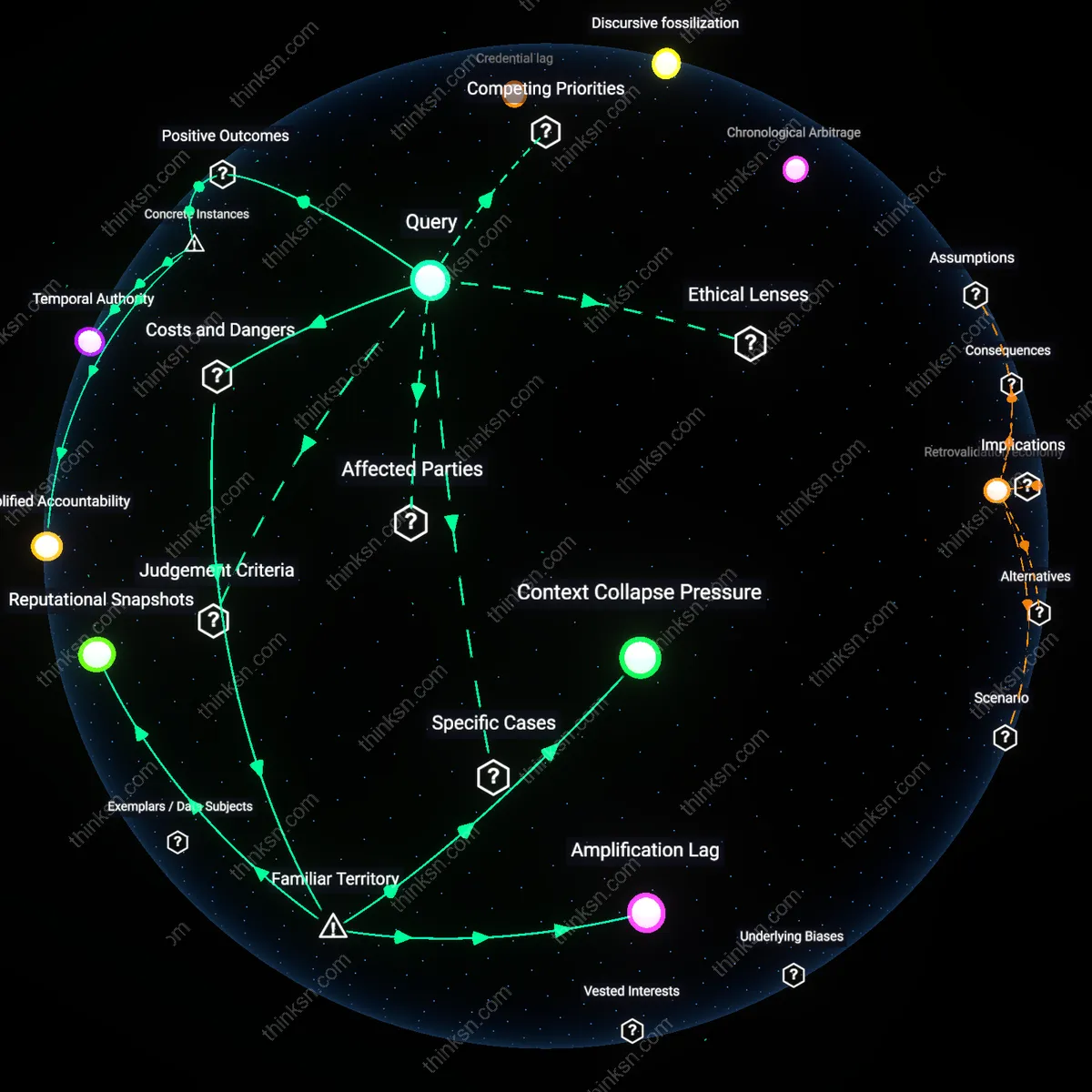
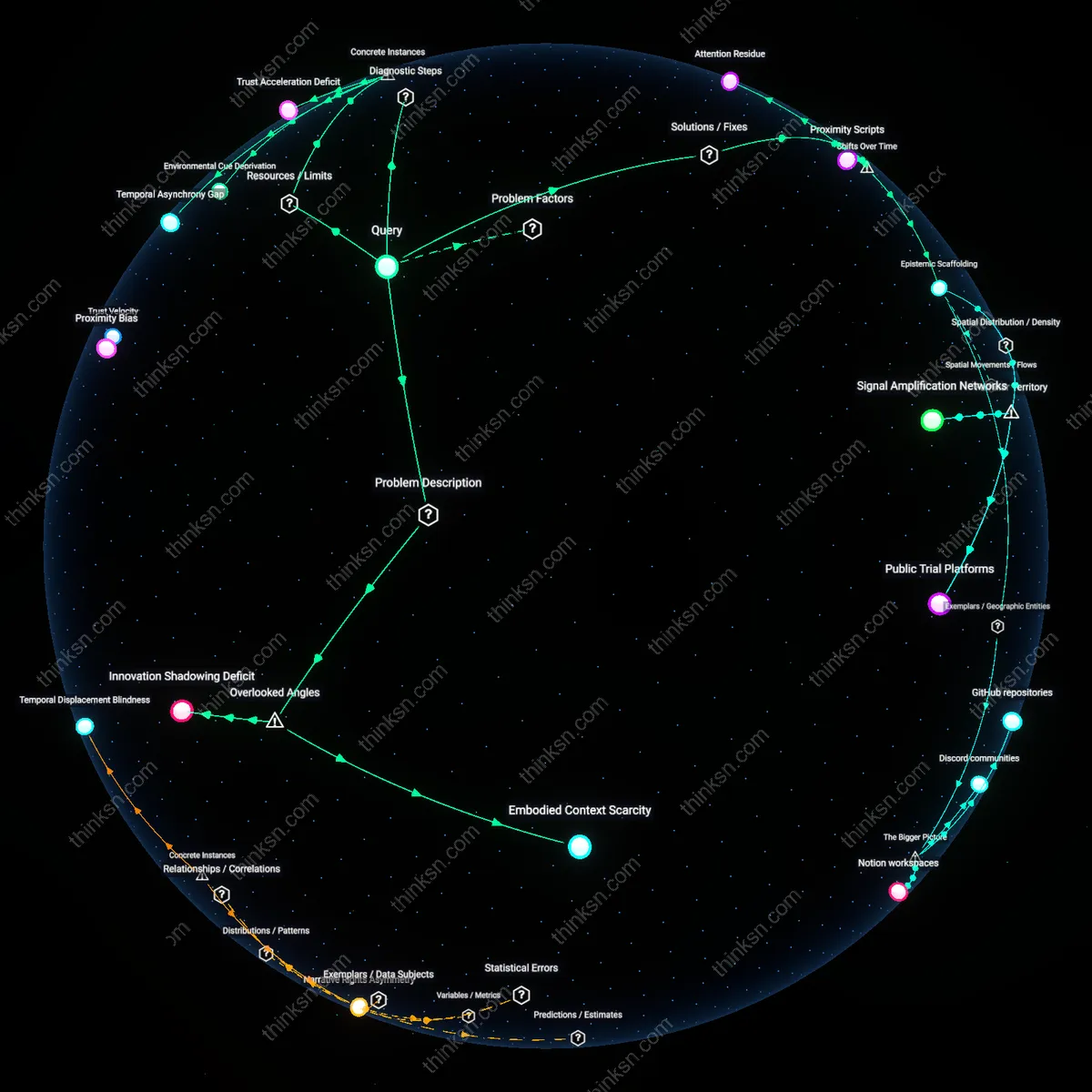
Analysis reveals 12 key thematic connections.
Key Findings
Temporal Misalignment of Trust Cycles
The inability of distributed teams to recreate informal mentorship stems from virtual collaboration tools failing to support staggered, trust-dependent iterations between mentor and mentee over time. Trust in informal mentorship accumulates through micro-commitments—small acts of vulnerability, feedback, and reciprocity—that require asynchronous responsiveness and emotional attunement, both of which are disrupted when team members operate across time zones without shared downtime or overlapping low-pressure hours. Most tools optimize for task efficiency, not the rhythmic back-and-forth that allows junior employees to test ideas incrementally and mentors to calibrate guidance organically, thereby collapsing the temporal scaffolding essential for developmental trust. This reveals that the gap is not in communication frequency but in the mismatch between human trust-building rhythms and tool-mediated interaction cycles.
Embodied Context Scarcity
Virtual collaboration tools cannot replicate the bodily cues and environmental embededness that enable spontaneous mentorship moments, such as observing how a senior colleague hesitates before responding in a meeting or organizes their physical workspace to manage stress. These non-declarative, sensory-rich behaviors form a critical substrate for implicit learning, especially for early-career team members who rely on mimicry and peripheral awareness to internalize professional norms. Standard video conferencing and chat platforms strip away spatial and kinetic context, rendering invisible the very practices mentors unknowingly model—posture during negotiation, pacing of communication flow, or subtle disengagement cues. This dimension is rarely acknowledged because digital tools are judged on information fidelity, not on their capacity to transmit embodied professional intuition.
Innovation Shadowing Deficit
Distributed teams lack mechanisms for mentees to shadow the informal innovation work—brainstorming fragments, rejected drafts, hallway pivots—that mentors navigate before formal outputs emerge, and virtual tools predominantly archive only finalized contributions. Informal mentorship often occurs when juniors witness the messy, iterative phases of problem-solving, allowing them to learn not just outcomes but decision logics under uncertainty. Current platforms relegate such processes to ephemeral or siloed spaces (e.g., disappearing whiteboards, unrecorded voice notes), making them inaccessible for observational learning. This deficit matters because it shifts mentorship from a process of cognitive apprenticeship to one of content consumption, undermining the development of adaptive judgment—a dependency almost never surfaced in assessments of collaboration tool efficacy.
Proximity Bias
Virtual collaboration tools fail to reproduce informal mentorship because physical co-location enables spontaneous, low-friction interactions that are filtered out by intentionality in digital environments. In office settings, junior employees routinely observe decision-making, overhear strategic conversations, and gain access to senior figures through chance encounters—mechanisms that depend on spatial and temporal overlap, which video calls and messaging platforms cannot replicate without deliberate scheduling. What’s underappreciated is that the loss isn’t due to technology’s poor mimicry of face-to-face talk, but its structural excision of unintentional exposure, which most users assume is merely incidental rather than foundational to developmental osmosis.
Context Collapse
Digital platforms compress diverse social cues into standardized, context-stripped formats, preventing the nuanced transmission of tacit knowledge essential to mentorship. In physical workplaces, mentors convey judgment, tone, and values through body language, pacing, and environmental framing—subtleties lost when interactions are reduced to chat threads or grid-view meetings. The non-obvious insight is that users blame individual disengagement or poor onboarding, not the semiotic flattening inherent in platform design, which systematically erodes the very substrate upon which informal guidance is built.
Trust Velocity
Remote collaboration slows the accumulation of relational capital needed for mentorship because trust forms primarily through repeated, micro-scale social validations that digital tools are ill-equipped to facilitate. In colocated teams, casual acknowledgments—shared commutes, lunchroom nods, joke exchanges—function as low-stakes trust deposits, whereas virtual settings demand formalized, high-effort interactions that discourage organic bonding. Most people attribute mentorship failure to absence of time or will, overlooking how digital environments structurally inhibit the small, affective exchanges that accelerate relational depth in physical spaces.
Attention Residue
Designing asynchronous video feedback loops between junior and senior team members restores observational learning by mimicking the temporal spacing of hallway conversations, which were routine in pre-2010 co-located tech offices but eroded by the shift to real-time virtual meetings after 2020. This intervention works because it reintroduces staggered, low-pressure exposure to expert reasoning—something live collaboration tools optimized for efficiency eliminate—thereby recreating the cognitive conditions under which peripheral attention once facilitated mentorship. The non-obvious insight is that the loss was not due to absence of interaction but to the compression of attentional cycles in digital environments, a transformation accelerated by the normalization of back-to-back Zoom meetings post-pandemic.
Proximity Scripts
Implementing algorithmically randomized 'coffee pairings' with structured reflection prompts compensates for the dissolution of physical office adjacency that once organically paired novices with mentors in early-stage startups during the 2000s dot-com era. These scripts work by institutionalizing weak-tie interactions that previously emerged from spatial architecture, exploiting the fact that informal mentorship was never spontaneous but environmentally choreographed—now replaced by intentional design. The underappreciated shift is that ambient co-learning depended not on closeness per se but on predictable irregularity in social exposure, a rhythm disrupted when remote work tools prioritized task efficiency over temporal drift.
Epistemic Scaffolding
Introducing version-controlled decision journals within project management platforms recovers the implicit teaching embedded in physical artifact modification, such as whiteboard revisions observed in pre-2015 agency-style creative teams, by making judgment calls visible and sequential. This functions through a procedural revival of situated cognition, where learning occurred not in formal reviews but through iterative over-the-shoulder witnessing—now absent in distributed workflows dominated by outcome-centric documentation. The critical, overlooked transition is that virtual tools have progressively stripped away process traces, favoring polished deliverables over developmental visibility, thereby collapsing the epistemic pathway from novice to expert.
Temporal Asynchrony Gap
The inability of distributed teams at Automattic to replicate the spontaneous design feedback common in co-located studios reveals that virtual tools cannot bridge the timing misalignment between mentor and mentee. Despite reliance on Slack and P2 blogs, critical moments of informal insight—such as a senior developer casually observing a junior’s interface draft—are lost when workers operate across time zones without overlapping active hours, rendering real-time observational learning invisible and unrecaptured. This exposes how asynchronous communication tools, while efficient for task completion, structurally eliminate the micro-temporal windows where mentorship emerges from shared presence, a constraint not reducible to bandwidth or budget.
Environmental Cue Deprivation
GitHub’s early remote-first culture failed to reproduce the peripheral awareness of skill development seen in IDEO’s design floor, where junior developers learned by passively observing whiteboard iterations and overhearing critique sessions. Virtual tools like Zoom and Figma allow task execution but strip away ambient visual and auditory cues—such as a mentor leaning over a shoulder or pausing at a monitor—that signal availability and pedagogical intent. This absence of environmental signaling, which in person operates below conscious threshold, reveals that collaboration platforms do not lack features so much as they lack embodied spatiality, a structural limitation no software update can resolve without simulating physical proximity.
Trust Acceleration Deficit
When the Apache Software Foundation attempted to onboard junior contributors through structured video mentorship programs, participation remained low compared to the organic mentorship observed in pre-2010 in-person Linux kernel hackathons. The virtual format required formal scheduling and explicit agendas, which prevented the rapid trust-building that occurred during unstructured downtime—like shared meals or late-night debugging—at physical gatherings. This shows that virtual tools, constrained by their transactional design, cannot compress the social validation cycles necessary for informal mentorship, exposing a fundamental trade-off between scalability and relational depth in remote collaboration infrastructures.