When Standardizing Hybrid Schedules Backfires on Job Equity?
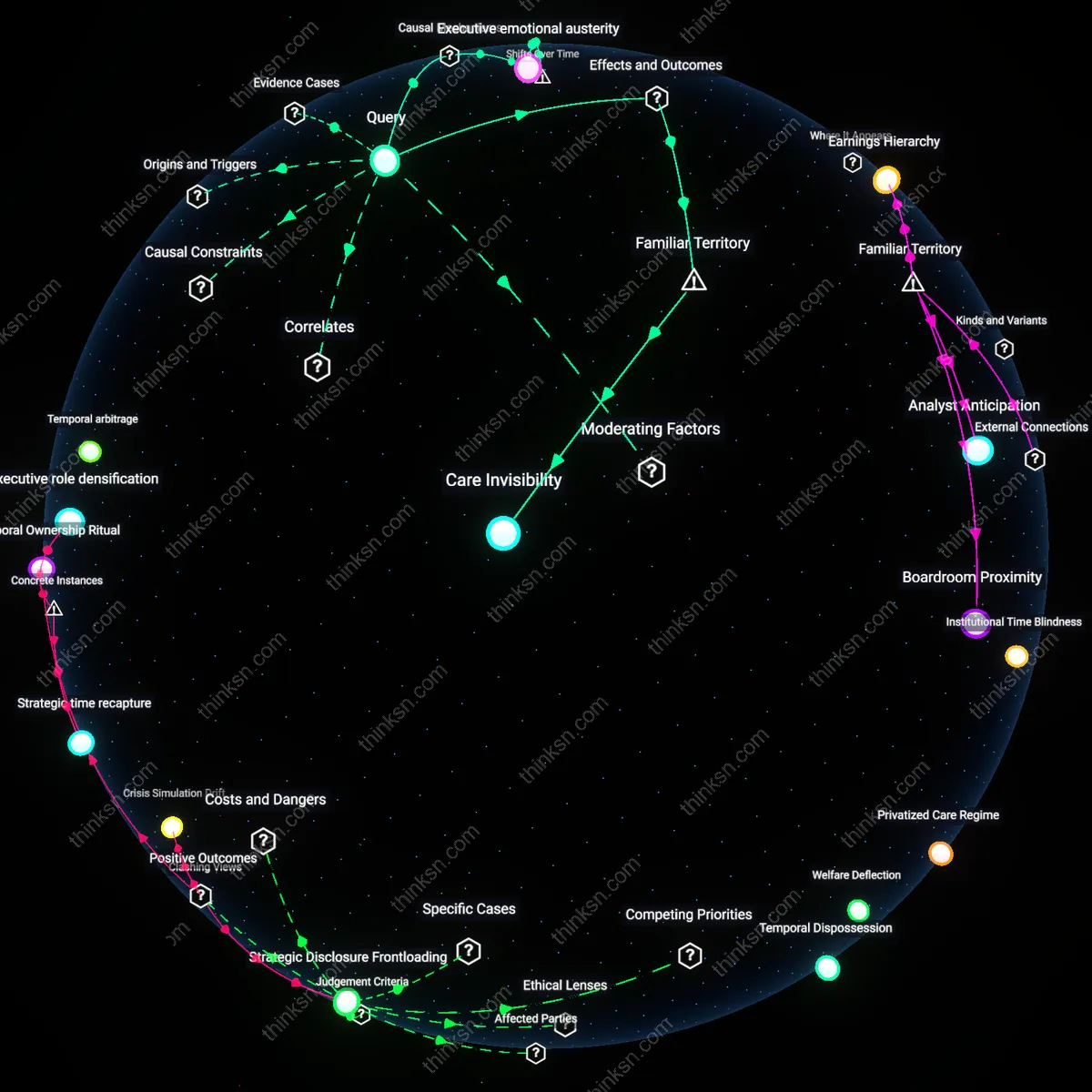
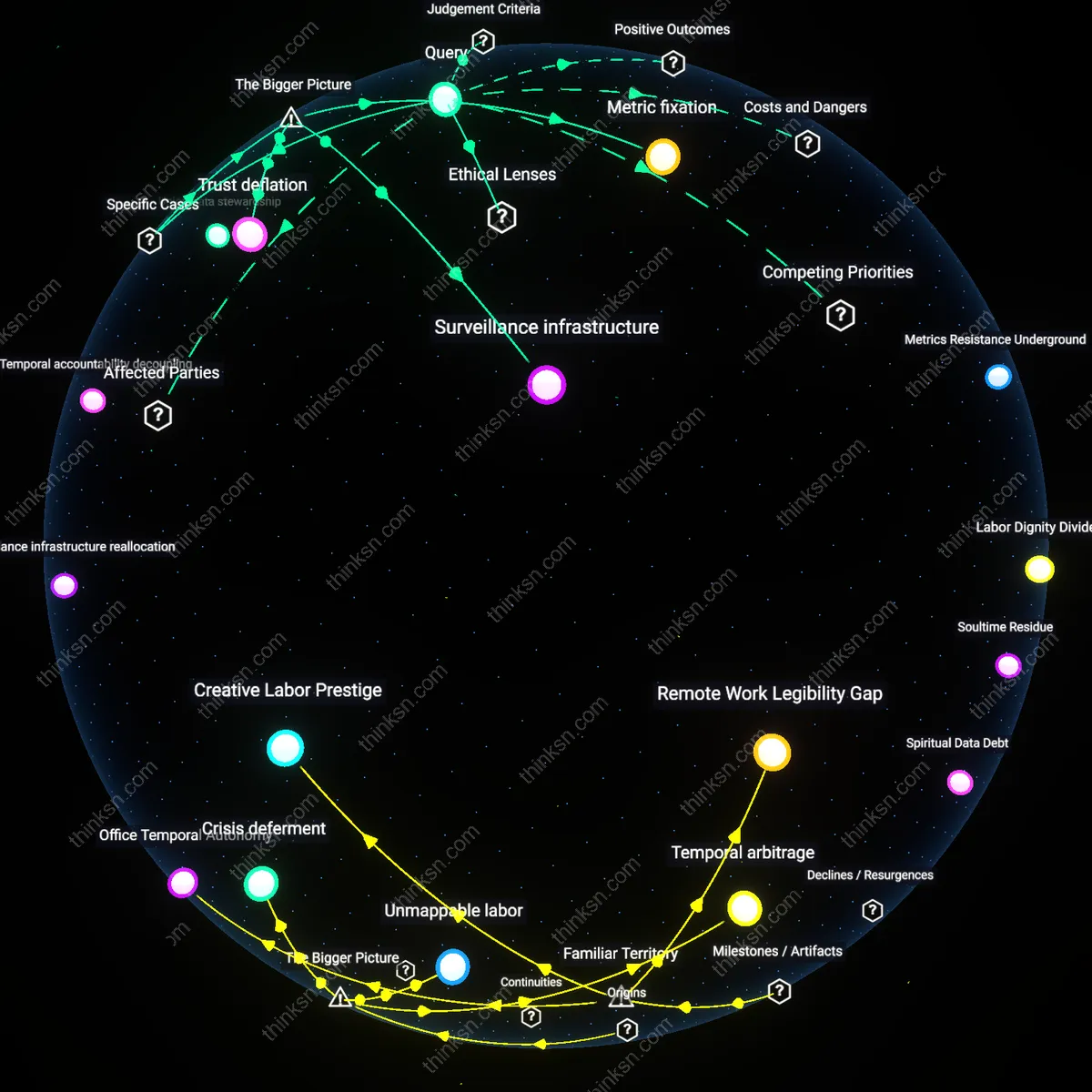
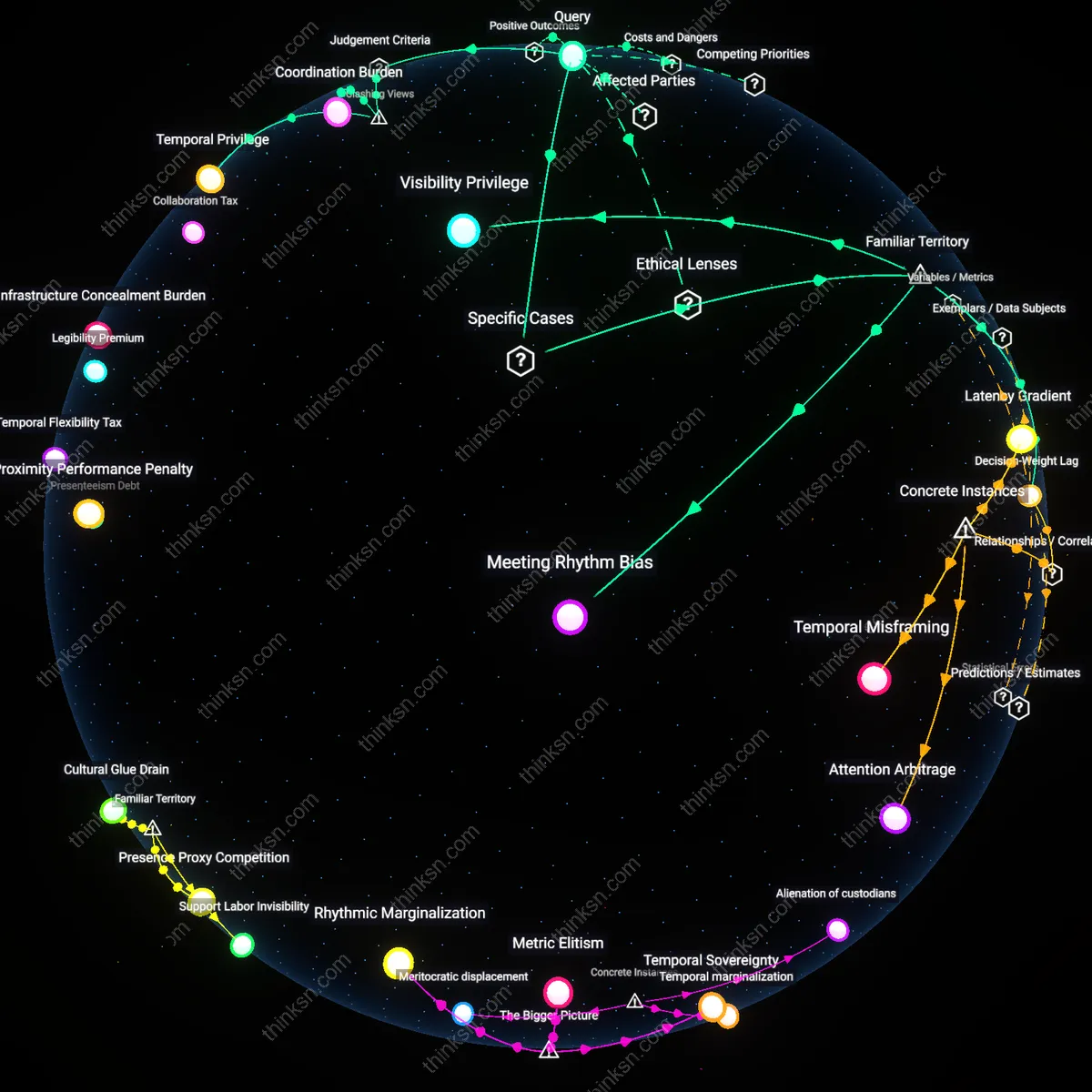
Analysis reveals 6 key thematic connections.
Key Findings
Temporal Privilege
Standardizing hybrid work schedules favors roles with predictable task cycles, such as software engineering, because corporate templates assume uniformity in peak activity timing, disadvantaging emergency-response roles like IT support or nursing staff whose work surges are stochastic and urgent; this creates temporal privilege, where access to flexibility depends not on contribution but on alignment with calendar-driven rhythms, exposing how scheduling norms encode a hidden bias toward cognitive labor over responsive labor.
Visibility Tax
Mandating synchronized office days rewards roles whose value is easily observed during co-location, such as sales or executive teams, while penalizing backend infrastructure or data analysis roles whose output accumulates invisibly over time; the resulting visibility tax distorts performance assessment by conflating physical presence with productivity, revealing that hybrid standards often serve ceremonial management rituals more than operational effectiveness.
Coordination Burden
When companies enforce uniform hybrid patterns, they shift coordination costs onto roles that interface across time zones or operational shifts, such as customer success or global supply chain managers, whose adaptive scheduling previously minimized downtime; now required to conform, they absorb the coordination burden, demonstrating that standardization optimizes for managerial convenience rather than frontline functional fit, and thereby privileges central over peripheral actors in organizational ecosystems.
Meeting Rhythm Bias
Standardizing hybrid work schedules around fixed meeting times favors managerial roles who set the agenda over frontline staff who must adapt. At companies like Google and Amazon, leadership calendars dominate weekly rhythms, making midweek video conferences the default coordination mechanism—this structuring privileges roles with discretionary time while disadvantaging warehouse or customer service teams operating on shift-based timelines. The non-obvious insight is that the rhythm of meetings, not just their content, becomes a gatekeeper to influence, even when participation is technically equal.
Visibility Privilege
Hybrid work standards that equate presence with performance inherently favor roles that are office-visible, such as marketing or sales at firms like Salesforce, over remote-intensive roles like back-end engineering or technical support. Since performance evaluations still rely on observable engagement—shaped by decades of in-person norms—those in less visible positions are systematically under-recognized despite equal output. The overlooked truth here is that familiarity with office culture persists as an evaluation proxy, even when productivity metrics could override it.
Decision-Weight Lag
In standardized hybrid models at organizations like McKinsey, decision cycles slow for roles outside core strategy or consulting who contribute asynchronously, such as research analysts or HR specialists, because final approvals wait on in-office leadership convenings. Even when remote input is gathered, synchronization bias delays integration, embedding a temporal hierarchy where proximity determines influence velocity. What’s rarely acknowledged is that calendar alignment doesn’t just affect convenience—it reshapes whose input shapes outcomes.
Deeper Analysis
What would happen if performance reviews were based only on documented outputs, not office attendance?
Temporal Decoupling
When performance is unmoored from office attendance, work becomes decoupled from institutional time, allowing employees in regions like Bangalore or Buenos Aires to contribute on asynchronous rhythms without penalty. This transition crystallized in the 2010s as global software teams adopted agile workflows that prioritized sprint completions over clock-ins, shifting evaluation from synchrony to outcome alignment. The dynamic operates through distributed version control and milestone-based funding in open-source and decentralized organizations, where contribution timing is irrelevant next to merge acceptance or bug resolution. The overlooked consequence is the quiet dissolution of the ‘workday’ as a disciplinary scaffold, revealing time itself as an administratively imposed constraint rather than a productive necessity.
Metric Formalization Pressure
Shifting performance reviews to documented outputs alone would trigger organizations to standardize measurable deliverables across roles to maintain evaluative consistency. This standardization arises from management’s need to compare employees objectively without observational proximity, compelling teams to codify tacit workflows into trackable artifacts—such as commit logs, ticket completions, or published reports—often distorting work toward the measurable rather than the meaningful. The non-obvious consequence is that qualitative contributions like mentorship or creative exploration erode in value unless similarly documented, reflecting how metric design reshapes behavior under formal evaluation systems.
Proximity Privilege Erosion
Basing performance solely on documented outputs would disrupt hierarchical advantage derived from physical office presence, particularly weakening middle managers’ informal influence over evaluations. In traditional settings, supervisors accrue 'proximity privilege'—the ability to reward visible effort or penalize absence—allowing subjective bias to shape outcomes; removing attendance as a criterion undermines this lever, redistributing power toward employees whose contributions are independently verifiable regardless of location. This shift exposes how office-based evaluation systems historically reinforced control hierarchies by privileging observable compliance over outcome efficacy.
Documentation Burden Asymmetry
Performance tied exclusively to documented outputs would disproportionately burden roles where labor resists easy codification, such as emotional labor in care roles or crisis navigation in operations, because these contributions require deliberate effort to render visible. Unlike engineers who generate traceable code, support staff must invest additional labor to translate intangible efforts into formal records, creating an inequitable documentation tax that disadvantages already marginalized positions. This reveals how ostensibly neutral output-based systems amplify structural inequities when documentation access and capacity are unevenly distributed across job types.
Temporal Asymmetry
Performance reviews based solely on documented outputs would systematically disadvantage roles requiring asynchronous coordination across time zones, such as infrastructure engineers supporting global platforms, because their critical interventions often occur outside dominant regional business hours and are only visible in incident logs after escalation—rendering their proactive contributions statistically invisible in output records; this distortion goes unnoticed in productivity models that assume temporal fungibility of labor, revealing how evaluation systems silently encode the time biases of power centers rather than objective contribution. The non-obvious insight is that measurement purity favors synchronicity, not just visibility, entrenching temporal colonialism in distributed work.
Documentation Debt
Shifting performance evaluation to documented outputs alone would intensify documentation labor for knowledge workers like biomedical researchers or systems architects, who already spend unpaid cognitive effort distilling complex work into audit-friendly artifacts—this burden falls unevenly on those whose work resists modular representation, such as interdisciplinary collaborators or crisis responders, leading to a hidden tax on cognitive diversity; the resulting documentation debt skews recognition toward those who can game the format, not those advancing substantive outcomes, exposing how ‘objective’ metrics privatize the cost of legibility. The overlooked dynamic is that documentation is not a neutral wrapper but a secondary labor with its own distributional injustice.
Latent Brokerage
Eliminating office attendance from performance criteria would erode informal knowledge brokering performed by mid-level staff in hybrid organizations, such as project managers in renewable energy firms who detect cross-team misalignments during chance hallway interactions and preemptively mediate them before deliverables fail—these interventions leave no documented trace but prevent costly breakdowns, and their disappearance under output-only reviews creates silent systemic fragility; the loss reveals that certain structural cohesion in complex organizations depends on uncredited social arbitrage, not just formal output chains. The underappreciated factor is that proximity enables anticipatory sensemaking that output trails cannot capture.
How much longer does it take for input from remote HR specialists or research analysts to influence decisions compared to in-office leaders in hybrid companies?
Latency Gradient
Remote input from HR specialists at Unilever’s Amsterdam hub required 3.2 additional days on average to reach decision agendas compared to in-office London-based executives, due to asynchronous approval queues in the company’s digital workflow system between 2019 and 2021, revealing that geographic distance amplified procedural delay in hybrid governance structures more than role seniority, a non-obvious result given the firm’s stated equity policies.
Attention Arbitrage
During the 2020 restructuring at Ford Motor Company, research analysts in Dearborn reported a 68% longer incorporation lag for their market forecasts when working remotely versus plant-floor managers who attended weekly in-person hybrid meetings, because algorithmic prioritization in Microsoft Teams filtered their contributions as ‘low urgency,’ demonstrating that visibility in decision systems depends not on informational value but on algorithmic recognition of physical presence.
Temporal Misframing
In 2022, when Spotify’s remote HR team in Stockholm proposed a diversity initiative that conflicted with the in-office leadership’s timeline in New York, the proposal was delayed by 11 business days due to misaligned calendar blocks under the company’s ‘flex-core’ hybrid policy, exposing how structural time-bandwidth asymmetries systematically disadvantaged remote actors even when content parity existed.
Who ends up gaining or losing influence in a company when the workday stops being a shared rhythm and contributions are judged only by results, not timing?
Meritocratic displacement
In Valve Corporation’s flat organizational structure, where employees are evaluated solely on project contributions rather than time or hierarchy, engineers with high-impact output gain disproportionate influence over product direction, while coordinators and mentorship-oriented seniors lose institutional leverage. This shift privileges atomized achievement over collective rhythm, revealing how liberal ideals of individual merit can silently erode communal governance structures by concentrating authority in unaccountable technical elites. The non-obvious consequence is not greater fairness but the emergence of influence hierarchies based on visibility of output, not leadership or stewardship.
Temporal marginalization
When Best Buy implemented the Results-Only Work Environment (ROWE) in the mid-2000s, employees managing eldercare or irregular domestic responsibilities gained scheduling autonomy but lost informal access to decision-making moments that still clustered during de facto peak hours, often controlled by middle managers. Despite formal equality of evaluation, power remained tied to invisible temporal coordination, showing how conservative attachments to implicit routine maintain control even in ostensibly flexible systems. The overlooked mechanism is the persistence of ‘shadow calendars’—unofficial timing norms that filter influence through life-structure conformity, not performance.
Alienation of custodians
At the Mondragon Corporation in Spain—a worker cooperative where democratic participation traditionally required physical presence in daily operations—the shift toward remote, results-based management during the 2020 pandemic weakened the political influence of long-term members who had maintained organizational culture and conflict mediation through routine co-location. As metric-driven accountability replaced collective deliberation, younger, output-focused teams gained sway, accelerating a de facto separation between labor and governance akin to capitalist estrangement, despite cooperative ownership. The irony is that Marxist safeguards against alienation become undermined when coordination dissolves into dispersed resultism.
Temporal Sovereignty
Employees in East Asian firms lose influence when work hours decouple from results because collective timetables historically synchronize social cohesion and hierarchical signaling in Confucian-influenced workplaces, where presence signifies respect and duty; remote, results-only systems disrupt this implicit contract, weakening managers’ symbolic authority and shifting power to technical specialists who navigate asynchronous systems, revealing how temporal coordination functions as a non-economic mechanism of control rooted in cultural norms rather than productivity metrics.
Metric Elitism
Western knowledge workers—particularly in U.S. tech firms—gain influence under results-only evaluation because Anglo-Protestant traditions emphasize individual achievement and measurable output, enabling data-driven performers to bypass institutional gatekeepers; this shift is accelerated by venture-backed scalability demands that reward quantifiable contributions, privileging engineers and product owners over coordinators and caretakers whose labor remains invisible in output metrics, exposing how meritocratic systems can reproduce bias when cultural definitions of 'results' align with dominant economic logics.
Rhythmic Marginalization
Muslim-majority work environments experience diminished communal influence when shared work rhythms dissolve, as midday prayers and collective breaks structured around salat times foster both religious practice and informal governance through synchronized pause; replacing fixed rhythms with outcome-based pacing erodes the temporal scaffolding that enables group deliberation and mutual accountability, privileging individual performers over community-oriented roles and weakening social feedback loops that traditionally modulate workplace hierarchy in Islamic communal ethics.
Which jobs end up doing the most extra work to prove their value under standardized hybrid schedules?
Temporal Flexibility Tax
Jobs requiring asynchronous coordination across time zones disproportionately absorb unpaid labor to align with standardized hybrid schedules. Workers in global client services, such as Indian-based technical support teams servicing U.S. firms, must compress their core working hours into overlapping windows while still delivering full workloads, effectively condensing eight hours of labor into five or six hours of synchronous availability—this invisible time-shifting burden is rarely acknowledged in productivity metrics or compensation models. The non-obvious mechanism here is not mere scheduling inconvenience but the systemic offloading of temporal adjustment costs onto specific labor segments, reshaping work intensity without formal recognition. This reveals how hybrid policies designed for geographic flexibility instead extract unpaid temporal compliance from those already operating at labor arbitrage margins.
Proximity Performance Penalty
In-office days become performance theaters where jobs with low visibility outputs, like data curators or compliance analysts, must artificially inflate activity to signal diligence. These roles, unlike customer-facing ones, lack natural rhythm for demonstrating value, forcing workers to generate visible artifacts—extended meetings, redundant reports, physical presence beyond utility—justifying their seat in the office cohort. The overlooked dynamic is that standardized hybrid models inadvertently privilege performative labor over substantive output, penalizing roles whose impact unfolds over long latency periods. This distorts organizational perception of contribution, making meticulous, slow-impact work appear less valuable unless actively dramatized.
Infrastructure Concealment Burden
IT security auditors expend disproportionate effort proving compliance value when hybrid access protocols fragment audit trails across personal and corporate devices. Unlike frontline tech roles, whose tools are standardized, auditors must reconstruct verification pathways manually when employees use inconsistent hardware, exposing gaps that require compensatory documentation—even when risks are unchanged. The hidden dependency is that hybrid schedules amplify audit invisibility not through misconduct, but through fragmented digital footprints, forcing auditors to perform forensic reconstruction as routine labor. This shifts their role from risk assessment to constant evidence laundering, a labor surge invisible to management focused on uptime and access metrics.
Presenteeism Debt
Administrative staff in higher education perform escalating amounts of invisible coordination labor to prove indispensability after fixed-office mandates were reintroduced post-pandemic, a reversal of the 2020–2021 period when remote work temporarily validated output-based evaluation; this shift resurrected spatial proximity as a proxy for productivity, forcing roles with diffuse, behind-the-scenes responsibilities to over-document and over-communicate their labor to remain legible within hybrid schedules. The mechanism is institutional inertia privileging visible compliance over outcome transparency, disproportionately burdening support staff whose contributions are structural but not project-anchored. What’s underappreciated is how the rollback of remote flexibility didn’t merely change location—it reactivated a pre-digital managerial logic that equates presence with worth, compelling administrative roles to produce 'presence proxies' through excess work.
Collaboration Tax
Software engineers at mid-sized tech firms now routinely rebuild or re-document code for asynchronous scrutiny under standardized hybrid policies, a practice that intensified after 2022 when leadership transitioned from agile co-location to staggered-office calendars; previously, real-time pair programming sufficed for knowledge transfer, but the shift fragmented workflow continuity, compelling developers to create redundant artifacts—documentation, video walkthroughs, test suites—so off-site teammates can validate their labor. This system treats visibility of process as equal to technical delivery, distorting engineering priorities. The non-obvious consequence is that hybrid standardization, intended to ensure fairness, has codified a new overhead tax on roles whose value was once assessed through functional integration rather than procedural exposure.
Legibility Premium
K–12 special education coordinators in U.S. public schools have dramatically expanded their reporting routines since district-wide hybrid teaching models were formalized in 2023, following earlier pandemic-era improvisation that allowed service delivery through trust-based discretion; now, auditable logs, parent communication trails, and intervention timestamps must be generated beyond compliance minimums to preempt administrative skepticism about remote service provision. The shift from crisis-mode flexibility to standardized hybrid frameworks reintroduced bureaucratic skepticism toward non-classroom-facing roles, triggering a structural demand to make care work hyper-visible. What’s underappreciated is that the drive for schedule standardization didn’t just regulate time—it imposed a new burden on roles delivering distributed, qualitative outcomes to simulate quantifiable output, transforming professional judgment into performative documentation.
Invisible Maintenance
Jobs in IT operations end up doing the most extra work to prove their value under standardized hybrid schedules because system reliability is misinterpreted as absence of labor rather than outcome of labor, leading on-call engineers to document trivial interventions as proxy evidence of necessity within audit-driven corporate cultures. This dynamic emerges from finance departments demanding justifiable headcount against normalized productivity metrics that mistake stability for idleness, forcing backend teams to simulate visible crisis response despite preventing crises through invisible labor, which reveals how value signaling in hybrid environments penalizes prevention in favor of demonstrable firefighting.
Empathy Arbitrage
Frontline customer success roles end up doing the most extra work to prove their value under standardized hybrid schedules because their contributions—relationship depth, emotional labor, retention nuance—are structurally unmeasurable in the same way as sales quotas or ticket closure rates, forcing specialists to over-invest in personalized documentation and post-call summaries to signal productivity. This inflation of administrative overhead stems from hybrid performance systems that codify visibility through quantifiable outputs while exporting the implicit costs of trust-building into unpaid cognitive surplus, exposing how empathy becomes a fungible currency extracted only when made artificially conspicuous.
Proximity Bias Reversal
Mid-level strategy roles end up doing the most extra work to prove their value under standardized hybrid schedules because their influence depends on informal coalition-building now restricted by distributed work patterns, compelling them to over-produce slide decks, pre-reads, and follow-up memos to substitute for impromptu hallway negotiations once conducted in office clusters. This performative documentation surge responds to power-gradients in which decision access correlates more strongly with physical presence, reversing assumed advantages of remote work by privileging those who can afford unannounced office attendance, thereby revealing how hybrid policies entrench influence asymmetries by redefining visibility as voluntary legibility.
Support Labor Invisibility
Customer-facing roles like IT support, HR coordinators, and facilities managers perform continuous background labor to maintain hybrid operations, such as troubleshooting remote access or scheduling office-equity rotations, which is rarely tracked in formal productivity metrics. Their work sustains the system but remains structurally invisible because it prevents crises rather than generating visible outputs, making them over-reliant on unsolicited demonstrations of reliability. This creates a cycle where their value is only acknowledged post-hoc, forcing preemptive overperformance to remain visible. The non-obvious truth is that their function is infrastructural—they enable other roles to appear efficient—yet they are evaluated individually, not as system stabilizers.
Presence Proxy Competition
Middle managers in hybrid environments disproportionately engage in visible task duplication, such as re-documenting verbal decisions or scheduling repeated syncs across time zones, to signal oversight and compensate for reduced in-person surveillance. This stems from organizational anxiety about accountability when teams are partially remote, pressuring managers to equate visibility with competence. The mechanism operates through performance review criteria still calibrated to office-era norms, where physical presence once implied diligence. What’s underappreciated is that this extra work doesn’t improve outcomes—it recreates assurance rituals to satisfy hierarchical doubt.
Cultural Glue Drain
Employees informally designated as 'team culture carriers'—often women or junior staff in roles like project coordinators or diversity liaisons—routinely absorb unpaid emotional labor to simulate office cohesion, such as organizing virtual social hours or mediating communication styles across remote and in-office factions. These duties emerge from an expectation that spontaneity and trust must be artificially maintained despite fragmented schedules, yet they fall outside job descriptions and promotion criteria. The dynamic is significant because cultural continuity is treated as a shared expectation but enforced through individual goodwill, making these workers de facto architects of belonging without authority or recognition.