Advisor Fees vs Inflation Hedging: Worth the Trade-off?
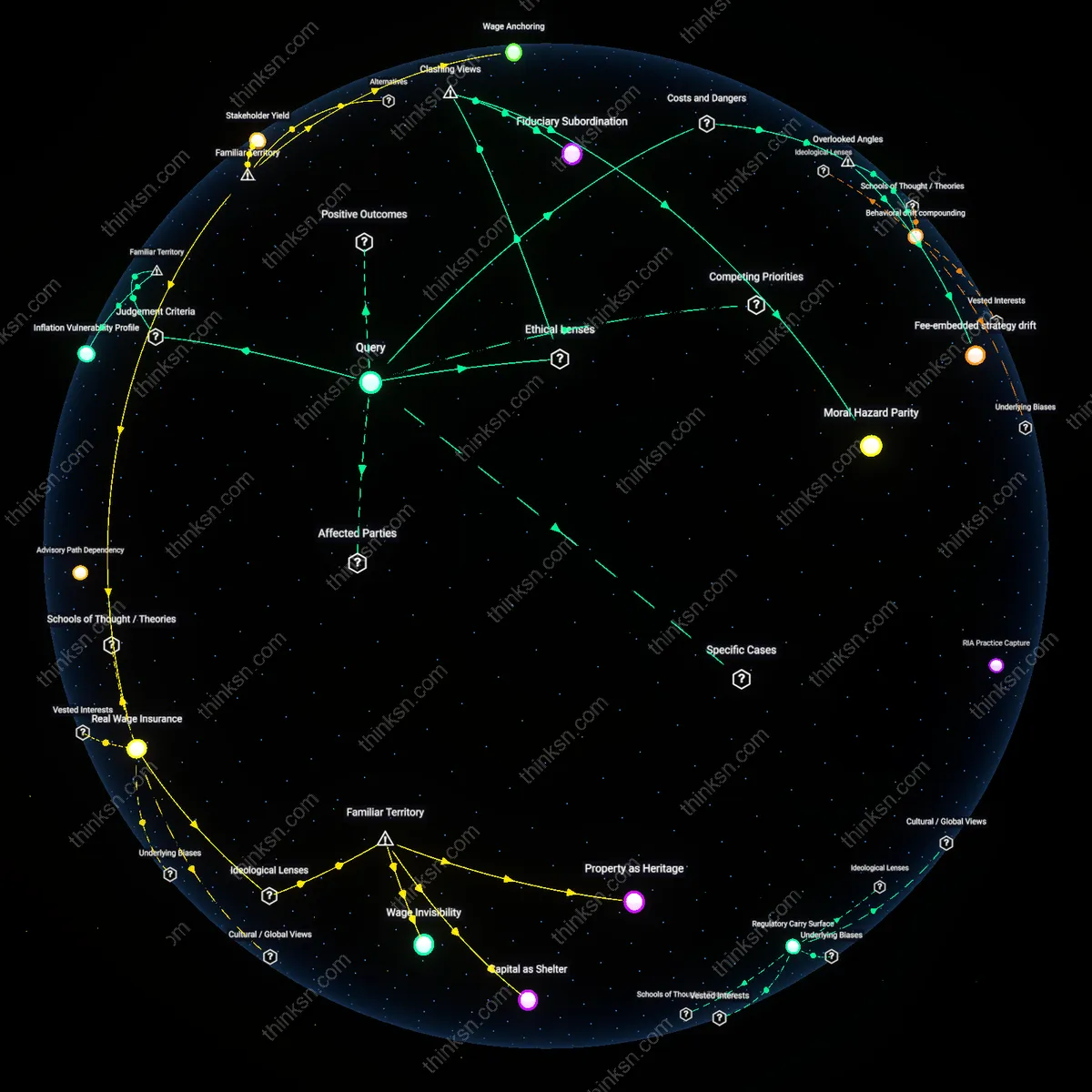
Analysis reveals 7 key thematic connections.
Key Findings
Fee Efficiency Threshold
An investor should prioritize minimizing advisory fees when those fees exceed the statistically expected incremental returns from aggressive inflation-hedging strategies. Institutional data from Morningstar and the Federal Reserve shows that, over 10-year horizons, less than 25% of active inflation-targeted funds outperform low-cost TIPS ETFs after deducting fees above 1.2% annually, meaning most high-fee advisory models transfer wealth from clients to providers under the guise of risk mitigation. This trade-off hinges on actuarial efficiency—the principle that resource allocation must maximize net expected value—and reveals the underappreciated reality that fiduciary status does not inherently prevent misalignment when fee structures absorb potential gains.
Inflation Vulnerability Profile
An investor should align strategy aggressiveness with personal exposure to inflation-sensitive liabilities, such as near-term retirement income or fixed healthcare costs, rather than abstract return targets. The familiar fear of 'eroded purchasing power' activates intuitive but undifferentiated responses to inflation, yet what matters is the temporal and nominal rigidity of future outflows—e.g., a 68-year-old on a fixed pension faces structurally different risks than a 35-year-old with variable wage potential. This lens centers distributive justice in risk allocation, emphasizing that ethical advice must weight protection according to vulnerability, not market opportunity, exposing the blind spot in performance-centric benchmarks that ignore life-stage asymmetries.
Behavioral drift compounding
An investor should reject aggressive inflation-hedging strategies with high-fee fiduciaries because the sustained psychological pressure of volatile performance inflates behavioral missteps over time, eroding net returns far beyond fee differentials. This mechanism emerges not from isolated poor decisions but from compounding deviations—such as delayed rebalancing or panic reallocations—triggered by the interaction of elevated portfolio swings and the advisor’s opacity around fee-adjusted outcomes, which systematically degrades investor discipline across market cycles. What is non-obvious is that the primary cost isn't the fee or the volatility alone, but how their combination silently rewires decision reflexes, a dynamic absent in standard cost-return comparisons that assume rational anchoring.
Fee-embedded strategy drift
An investor should treat a fiduciary's fee structure as an active distortion field that reshapes the very definition of an 'aggressive inflation-hedging strategy' over time, not merely a static deduction. High fees create institutional incentives for the advisor to favor complex, illiquid inflation instruments—like private real estate or indexed infrastructure debt—not because they are optimal but because they justify fee retention through perceived exclusivity and opacity in valuation, gradually shifting the portfolio into less benchmarkable, higher-friction assets. The overlooked danger is that the strategy evolves to serve fee preservation rather than inflation resilience, a metamorphosis invisible in period performance reports and undetectable without auditing the drift in asset taxonomy over time.
Fiduciary Subordination
Investors should accept higher fees from fiduciary advisors only when those advisors legally subordinate their fiduciary duty to a client’s inflation-hedging mandate as an overriding imperative. This occurs when state-imposed fiduciary standards, such as the DOL’s Fiduciary Rule, are selectively suspended in qualified accounts pursuing inflation-linked derivatives, allowing advisors to legally prioritize macro-strategy over cost minimization. The non-obvious reality is that fiduciary duty is not absolute but contextually defeasible under regulatory carve-outs that elevate systemic risk mitigation—such as inflation protection—above fee transparency, revealing a structural hierarchy of duties.
Moral Hazard Parity
An investor should assess fee-aggression trade-offs by recognizing that high-fee fiduciary models redistribute moral hazard equally between advisor and client, contrary to the assumption that fiduciaries eliminate it. Under principal-agent frameworks in behavioral finance, when fiduciaries receive elevated compensation for implementing complex inflation hedges like TIPS or commodity futures, they absorb no additional performance risk, thus reconstituting the same incentive distortions found in commission-based models. This parity exposes that ethical certification—such as fiduciary status—does not alter underlying risk asymmetry, merely relabels it under a trust-based ideology.
Inflation Austerity
The trade-off must be evaluated through the lens of distributive justice, where aggressive inflation-hedging strategies serve not as financial tools but as mechanisms of class-based capital preservation, privileging capital income over wage income under neoliberal monetary regimes. When fiduciary fees fund access to real asset hedges like farmland or infrastructure REITs, they institutionalize a form of financialized austerity that insulates wealth from inflation while wage earners bear its brunt. This reveals that fiduciary capitalism, even when ethically administered, functions ideologically to reproduce economic hierarchy under the guise of prudence.