When More Savings Hurts: HSAs for Self-Employed Income Volatility?
Analysis reveals 6 key thematic connections.
Key Findings
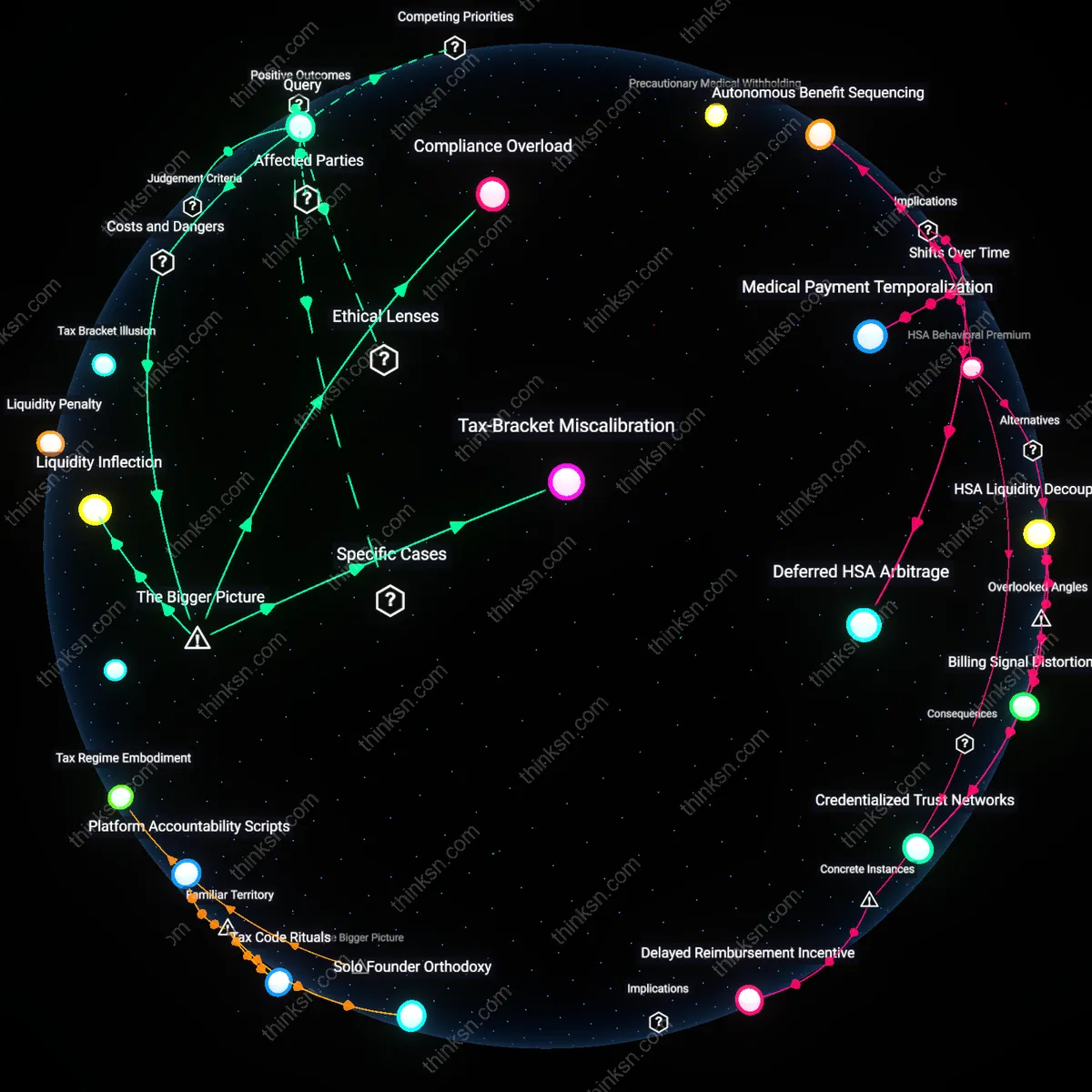
Liquidity Penalty
Higher health-savings account contributions begin causing harm when they deplete emergency cash reserves necessary for quarterly tax payments among self-employed individuals earning below $50,000 in volatile years; the mechanism operates through IRS requirement mismatches—HSA contributions are binding and use-restricted while tax liabilities are elastic and cash-flow-dependent. This misalignment penalizes low-balance contributors who prioritize long-term savings over short-term fiscal agility, revealing a structural disadvantage in timing, not intent—what most assume is prudent saving becomes a liquidity trap during down months when both taxes and premiums are due.
Tax Bracket Illusion
Contributions to HSAs turn counterproductive when self-employed individuals in fluctuating income brackets overestimate their current marginal rate and lock funds into a high-deductible structure they cannot sustain in lean years; this occurs through the interplay of progressive taxation and front-loaded premium commitments, where a single high-earning year triggers a contribution maximization strategy that backfires when subsequent income drops 40–60%. The flaw lies in the invisibility of bracket regression—people remember tax savings at peak earnings but overlook how HSA illiquidity amplifies risk during resets, mistaking volatility for stability.
Insurance Mismatch
HSA overfunding harms self-employed individuals when paired with high-deductible plans that require cost-sharing burdens exceeding actual healthcare utilization, especially in low-need but income-unstable years; this dynamic plays out when monthly premium savings are outweighed by the psychological and transactional friction of deferring care due to accumulated but inaccessible HSA balances. Most associate HSAs with control and autonomy, but the system actually incentivizes underconsumption not for medical prudence but account preservation—a distortion most fail to detect until faced with acute needs they delay because funds feel 'designated' rather than available.
Liquidity Inflection
Higher health-savings account contributions begin harming self-employed individuals with volatile income when annual deposits exceed the point at which reserved cash compromises emergency adaptability, forcing reliance on high-cost credit during income troughs. This occurs because self-employed workers lack employer-sponsored safety nets and face unpredictable revenue cycles, making over-commitment to tax-advantaged but illiquid accounts a hidden liquidity trap, especially in regions with limited access to low-interest credit; the systemic risk emerges when tax policy incentivizes saving without syncing with income variability, turning a personal finance tool into a cash flow hazard. The non-obvious consequence is that optimal tax efficiency can simultaneously trigger financial fragility when income streams are non-linear.
Compliance Overload
Elevated HSA contributions generate negative consequences for variable-income self-employed individuals when tracking and substantiating medical withdrawals becomes an unmanageable administrative burden during low-income years, increasing the risk of IRS penalties due to documentation gaps. This happens because high contribution levels motivate larger withdrawals, which require rigorous recordkeeping across tax years—an onus that disproportionately impacts solo operators without accounting support, especially in gig-driven economies where time is allocated toward income generation, not compliance; the broader system fails by coupling complex regulatory accountability with individualized financial incentives absent support infrastructure. The underappreciated dynamic is that the cognitive load of compliance scales with contribution volume, not just income level.
Tax-Bracket Miscalibration
Increased HSA contributions harm self-employed individuals with erratic earnings when they are made during low-income years under assumptions of high marginal rates, but subsequent income surges push withdrawals into higher effective tax brackets, eroding the intended tax arbitrage. This reversal occurs because contribution decisions are made annually without multi-year forecasting tools accessible to non-CPA sole proprietors, and the U.S. progressive tax system penalizes uneven realization of income; the systemic flaw lies in structuring HSAs around static tax logic while gig and freelance economies produce dynamic earnings curves. The overlooked mechanism is that intertemporal tax miscalibration—betting on future rates based on present conditions—converts anticipated savings into retroactive efficiency loss.