Are Mindfulness Programs Turning Childhood Normalities into Pathologies?
Analysis reveals 9 key thematic connections.
Key Findings
Pedagogical Triaging
The debate reveals that schools are increasingly expected to triage emotional behaviors through mindfulness because public funding reductions have eroded counseling staff, shifting detection and management of distress onto classroom teachers using scalable, low-cost protocols. This operates through instructional routines standardized across districts—like morning check-ins or breathing exercises—that convert subjective emotional states into observable, trackable behaviors, effectively repurposing mindfulness from practice to proxy. What is underappreciated in familiar discussions of 'wellness' is that these programs often serve less as prevention than as surveillance infrastructure, identifying which children fail to self-correct, thereby directing limited clinical resources only after visible disruption occurs—revealing a judgment criterion rooted in fiscal efficiency over developmental justice.
Therapeutic Citizenship
Participation in mindfulness routines is quietly becoming a prerequisite for full classroom inclusion, where children who cannot regulate their affect in prescribed ways are subtly marked as incompatible with the learning environment, thus redefining good student conduct as a form of therapeutic citizenship. This emerges in teacher evaluations and behavior charts that equate compliance with breathwork or emotional labeling with readiness to learn, embedding clinical norms into daily pedagogy. While public discourse frames mindfulness as inclusive support, the underappreciated consequence is that emotional expression is no longer neutral—children must perform insight and self-soothing to avoid remedial tracking, exposing a practical judgment criterion that equates manageability with educational worthiness.
Pedagogical Biopolitics
The integration of mindfulness into public elementary schools since the 2010s reflects a shift from discipline-based classroom management to affective optimization, where teachers and administrators deploy breath-awareness exercises to reduce behavioral disruptions. This change emerged as federal education policies like No Child Left Behind intensified scrutiny on student performance and school conduct, pushing districts to adopt low-cost, scalable interventions that internalize emotional labor in children. The non-obvious insight is that mindfulness, while framed as liberation from stress, functions as a recalibration of governance—shifting from external punishment to preemptive self-regulation—thereby producing compliant learners without overt coercion.
Clinical Citizenship
The normalization of mindfulness apps in kindergarten curricula since the late 2010s marks a transition from episodic mental health intervention to continuous emotional surveillance, where parents, educators, and pediatric clinicians collaborate to monitor mood fluctuations in real time. Enabled by digital platforms like MindYeti or Calm Classroom, this shift reframes emotional outbursts not as developmental stages but as early markers of dysregulation requiring modulation. What is underappreciated is that this trajectory produces a new form of subjectivity—children learn to interpret inner experience through a therapeutic lexicon, positioning emotional self-management as a civic duty rather than a personal skill.
Affective Infrastructure
The expansion of mindfulness programs in Title I schools after 2015 reveals a structural pivot in public education funding, where social-emotional learning (SEL) grants from foundations like Wallace and CASEL fill gaps left by austerity in school psychology services. This shift replaced one-on-one counseling with group-based mindfulness routines, redistributing limited resources through scalable classroom rituals rather than individualized care. The overlooked consequence is the institutionalization of emotional regulation as shared environmental design—transforming hallways and morning meetings into standardized affective circuits that preempt crises but obscure deeper socioeconomic stressors.
Preventive Surveillance Logic
The integration of mindfulness into early curricula exemplifies how preventive health paradigms can subtly reconfigure normative behavior thresholds, where anticipatory interventions displace reactive care and in doing so redefine ordinary emotional fluctuations as risks to be managed. Public health agencies and curriculum developers, responding to epidemiological trends in adolescent depression, leverage mindfulness as a non-stigmatizing tool to build 'resilience'—yet in standardizing emotional regulation techniques, they tacitly establish surveillance norms that categorize tantrums, inattention, or mood swings as early indicators of dysfunction rather than age-appropriate expressions. This shift is systemically enabled by data-driven education reforms that reward early identification of at-risk students, thus aligning clinical prevention models with school accountability frameworks. The non-obvious consequence is that emotional life becomes governed not through diagnosis but through ambient monitoring, where the boundary between care and control dissolves.
Therapeutic Schooling Model
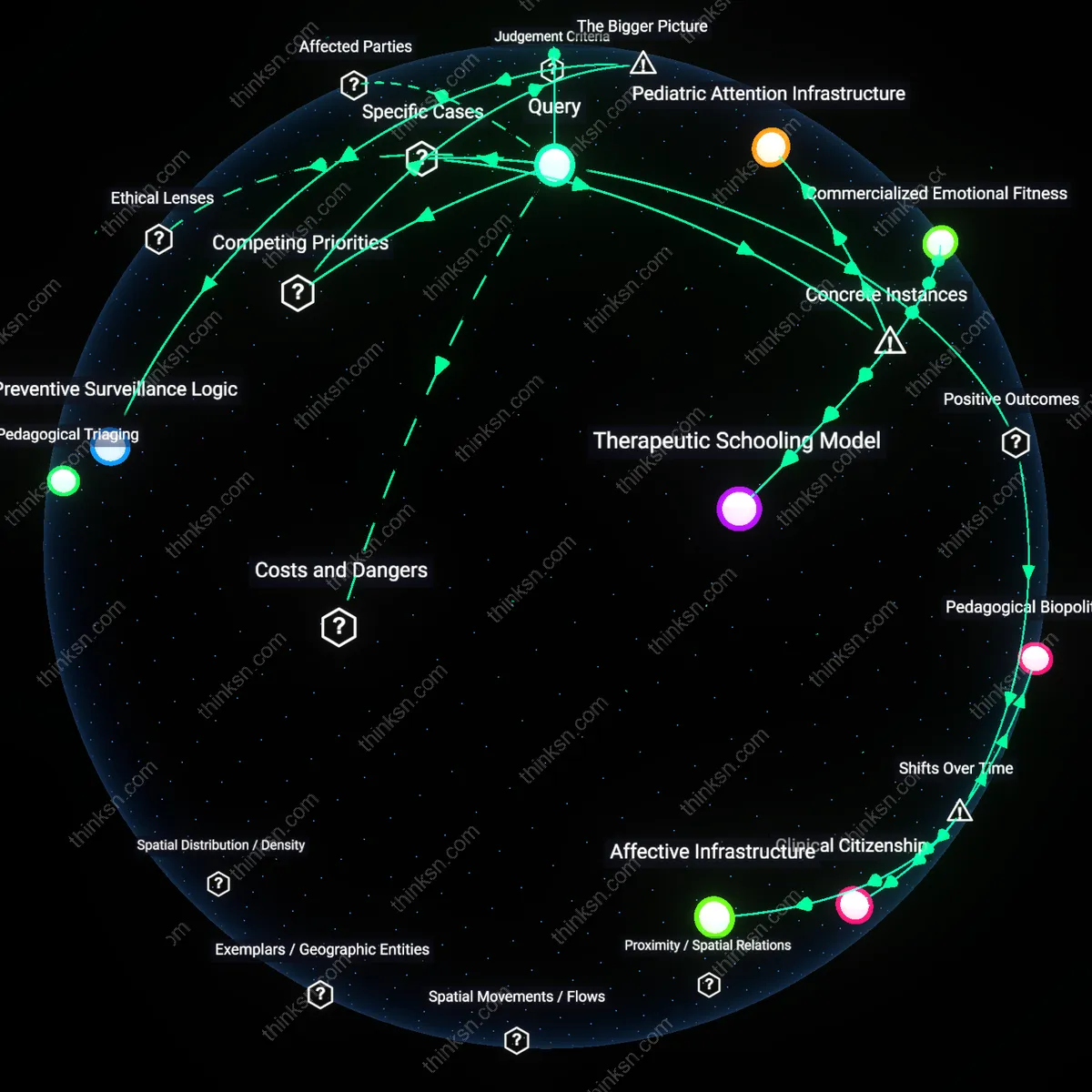
The Oakland Unified School District’s implementation of mindfulness-based curriculum in elementary schools reveals a prioritization of preemptive emotional regulation over developmental tolerance, where classroom behavior management is increasingly mediated through clinical wellness frameworks rather than pedagogical adaptation. This shift channels typical childhood impulsivity into structured mindfulness routines, effectively redefining age-appropriate distractibility as a condition requiring intervention, thereby embedding therapeutic protocols into the school day through partnerships with organizations like Mindful Schools. The non-obvious consequence is that schools begin to function not just as academic institutions but as early nodes in a mental health surveillance network, normalizing self-monitoring from a young age under the banner of wellness.
Pediatric Attention Infrastructure
The rise in ADHD diagnoses among preschoolers in the southeastern U.S., particularly in states like Alabama and Mississippi, coincides with the rollout of state-funded mindfulness initiatives in Head Start programs, indicating a structural alignment between early behavioral standardization and medical categorization. Here, mindfulness is adopted not as a cultural practice but as a compensatory tool to manage children deemed 'at-risk' for regulatory failure, effectively extending the reach of pediatric psychology into preclinical domains. This reveals how emotional regulation is being institutionally defined as a measurable deficit, where mindfulness serves as a soft corrective that precedes and justifies more formal medical intervention, thus normalizing surveillance of child behavior long before clinical thresholds are met.
Commercialized Emotional Fitness
The adoption of the 'Mind Yeti' mindfulness app in public elementary schools across Colorado reflects a market-driven model of emotional regulation, where third-party tech firms provide scalable solutions to districts under pressure to demonstrate student behavioral outcomes. In this case, specific classrooms in Denver Public Schools use standardized audio-guided sessions to manage stress and focus, reframing emotional volatility as a performance issue solvable through repeatable digital routines. The underappreciated dynamic is that privatized tools like Mind Yeti displace teacher-led discretion in favor of algorithmic emotional pacing, turning mindfulness into a commodified skill akin to literacy or numeracy, reinforcing the idea that emotional fitness requires external, branded intervention.