Buy Now or Wait? Home Buying Dilemma for Growing Families
Analysis reveals 10 key thematic connections.
Key Findings
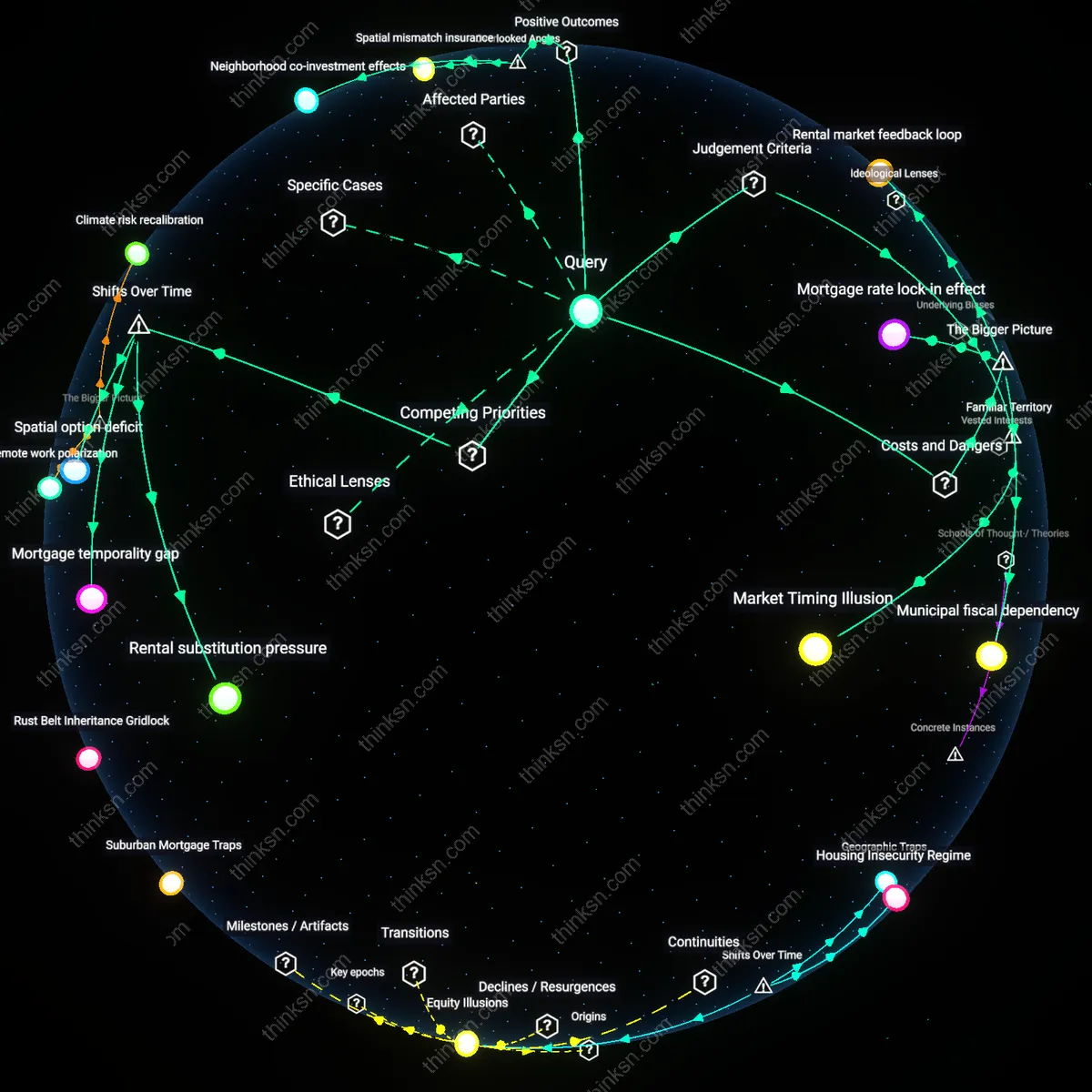
Market Timing Illusion
Delay the purchase because betting on predictable price corrections overestimates the regularity of housing cycles and underestimates the political entrenchment of supply scarcity in desirable school districts. Most families associate housing with long-term appreciation, assuming downturns are cyclical and accessible, but structural underbuilding in metro areas like Austin or Seattle has erased symmetrical rebound patterns, making 'waiting' a passive bet on systemic correction that rarely materializes locally. The underappreciated reality is that rent avoidance now competes with ownership lock-in, and the public rarely accounts for how municipal land-use norms neutralize macroeconomic corrections at the neighborhood level.
Equity Trapping
Postpone buying to preserve liquidity for strategic mobility, since rising rents often correlate with localized appreciation that benefits only incumbent owners and locks new buyers into debt-constrained positions during supply shortages. Families usually see homeownership as stability, but in high-growth corridors such as Denver or Atlanta, early entry at peak prices traps household wealth in illiquid, overvalued assets that resist downsizing or pivoting when remote work or caregiving demands flexibility. The overlooked mechanism is that ownership can diminish adaptive capacity—renting becomes leverage, not delay—enabling exit from depreciating school zones or tax regimes without foreclosure risk.
Neighborhood co-investment effects
A family should buy a larger home now because early homeownership triggers compounding neighborhood reinvestment that inflates both social capital and property values in ways that late entrants cannot capture. When families anchor themselves in emerging neighborhoods, they initiate informal networks—like coordinated landscaping or shared childcare—that subtly raise area desirability; these collective micro-improvements, though unpriced individually, cumulatively attract municipal upgrades and private services, accelerating appreciation. Most housing models overlook how individual purchase timing influences this feedback loop, treating neighborhoods as static backdrops rather than dynamic systems shaped by resident density and tenure stability—this social compounding is a hidden return on early ownership.
Spatial mismatch insurance
A family should buy a larger home now because homeownership acts as an implicit hedge against spatial mismatch in labor markets, a protection that appreciates as remote work recalibrates urban hierarchies. As hybrid work entrenches, firms are clustering in amenity-rich suburbs, making residential location a proxy for future job access; owning now locks in proximity to emerging economic nodes before zoning or congestion restricts supply. Conventional rent-vs-buy calculators treat housing as a standalone expense, missing how home equity functions as geographic optionality—this spatial insurance becomes more valuable as labor mobility decouples from city centers and ties to neighborhood-level opportunity density.
Rental market feedback loop
A family should not buy a larger home now because immediate purchases amplify demand-side pressure in housing markets, which reinforces investor speculation and institutional buy-in that inflates prices across both ownership and rental sectors; this occurs as institutional actors like Blackstone or Invitation Homes monitor homeownership trends as signals for single-family rental profitability, triggering portfolio expansion that converts owner-intended units into high-margin rentals, thereby increasing competition and rent levels even in markets untouched by direct investment—revealing how individual homeownership decisions feed into a counterproductive cycle where attempts to escape rising rents inadvertently accelerate them through observable market signaling mechanisms.
Mortgage rate lock-in effect
Buying a larger home now risks long-term exposure to higher interest rate environments that could persist due to the Federal Reserve’s delayed response to inflationary feedback from real estate asset inflation, which embeds systemic rigidity into household balance sheets; because mortgage rates are sensitive to 10-year Treasury yields shaped by expectations of sustained housing cost inflation, a wave of current buying validates those expectations, prompting yield increases that lock future buyers—and current over-leveraged families—into higher carrying costs for decades, revealing how seemingly individual timing decisions reinforce macrofinancial conditions that reduce intergenerational wealth mobility under conditions of monetary policy inertia.
Municipal fiscal dependency
Purchasing a larger home now sustains municipal revenue models that are structurally dependent on rising property values to fund essential services, which incentivizes local governments to resist zoning reforms and affordable housing development, thereby perpetuating supply constraints and rent inflation; city councils and school districts, relying on property tax receipts tied to assessed home values, align politically with homeowner interests to block density-allowing policies, creating a feedback loop where increased demand from families upgrading homes strengthens anti-supply coalitions—demonstrating how private housing consumption fuels public sector dependencies that systematically undermine housing affordability for the broader population.
Rental substitution pressure
A family should buy a larger home now because delaying purchase risks being permanently priced out due to the structural transformation of rental markets since the 2008 financial crisis, when institutional investors began treating residential real estate as a financial asset, thereby merging housing and capital markets in ways that sustain rent and price inflation simultaneously; this shift means renting is no longer a temporary or transitional mode but a locked-in cost trap that erodes equity-building capacity over time, making deferral a hidden intergenerational tax on mobility. The residual condition—rental substitution pressure—emerges from the breakdown of the postwar assumption that renting is a short-term step toward ownership, replaced by a reality where rising rents are not just costs but active mechanisms of exclusion from ownership altogether.
Mortgage temporality gap
A family should delay purchasing a larger home because the post-1970s shift from fixed- to variable-rate mortgage dominance has created a mismatch between household planning horizons and financial market volatility, such that long-term security-seeking behavior (like buying for stability) now amplifies exposure to short-term rate shocks that didn’t dominate earlier eras of homeownership; today’s buyers face a new temporality where a decision framed as permanent carries embedded financial risk cycles that reset every few years, turning the ‘forever home’ into a speculative trade. This temporality gap reveals how the decline of predictable financing regimes has decoupled housing tenures from generational time, making security a function of financial timing rather than commitment.
Spatial option deficit
A family should buy now because the suburban development model dominant from the 1950s to 1990s has collapsed under ecological and infrastructural strain, constricting new large-home supply in desirable areas and making available homes a dwindling option rather than a fungible commodity, thus turning ownership into a race against the vanishing possibility of spatial flexibility; the shift from unlimited sprawl to constrained footprint development since the early 2000s has transformed housing stock into a zero-sum geographic ledger where waiting means permanently accepting smaller or less suitable spaces. This scarcity produces a spatial option deficit—an erosion not of affordability alone but of meaningful choice in household formation under sustainably scaled environments.