Larger Yards vs. Higher Density: Balancing Homeowner Wishes and Property Taxes
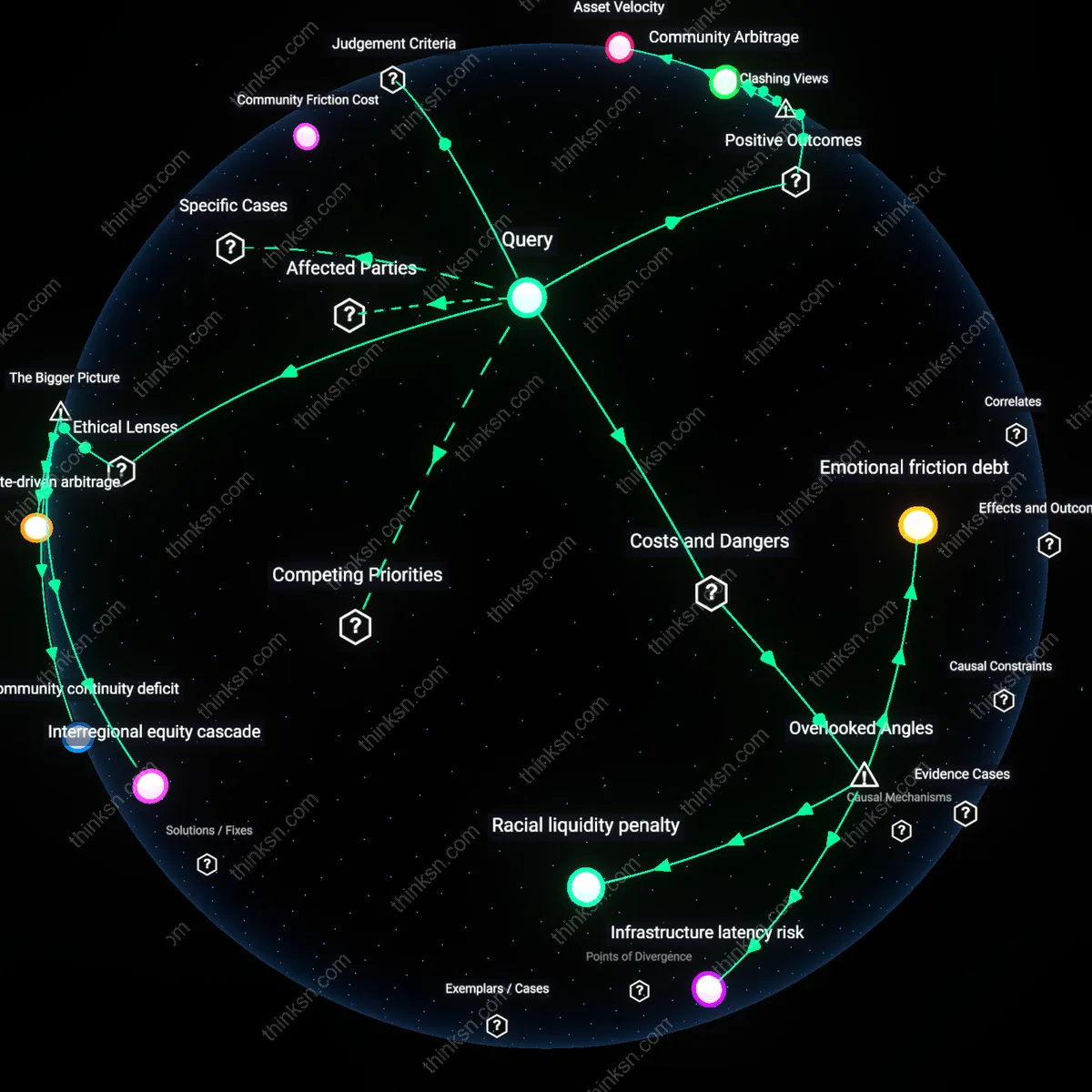
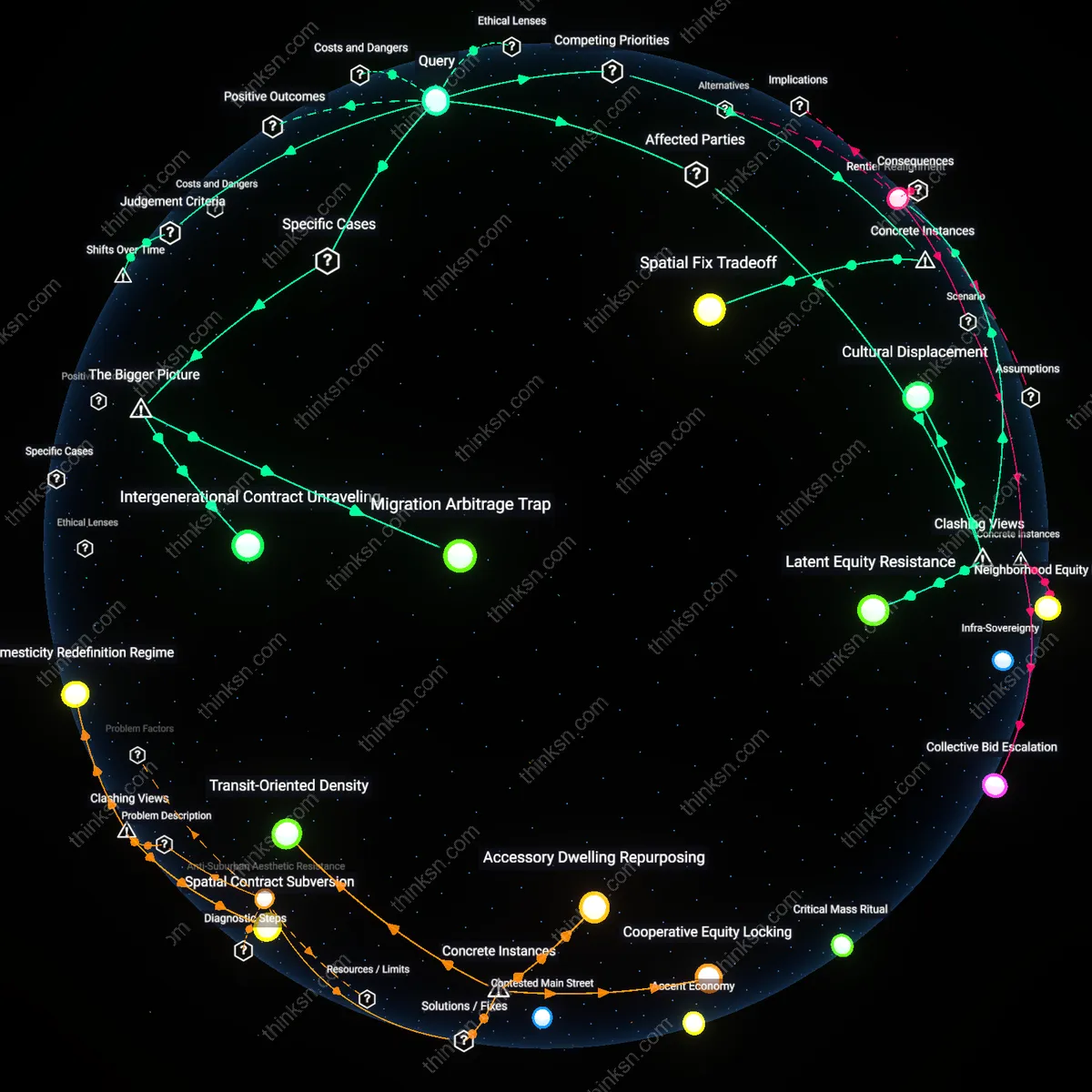
Analysis reveals 11 key thematic connections.
Key Findings
Tax Equity Paradox
A homeowner must accept that preserving single-family zoning to protect personal space preferences directly undermines municipal capacity to stabilize property tax burdens across income groups. Municipal tax bases depend on assessed land value per acre, and exclusive low-density zoning restricts supply in high-opportunity areas, inflating individual assessments and forcing reliance on owner-occupied tax contributions—this entrenches regressive taxation where lower- and middle-income households bear disproportionate shares of essential service funding. The non-obvious mechanism is that NIMBY-enforced density limits don't reduce taxes; they shift them onto existing owners by preventing cross-subsidization through multifamily units, revealing fiscal equity as structurally incompatible with spatial exclusivity.
Zoning Arbitrage
Homeowners can align personal space values with density needs only by treating zoning variances as negotiable commodities subject to public return. In cities like Portland and Minneapolis, accessory dwelling unit (ADU) legalization in single-family zones allows owners to expand private utility (rental income, family housing) while incrementally increasing housing stock—but only when the city mandates density as a condition of homeownership privilege, such as tying property tax abatements to rental affordability covenants. The dissonance lies in rejecting the idea that density must be imposed from above; instead, it can be incentivized through private gain that is contractually bound to public benefit, exposing zoning not as a fixed rule but a tradeable right.
Fiscal Proximity
The homeowner must recognize that property tax affordability is not determined by their lot size but by the aggregate yield of neighboring parcels, making personal space a secondary variable in fiscal outcomes. In high-cost municipalities like Arlington, VA, tax rates remain low not because of homeowner size preferences but because corridor-based zoning permits vertical density near transit, dispersing assessment risk across thousands of units while subsidizing single-family tax stability. The overlooked truth is that preserving one’s aesthetic or spatial preference depends on others’ proximity to density—affordability is sustained through deliberate spatial dissonance, not harmony, revealing that fiscal resilience is parasitic on concentrated development elsewhere.
Backyard Compromise
Host backyard accessory dwelling units to absorb regional housing demand, directly offsetting tax pressure through rental income. Homeowners in cities like Portland and Los Angeles leverage ADUs to generate $1,500–$2,500 monthly revenue, which counters tax hikes by aligning personal land use with municipal density goals through a private fiscal balancing loop. This taps into the familiar image of the backyard as underused space, but the non-obvious insight is that monetizing this zone stabilizes household affordability without altering primary living conditions—transforming a symbol of suburban privacy into a quiet tax shield.
Property Trade-in
Sell into higher-density housing types and reinvest savings into lower-maintenance, centrally located units, reducing personal cost burdens while meeting regional density targets. As middle-aged homeowners in Austin and Atlanta downsize from large suburban houses to urban condos, they lower their individual tax exposure and concentrate tax bases efficiently, reinforcing municipal revenue stability without rate increases. While downsizing is commonly seen as a life-stage choice, its underappreciated systemic role is as a market-mediated feedback valve—channeling household preferences into structural tax resilience.
Accessory Dwelling Units
In Portland, Oregon, homeowners reconciled single-family lot preferences with urban density mandates by constructing accessory dwelling units (ADUs) on existing properties, enabled by city zoning reforms that waived parking requirements and streamlined permits; this mechanism allowed personal control over design and use while incrementally increasing housing supply, revealing that regulatory simplification on individual lots can unlock community-scale density without altering neighborhood scale or taxing residents directly, a shift often overlooked in debates dominated by high-rise or forced redevelopment models.
Tax Base Expansion
In Minneapolis, the 2040 Comprehensive Plan permitted triplexes citywide, including in historically single-family zones, to address housing scarcity and stabilize property taxes amid rising inequity; by allowing moderate-density housing where homeowners retained investment stakes, the policy leveraged private ownership to expand the property tax base incrementally without requiring public subsidies, demonstrating that distributed density can preserve fiscal solvency while avoiding concentrated burdens on low-income renters or public infrastructure—a dynamic rarely credited in opposition narratives centered on neighborhood character loss.
Density Transfer Rights
In Manhattan’s Upper West Side, property owners participated in a density transfer program under New York City’s Special West Side District, allowing unused development rights from low-rise, owner-occupied buildings to be sold to developers building taller on other sites; this market mechanism let homeowners benefit financially from citywide density goals without altering their own living environment, exposing how tradable development rights can align individual asset protection with systemic affordability pressures, an underutilized tool in suburban and mid-density municipalities.
Fiscal Zoning Tradeoffs
Homeowners can reconcile personal space preferences with community density needs by participating in municipally moderated zoning reclassifications that incrementally shift low-density parcels into transit-oriented development zones, thereby capturing rising land value through targeted property tax abatements tied to affordability covenants over time. This mechanism, institutionalized in cities like Portland after the 2000 Metro Urban Growth Boundary tightening, realigns homeowner incentives with regional housing capacity by converting anticipated tax increases into density-allowed, equity-preserving redevelopment rights—what was once a zero-sum conflict between neighborhood character and fiscal sustainability now operates as a calibrated tradeoff schedule indexed to infrastructure capacity and demographic inflows.
Suburban Retrofit Debt
Homeowners reconcile space preferences with density mandates by leveraging post-2010 FHA Energy Retrofit loans to co-finance accessory dwelling units (ADUs) within existing single-family envelopes, transforming deferred maintenance obligations into density-compliant housing stock while retaining aesthetic control. As seen in Sacramento’s 2017–2022 ADU boom, this shift repurposed a legacy system of home improvement finance—originally designed for energy efficiency—into a stealth densification engine, revealing how federal mortgage policy adjustments after the housing crash inadvertently created a conduit for incremental density that bypasses overt zoning battles by embedding it in household repair cycles.
Tax Equity Inflection
Homeowners balance autonomy and density pressures by engaging in municipal participatory budgeting processes that link parcel-level development concessions to school district funding stability, as piloted in Minneapolis after the 2019 Minneapolis 2040 Plan dismantled single-family zoning. This shift—from exclusionary zoning as a tool of fiscal self-protection to negotiated development yield agreements—marks the point at which homeowners began treating property tax resilience not as a function of spatial homogeneity but as an outcome of managed heterogeneity, exposing a new fiscal logic where neighborhood viability depends on tiered density contributions rather than uniform lot standards.