How Temporary Work Permits Shape Undocumented Workers Futures?
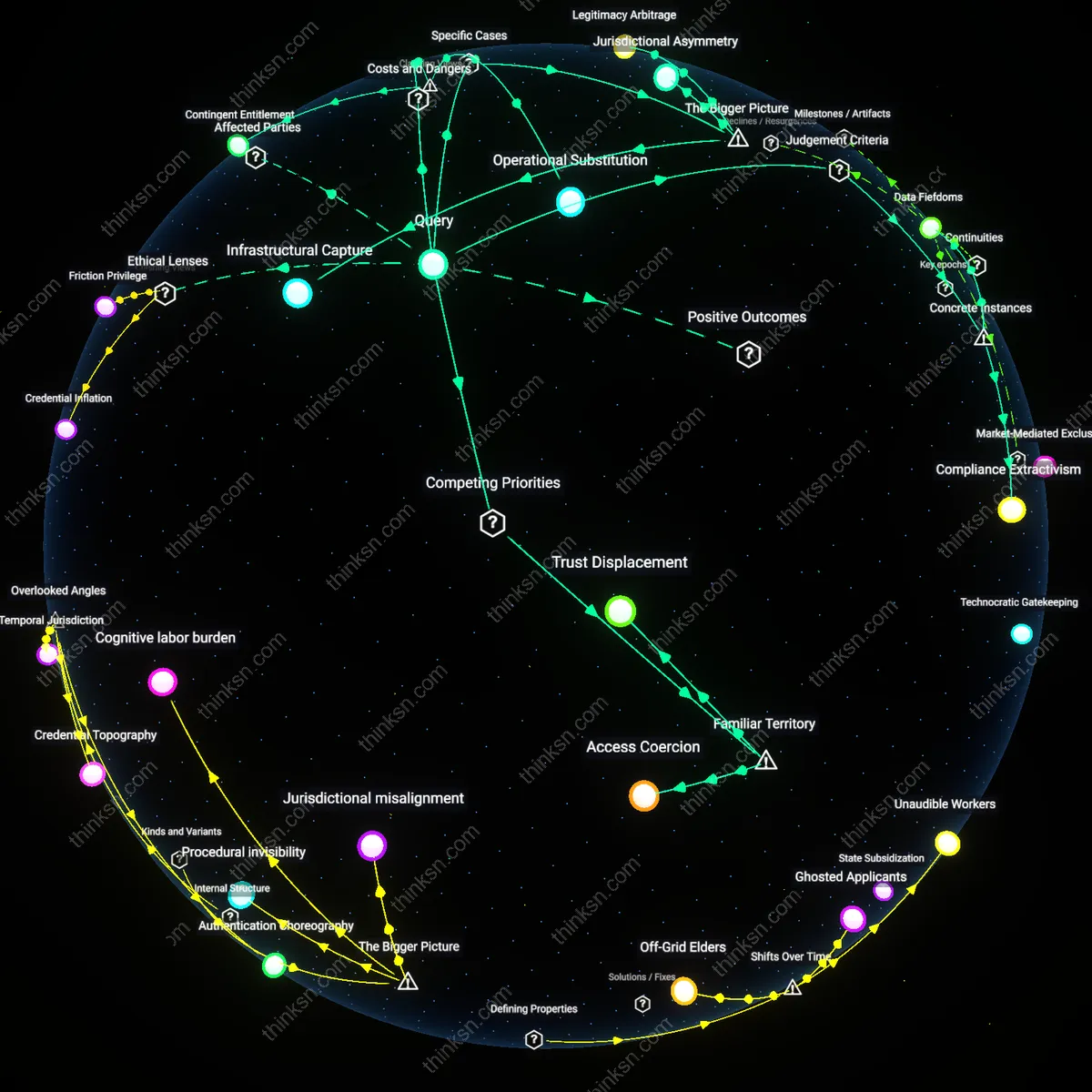
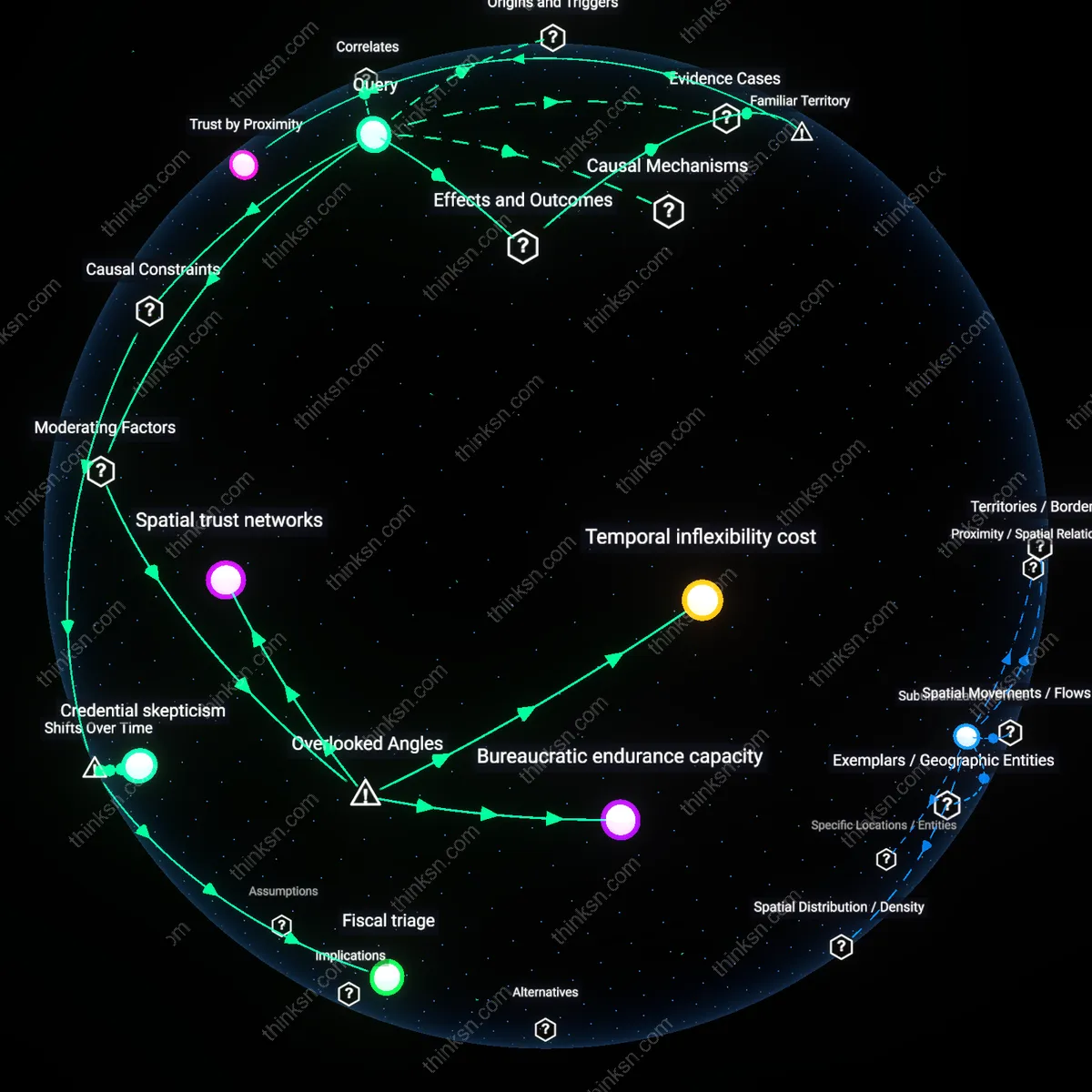
Analysis reveals 10 key thematic connections.
Key Findings
Temporal precarity
The temporary nature of work permits institutionalizes a form of futurelessness that recalibrates undocumented workers’ long-term planning around recurring crisis points rather than sustained career progression or community investment, particularly after the 1986 Immigration Reform and Control Act introduced temporary legalization programs without permanent integration pathways. This cyclical temporality binds migrant labor to renewal deadlines, deportation risks, and employer-dependent status, transforming career decisions into short-horizon calculations that prioritize immediate survival over skill accumulation or civic participation, revealing how administrative temporality—not just legal exclusion—organizes migrant life trajectories. The non-obvious insight is that time itself becomes a disciplinary tool, structuring behavior through recurring uncertainty rather than one-time exclusion.
Documented dependency
Beginning in the 1990s, the expansion of temporary work visa categories like H-2A and H-2B tethered undocumented workers’ access to formal labor markets to employers who control permit renewal, creating a feedback loop in which long-term career growth is constrained by institutionalized power imbalances rather than individual merit or aspiration. This shift from border-based exclusion to workplace-enforced temporality transforms employers into de facto immigration gatekeepers, discouraging workers from pursuing education, unionization, or community leadership roles that might jeopardize sponsorship, thereby embedding subordination within the labor contract itself. The key underappreciated dynamic is that documentation ceases to be a neutral status and becomes a relation—one that reproduces dependency across generations of migrant labor.
Spatial deferral
Following the increased securitization of urban centers post-9/11, particularly through programs like Secure Communities launched in 2008, undocumented workers with temporary permits began relocating to peripheral towns and rural economies not just for employment but to delay the spatial consequences of permit expiration, such as heightened surveillance or eviction from established ethnic enclaves. This strategic retreat into geographically dispersed, lower-capacity communities disrupts traditional models of immigrant incorporation that assume cumulative social embeddedness, instead producing a deferred form of community engagement that is intentionally provisional and geographically mobile. The overlooked shift is that settlement patterns no longer reflect integration trajectories but time-management strategies, where space is used to stretch the functional lifespan of temporary status.
Status liminality
Temporary H-2A visa holders in North Carolina’s tobacco farms avoid enrolling in vocational training because enrollment requires documentation of residency stability they cannot provide. Growers routinely discourage long-term skill development, knowing workers will be deported after 10 months, severing any return on investment. This institutionalized transience suppresses human capital accumulation not through individual choice but through structural exclusion from education systems tied to permanent status. The non-obvious insight is that the permit’s time-bound validity directly disables participation in state-sponsored advancement programs, rendering skill growth a prohibited future path rather than a personal decision.
Spatial containment
In Southern California’s Central Valley, undocumented dairy workers on short-term I-94 permits limit community investment because landlords reject lease contracts longer than six months, anticipating worker non-renewal. Local schools report lower parental involvement from this cohort, not due to disinterest but because administrators withhold bilingual leadership roles from families flagged as 'high-mobility.' This administrative sorting, triggered by permit expiration, produces geographic entrapment—workers cluster in transient housing where long-term organizing is destabilized by anticipated departures. The overlooked mechanism is how local institutions, not federal law, operationalize temporariness to spatially segregate and politically neutralize future-oriented action.
Temporal Precarity Discount
The temporary nature of a work permit systematically reduces undocumented workers' investment in geographically fixed community institutions because the anticipation of forced mobility—driven by permit expiration or non-renewal—triggers a temporal discounting mechanism that devalues long-term local engagement. Public school volunteering, neighborhood associations, and homeownership are avoided not due to lack of interest or resources, but because perceived future displacement makes such commitments appear irrational under a calculus of anticipated instability. This dynamic is rarely captured in policy debates that assume social integration follows legal access, overlooking how temporal uncertainty rewires cost-benefit assessments of community participation. What matters is not just legal status, but the cognitive discount rate applied to future belonging.
Credential Vaporization
The temporary nature of a work permit undermines undocumented workers' accumulation of recognized occupational credentials because training programs and certifications often outlast or fall outside the validity window of their legal authorization, rendering completed skill investments null when status lapses. Workers in specialized trades like medical coding or solar installation in cities like Houston or Phoenix may complete certification courses only to find their permits expire before employers can sponsor renewals, causing hard-earned qualifications to evaporate in labor market recognition. This creates a hidden de-skilling effect where human capital development is structurally decoupled from credential durability, a dynamic absent from workforce development models that conflate training access with career mobility.
Interstate Status Arbitrage
The temporary nature of a work permit induces undocumented workers to prioritize mobility between states with divergent enforcement climates and service access, transforming career and community decisions into strategic calculations of jurisdictional advantage rather than local loyalty. For example, a worker with a pending DACA renewal might relocate from Arizona to Illinois not for job quality but to access driver’s licenses and in-state tuition, treating state borders as operational thresholds for stability rather than community roots. This reveals a shadow geography of legal resilience—where community engagement is not abandoned but redistributed across jurisdictions—challenging the assumption that transience reflects disengagement rather than tactical positioning.
Deferred Belonging
Work permits condition undocumented workers to delay community investments because residency uncertainty forces decisions around housing, education, and civic participation into perpetual deferral. Employers, landlords, and school administrators often require documentation that expires, making multi-year commitments feel precarious—even when local norms encourage inclusion. This deferral is not apathy but a rational response to systemic time limits, a non-obvious resilience strategy where near-term stability is prioritized over long-term integration, revealing how temporary status institutionalizes waiting as a mode of social existence.
Economic Chaining
Undocumented workers under temporary permits concentrate in sectors where employers exploit the permit’s expiration to control wages and job mobility, such as seasonal agriculture or construction. The rotation of labor—built into visa programs like H-2A or similar national models—creates a system where workers are valued only for immediate output, not skill development, thereby normalizing career stagnation. The non-obvious insight is that employers, not just policy, engineer career short-circuiting by designing roles that assume transience, turning temporary status into a self-fulfilling prophecy of low upward mobility.