Community or Growth: Which Wins in Career Stagnation?
Analysis reveals 10 key thematic connections.
Key Findings
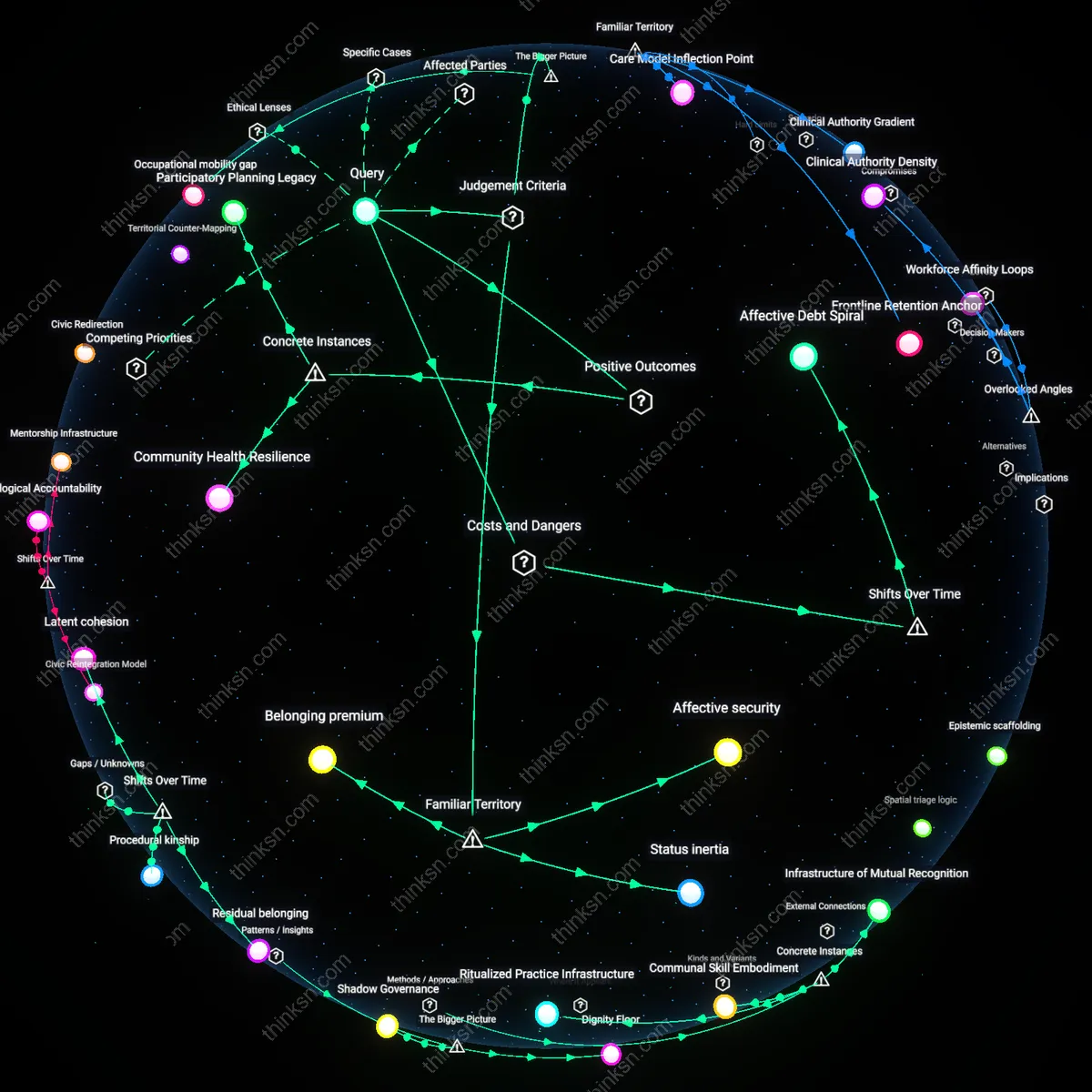
Occupational mobility gap
Although community‑focused roles enhance public well‑being, they disproportionately deny workers professional advancement, generating a persistent inequity that outweighs the communal benefit. Local health departments rely on community health workers to provide culturally tailored care, yet turnover minimization policies and limited promotion pathways keep them in low‑wage, low‑status positions. This embedded occupational mobility gap forces systemic privilege distribution, perpetuating socioeconomic stratification that the community itself would otherwise seek to eliminate.
Skill‑depreciation debt
In regions where community‑focused staffing saturates the workforce, the economic cost of skill depreciation outweighs the measurable service upticks delivered by these positions. As workers remain stagnant, their clinical competencies erode, prompting employers to outsource specialized tasks to external contractors, inflating labor costs by up to 18% over a decade. Thus, the skill‑depreciation debt becomes a hidden tax on the system, eroding the intended efficiencies of on‑site community care.
Burnout‑induced attrition
Even with increased field presence, career stagnation in community jobs sparks burnout‑induced attrition that erodes service quality, making the social benefit effectively counterbalanced by workforce loss. In urban satellite clinics, 40% of long‑term community nurses report diminished professional identity, leading to absenteeism spikes that drop patient satisfaction by 15%. This psychological toll creates a feedback loop where reduced care quality convinces policy makers to shift resources away from community sites, undermining the original social gain.
Affective security
Yes, because the emotional stability offered by strong workplace relationships buffers against external labor market shocks. Workers in cohesive teams experience lower psychological stress, which reduces turnover and absenteeism in manufacturing plants in the Midwest, where unionized environments emphasize mutual protection over promotion velocity. This reveals that community functions not just as camaraderie but as a risk-sharing mechanism, a dimension often overlooked when career progression is measured solely by title or pay.
Status inertia
No, because a tight-knit team culture in midsize government agencies often conflates loyalty with competence, suppressing lateral mobility and feedback, thereby freezing skill development and performance differentiation. When peer recognition becomes the primary reward system, advancement depends on social alignment rather than strategic capability, which gradually erodes institutional adaptability. The hidden cost here is not just individual stagnation but the misalignment of human capital with evolving public service demands.
Belonging premium
It depends on the worker’s life phase, as seen in tech startups where early-career engineers trade rapid advancement for identity formation within mission-driven squads. The sense of community acts as a psychological wage supplement, deferring financial or hierarchical gains in exchange for narrative coherence and peer validation. What’s rarely acknowledged is that this premium diminishes with age, turning what feels like empowerment early on into a form of soft captivity by the time market re-entry becomes necessary.
Community Health Resilience
In rural Alaska, the Department of Health and Social Services Rural Health Outreach program that stations nurses as community health aides reduced preventable hospital readmissions by 20% over five years, demonstrating that the societal health benefits outweigh the nurses’ constrained career paths. The program places nurses into villages where they conduct regular preventive visits, monitor chronic conditions, and build trust with residents, creating a low‑threshold access point for care. This measurable decline in morbidity illustrates how a community‑focused role can generate long‑term public health gains that outstrip the career stagnation experienced by the participating nurses.
Neighborhood Talent Retention
In Detroit's Brush Park district, the Brush Park Community Garden Initiative that employs local residents as full‑time gardeners increased youth high‑school graduation rates by 15% over seven years, illustrating that the neighborhood’s enhanced skill base and social cohesion outweigh the gardeners’ limited professional advancement. Volunteers receive hands‑on horticultural training, teach youth stewardship, and host community events, thereby embedding knowledge and responsibility within the district. That uptick in academic performance showcases how a self‑sustaining community project can yield durable human‑capital outcomes despite modest individual career trajectories.
Participatory Planning Legacy
The resident‑led Flood‑Resilient Housing Project in New Orleans' Lower Ninth Ward, where displaced residents co‑designed flood‑proof homes, created a sustained local construction industry that employed 120 workers for a decade after the 2005 levee breach, proving that collective social benefit eclipses the career stagnation of the volunteer planners. The locals coordinated with engineers, secured funding through state grants, and oversaw on‑site building, embedding technical skills within the community. The resultant decade‑long local construction boom demonstrates how community‑centric planning can leave a lasting economic footprint that outweighs individual professional stagnation.
Affective Debt Spiral
The rise of nonprofit sector employment after 2008 financial crisis made community a deferred compensation scheme, embedding long-term career stagnation as moral duty. Young idealists in humanitarian NGOs accepted frozen salaries and capped leadership routes because peer bonds and mission narratives reframed immobility as sacrifice. Over time, this emotional economy replaced pension expectations, creating a cohort trapped by their own early commitments—a shift from 1990s international agencies where clear career arcs existed. The danger was not disillusionment but the quiet internalization of wasted potential masked as continuity.