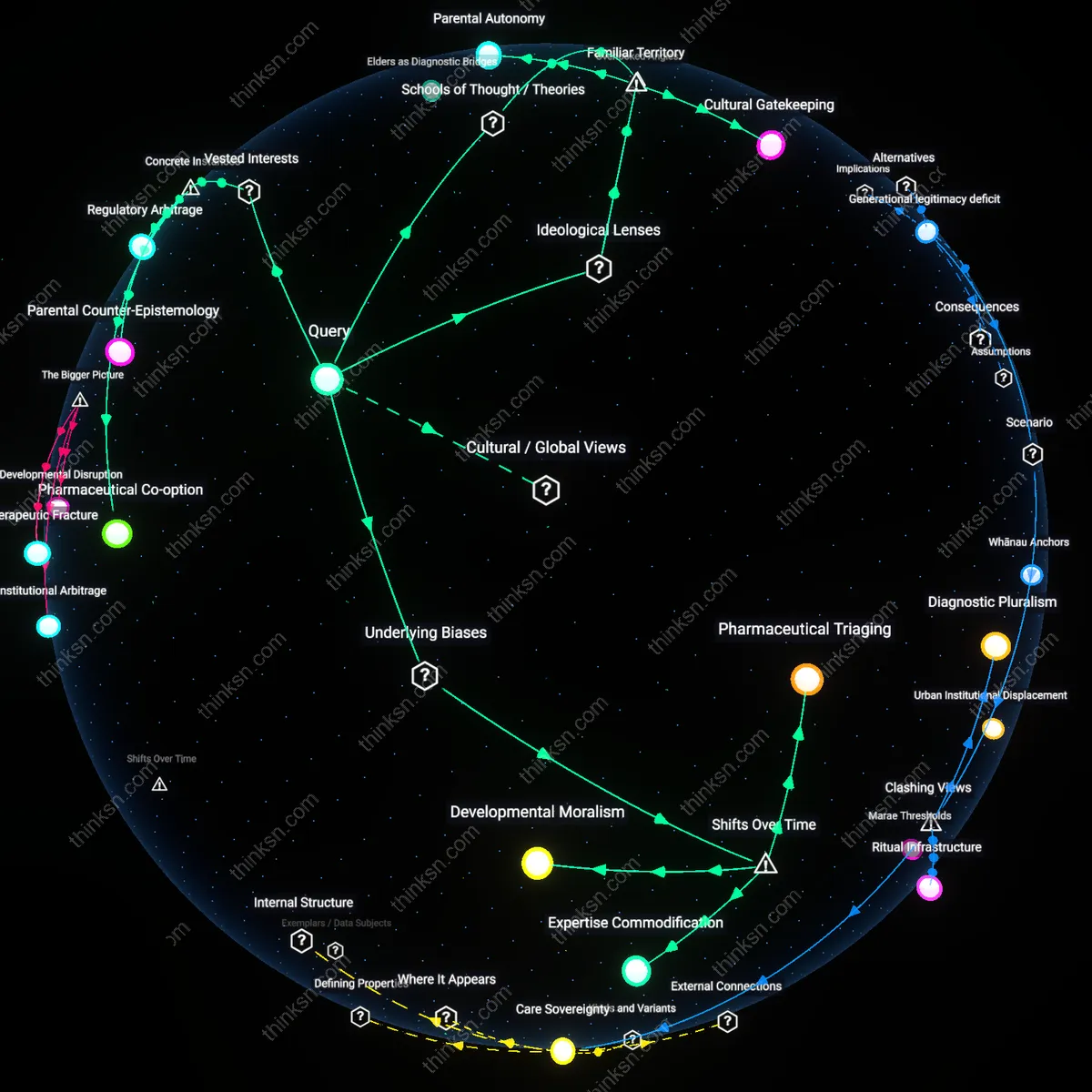
Support Group or Therapist? Weighing Shared Experience vs Lived Empathy
Analysis reveals 17 key thematic connections.
Key Findings
Therapeutic legitimacy
Someone should choose professional therapy when regulatory recognition of clinical standards has made it the socially sanctioned response to psychological distress, particularly after the deinstitutionalization wave of the 1970s shifted mental health care into outpatient models dominated by licensed providers. This shift entrenched insurance reimbursement systems and medicalized diagnostic frameworks—like DSM-based criteria—that elevated evidence-based practice as the benchmark of care, marginalizing peer-led models despite their community embeddedness. The non-obvious consequence is that legitimacy now flows through credentialing bodies rather than experiential resonance, making therapy the default even when empathy gaps persist.
Lived expertise
Someone should prioritize peer support when recovering from trauma tied to identity-based or systemic harm—such as racialized violence or LGBTQ+ marginalization—because the rise of social justice movements since the 1980s revalued firsthand experience as a valid form of knowledge production previously excluded from clinical settings. Grassroots organizations like Alcoholics Anonymous or Black mental health collectives built alternative epistemologies where shared suffering became a mechanism of trust and resistance to pathologizing norms. The underappreciated shift is that peer support is no longer supplemental but foundational in contexts where professional neutrality replicates the erasure survivors seek to overcome.
Crisis infrastructure
Someone should choose between peer and professional support based on whether they are in acute distress or chronic adjustment, because emergency mental health responses since the 1990s—spurred by mass shootings and rising suicide rates—have layered crisis hotlines staffed by trained volunteers alongside ER psychiatric evaluations, creating a bifurcated system where immediacy trumps method. In this staged architecture, peer networks function as first responders due to availability and relatability, while therapy enters later if stabilization allows access—revealing that timing, not just efficacy, determines pathway. The unspoken reality is that evidence-based methods often come too late because the crisis moment belongs to informal care.
Care Alignment Principle
Choose the option whose structure of accountability matches the individual’s primary need—emotional recognition or clinical outcomes. In peer support, mutual aid operates through shared vulnerability and lateral trust among people with analogous trauma histories, making it effective when social validation is a precondition for healing; in professional therapy, hierarchal clinical standards enforce fidelity to diagnostic categories and treatment protocols optimized for symptom reduction. The underappreciated dynamic is that what feels empathetic isn't always therapeutically held accountable to evidence, while what is accountable to evidence often depersonalizes suffering, revealing that judgment hinges on whether the individual prioritizes moral recognition or measurable recovery.
Trauma Congruence Threshold
Select peer support when the psychological wound is rooted in stigmatized or identity-shaped experiences such as addiction, racial trauma, or gender dysphoria, because lived equivalency in peer networks creates diagnostic clarity no clinician can simulate through training alone. Professional therapy excels in neurochemical dysregulation like OCD or panic disorders, where standardized interventions outperform narrative resonance. The non-obvious reality is that empathy isn't a proxy for competence—some forms of suffering require experiential knowledge as infrastructure, not emotional tone, shifting the frame from 'personal vs. professional' to 'epistemic adequacy for a given trauma modality.'
Reciprocity Equity Norm
Opt for peer support when preserving relational symmetry prevents retraumatization from authority-based dynamics, especially for populations historically pathologized by medical systems—Black communities, disabled people, survivors of institutionalization—because therapy’s one-directional expertise can replicate oppressive power structures even when well-intentioned. Peer networks, by contrast, distribute interpretive authority and grant epistemic dignity through mutual sense-making. The overlooked point is that justice in care isn't just about efficacy but about whether the recipient can exist as a subject, not an object of treatment, elevating reciprocity to a criterion of ethical access.
Structural Accessibility Leverage
Prioritize peer support in communities with underfunded mental health infrastructure because it activates latent social capital through low-barrier, trust-based networks that circumvent systemic gaps in care access. In regions like rural Appalachia or post-industrial cities, where clinical shortages and stigma compound treatment inequity, peer networks become functional substitutes by leveraging shared identity and localized trust — mechanisms that formal systems cannot easily replicate. This dynamic reveals how resource-constrained environments amplify the functional value of lived-experience relationships, turning informality into a structural advantage rather than a compromise.
Empathy Trap
Choosing peer support in acute psychosis management risks normalizing delusions when Jordan Peterson’s clinical oversight in Canada allowed peer-led groups to validate paranoid ideation as ‘shared truth,’ bypassing diagnostic containment; this reveals how peer empathy, without clinical boundaries, can reinforce pathological narratives under the guise of validation, subverting recovery through affective alignment rather than reality testing.
Therapeutic Delay
Relying solely on evidence-based CBT in PTSD treatment delayed healing among 2010 Haiti earthquake survivors because Partners In Health therapists dismissed communal mourning rituals as 'cognitive distortions,' fracturing trust and increasing dropout; this shows how clinical fidelity to protocol can pathologize cultural resilience, turning methodological rigor into structural violence by erasing context as clinical noise.
Systemic Abandonment
When the UK’s IAPT program replaced trauma-specialist roles with peer advocates in 2015 to cut costs, survivors of sexual violence reported escalated dissociation due to repeated retraumatization in unmoderated groups at Manchester clinics; this demonstrates how institutional cost-shifting disguises austerity as inclusion, converting peer solidarity into an operational hazard when safety infrastructure is defunded.
Crisis Arbitrage
Someone should choose professional therapy during acute physiological crisis because empathic attunement in peer networks can inadvertently amplify dysregulation through affective resonance, as seen in trauma support groups where shared narratives trigger simultaneous flashbacks that overwhelm containment capacity. Unlike professionals trained to maintain metacognitive distance, peers immersed in reciprocal vulnerability lack protocols to interrupt cascading psychological collapse — a risk especially pronounced in rural communities with sparse mental health infrastructure but strong communal ties. The counterintuitive insight is that personal empathy, while restorative in stable conditions, becomes cognitively hazardous in high-symptom volatility, where dehumanizing detachment in clinical practice (e.g., diagnostic categorization) paradoxically enables safer processing. This reveals how emotional authenticity trades off with systemic survivability when neural reactivity outpaces relational containment.
Therapeutic Trade-off
Someone should choose professional therapy over peer support when managing acute psychosis in crisis stabilization units at public hospitals like those in New York City’s Health + Hospitals network because clinical protocols require rapid symptom control through medication and legal authority, displacing empathetic mutuality with procedural authority. In these settings, clinicians treating patients under involuntary commitment laws prioritize safety and behavioral compliance over experiential solidarity, making peer supporters—despite shared histories—excluded from core interventions due to liability and standards of care. This reveals that clinical systems institutionalize expertise in ways that structurally suppress empathy-bearing roles during high-risk episodes, a non-obvious consequence given the cultural valorization of lived experience in recovery narratives.
Empathy Disqualification
A veteran struggling with moral injury after deployment may find peer support at a Vets Center more conducive than VA-contracted cognitive processing therapy because certified therapists are barred from validating certain combat-related guilts as 'adaptive' due to clinical ethics, whereas peers who served in units like the 101st Airborne carry interpretive authority no credential can confer. The VA’s mandatory reporting obligations and diagnostic frameworks render therapists unable to reciprocally acknowledge ethically ambiguous actions, weakening therapeutic alliance at key moments when shame resists pathologization. Here, the clinical requirement to depersonalize trauma conflicts with the relational necessity of co-validated experience, exposing how certification enforces a form of emotional neutrality that disqualifies otherwise crucial empathetic insight.
Crisis Hierarchy
During the 2019 measles outbreak in Clark County, Washington, public health counselors found that anti-vaccination parents responded more openly to peer advocates from local parenting collectives than to state epidemiologists, because trust hinged on perceived shared risk assessment rather than technical knowledge, yet during actual contagion peaks, clinical teams overruled community mitigations using legal health mandates. The transition from preventive dialogue to emergency intervention shifted legitimacy from relational parity to institutional authority, revealing that empathy is privileged only when immediate bodily threat is low. This inversion—where trusted peer networks are sidelined at the moment of greatest medical urgency—demonstrates how pragmatic crisis escalation downgrades mutual understanding in favor of command-and-control protocols.
Therapeutic Sovereignty
Someone should prioritize professional therapy because clinical protocols governed by biomedical ethics override peer-based models when managing diagnosable mental health conditions, as codified in the American Psychiatric Association’s Diagnostic and Statistical Manual and enforced through insurance reimbursement structures that valorize credential-based authority. This hierarchy reflects utilitarian legal doctrines such as parens patriae, which authorize state-sanctioned intervention when individual autonomy risks public harm—positioning licensed professionals as ethically empowered to make binding treatment decisions. Contrary to the intuitive assumption that shared suffering enhances care efficacy, systems of forensic psychiatry and mandatory treatment orders rely on the depersonalization of diagnosis to ensure consistency, revealing that objectivity in mental health is institutionally defined as exclusion of personal narrative.
Empathy Arbitrage
Someone should choose peer support because lived-experience communities already function as counter-institutions that redistribute epistemic authority from medical hierarchies to marginalized subjects, exemplified by the 1970s psychiatric survivor movements that founded the National Empowerment Center and directly challenged the ontological primacy of clinical categories. This choice operates through an ethic of radical care derived from anarchistic political traditions, where trust emerges not from certification but from mutual vulnerability—undermining the neoliberal framing of therapy as a privatized commodity. Against the dominant view that clinical neutrality ensures better outcomes, the sustained efficacy of peer-led crisis respite centers like those in the Open Dialogue network reveals that empathy, when decoupled from licensure, becomes a form of insurgent capital that deconditions pathologization.
Diagnostic Apartheid
Someone should reject the forced choice entirely because the dichotomy itself reproduces a structural violence embedded in health policy, where Medicaid reimbursement rules in the U.S. systematically underfund peer support certifications while privileging doctoral-level providers, constructing a caste-like division in care access. This mechanism functions through legal doctrines like medical necessity, which courts have upheld as justification for denying coverage to non-clinical modalities regardless of patient-reported benefit—validating care only when filtered through professional gatekeeping. Challenging the intuitive belief in patient autonomy, this reveals that the decision matrix is not individual but procedurally predetermined by insurance adjudication systems, exposing a hidden architecture of epistemic segregation.