Is Remote Flexibility Worth Less Pay for Senior Developers?
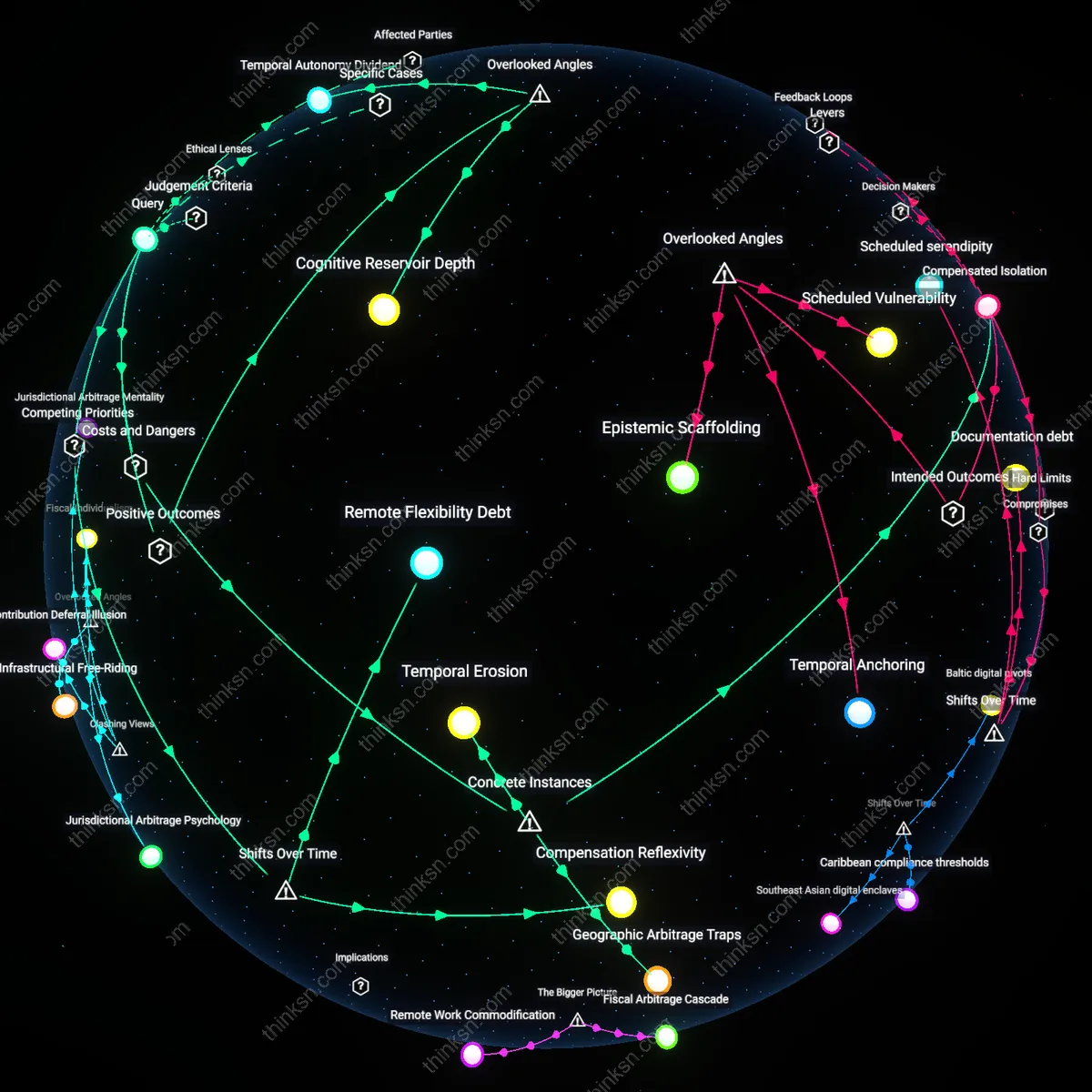
Analysis reveals 8 key thematic connections.
Key Findings
Cognitive Reservoir Depth
Prioritize remote work with reduced salary to preserve cognitive reservoir depth, a finite resource governing long-term innovation capacity. Senior developers who work remotely avoid daily office navigation—commutes, open-floor distractions, and meeting-chain fatigue—which cumulatively erode executive function and reduce ability to engage in deep architectural thinking. This preservation of uninterrupted attention cycles is invisible in compensation models but directly determines how effectively a developer can mentor, refactor legacy systems, or incubate next-generation patterns; most organizations undervalue this because its impact surfaces years later in codebase maintainability and team resilience.
Geographic Optionality Premium
Accept lower remote compensation to unlock geographic optionality premium, which emerges from strategic mobility across jurisdictions with divergent tax, cost-of-living, and regulatory regimes. A senior developer earning less from a U.S.-based office role may actually retain higher discretionary income and lifestyle elasticity by relocating to a jurisdiction with autonomous tax status or digital nomad incentives, such as Portugal’s NHR program or Georgia’s Foreign Citizen Resident Permit. This dimension is overlooked because salary comparisons typically assume fixed geography, yet the real arbitrage lies in coupling remote work with legal-jurisdiction fluidity—transforming salary reduction into a catalyst for sustained financial optionality and risk decentralization.
Temporal Autonomy Dividend
Choose reduced-salary remote work to capture the temporal autonomy dividend, where unstructured time reclamation enables compounding investment in asymmetric learning and career-defining projects. Office-based roles impose synchronized schedules that fragment the day into bidirectional coordination blocks, whereas remote work—even at lower pay—grants control over chronotype alignment and task batching, allowing senior developers to redirect time surpluses into high-leverage activities like contributing to foundational OSS, publishing design systems, or incubating internal tools. This dividend is invisible in standard job evaluations because it treats time as fungible rather than compoundable, yet it disproportionately shapes long-term career inflection points.
Compensated Isolation
Accepting reduced salary for remote work risks normalizing isolation as a de facto job requirement, as seen when Twitter’s 2022 distributed workforce shift led to untracked declines in mental health and peer mentorship, particularly among mid-level engineers who lost informal learning pathways; this mechanism operates through the erosion of spontaneous collaboration in digital-only environments, revealing that cost savings from remote work are often achieved by offloading social infrastructure costs onto employees’ psychological resilience.
Geographic Arbitrage Traps
Pursuing higher office-based pay in global tech hubs can lock developers into unsustainable cost-of-living spirals, exemplified by senior engineers at Amazon’s Seattle headquarters who, despite six-figure salaries, faced forced displacement due to housing inflation amplified by tech-industry clustering; this dynamic emerges when regional labor markets become distorted by concentrated corporate hiring, exposing how short-term income gains may be systematically erased by infrastructural feedback loops they themselves accelerate.
Temporal Erosion
Remote work’s salary reduction may appear manageable initially but incurs long-term career depreciation, as demonstrated by Oracle’s post-2016 remote policy where offsite senior developers were systematically excluded from high-visibility project allocations, leading to slower promotion cycles and diminished equity accumulation; this occurs through informal decision networks that persist in physical offices, revealing that apparent compensation trade-offs obscure deeper inequities in access to organizational time and presence.
Remote Flexibility Debt
A senior developer should prioritize office-based work today because remote flexibility has become a deferred cost rather than an immediate benefit, a shift from early pandemic years when geographic decoupling from headquarters conferred unprecedented leverage. Initially, remote work allowed senior engineers at Silicon Valley firms to relocate to lower-cost regions while retaining premium salaries—effectively capturing wage arbitrage. But after 2022, as companies like Google and Meta re-centralized hybrid policies and tied promotion velocity to in-person collaboration, remote employees experienced asymmetric access to mentorship and project visibility, slowing advancement trajectories. The non-obvious insight is that remote flexibility, once a value accretive to individual autonomy, has transitioned into a career-slowing obligation for many senior developers, creating a hidden accumulation of missed opportunities—what is now encoded as Remote Flexibility Debt.
Compensation Reflexivity
Senior developers now assess compensation not as a static trade-off between salary and location, but as a recursive signal of organizational trust, a shift that crystallized after the 2023 tech layoffs when workforce reductions disproportionately affected remote-first roles. Previously, higher office-based pay was seen as offsetting commuting burdens, but post-layoff patterns revealed that colocated employees retained stronger informal networks, faster communication loops, and greater decision-making proximity—factors that now retroactively define compensation as evidence of inclusion in core operational circuits. The higher salary is no longer just remuneration; it reflects a developer’s insertion into critical real-time interaction chains, making pay a measure of institutional embeddedness. This transformation reveals Compensation Reflexivity—the way monetary value comes to signify not labor input but relational centrality within a re-hierarchized post-remote recalibration.