Is Creative Fulfillment Possible With Costly Certifications?
Analysis reveals 7 key thematic connections.
Key Findings
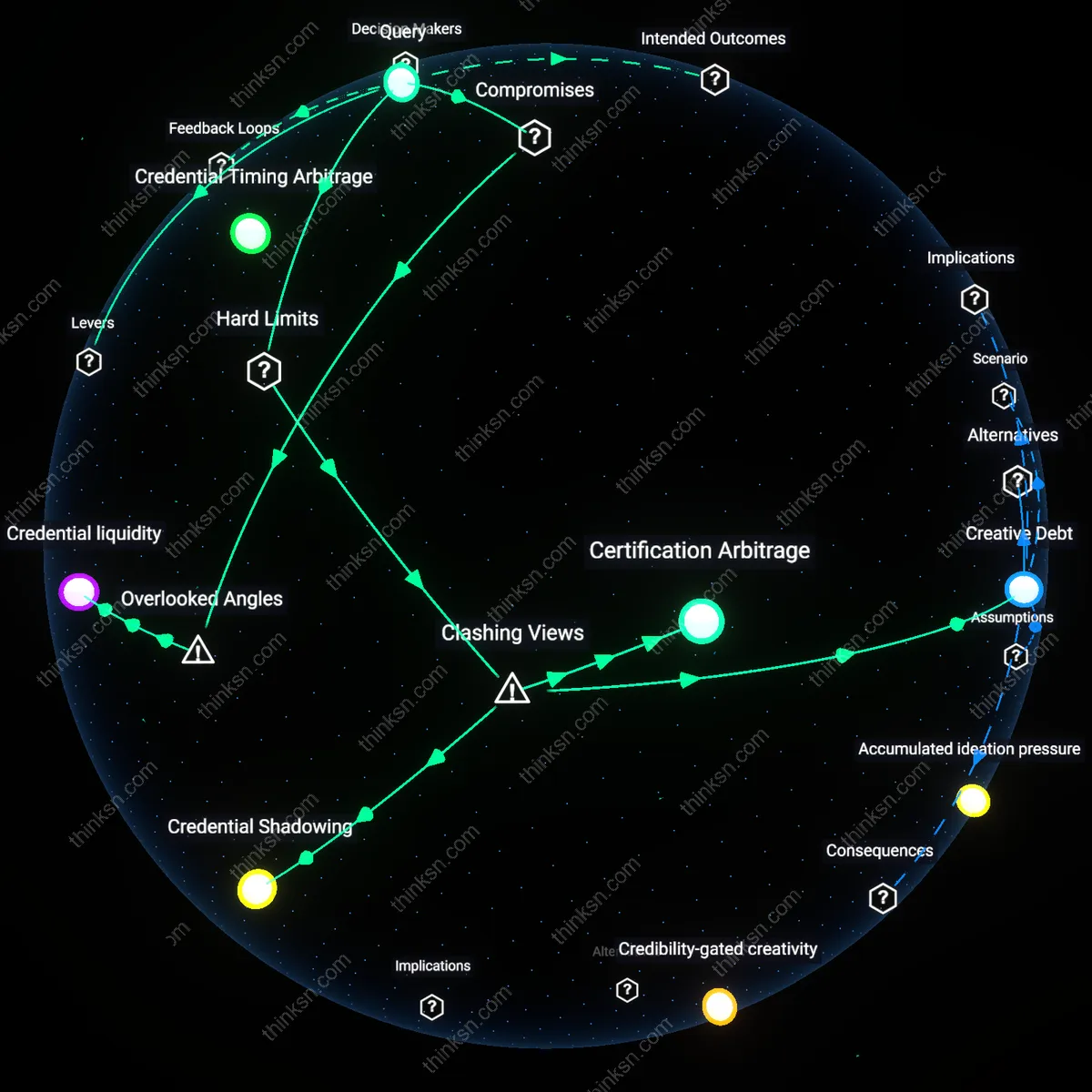
Certification Arbitrage
Pursue certification only in jurisdictions where it grants minimal practice rights but maximal mobility. By completing the credential in a region with lower clinical or operational barriers—such as obtaining a nursing license in a U.S. state with accelerated pathways and compact privileges—a professional accesses faster entry into regulated practice elsewhere, bypassing time-intensive training in stricter systems. This works through real differences in interstate or international credentialing frameworks, exploiting regulatory asymmetries rather than conforming to a uniform standard. The non-obvious insight is that certification is not a fixed educational burden but a geographically variable asset, and creative fulfillment can advance during fast-tracked practice rather than before it.
Creative Debt
Treat creative work not as an output to sustain during certification, but as deferred equity accumulated through deliberate under-engagement. By structuring the certification period as a temporary suspension of personal artistic or innovative pursuits—a calculative withdrawal from expression—professionals create a reservoir of unspent creative energy that fuels post-certification innovation. This mechanism operates through psychological scarcity effects, where enforced limitation amplifies post-restriction productivity, contrary to the assumption that creativity must be continuously nourished. The dissonance lies in rejecting the idea that creative fulfillment requires constant practice, revealing that suppression can function as investment.
Credential Shadowing
Engage in parallel, unofficial practice within the new field during certification by assuming provisional roles that mimic professional responsibilities without legal recognition—such as a pre-licensure architect drafting speculative designs for community housing projects through nonprofit partnerships. This occurs through gray-zone participation in open-access systems where formal credentials are not enforced for non-liability tasks, allowing experiential development without breaching regulatory hard limits. Unlike balancing acts that dilute focus, this approach uses certification as a cover for covert immersion, exposing the unstated truth that legitimacy often precedes formal permission when performed in socially sanctioned but unregulated spaces.
Credential Subsidy Leverage
Negotiate employer-sponsored certification funding in exchange for a contractual service commitment, directly aligning institutional demand with individual upskilling. This mechanism shifts the financial burden from professionals to firms that extract value from newly certified labor, activating labor market dynamics where human capital investment becomes a negotiated term of employment rather than a personal cost. The non-obvious insight is that certification barriers function as de facto hiring filters only when employers treat them as fixed; when professionals leverage their existing expertise as bargaining power, they expose the malleability of credentialing regimes within employment contracts.
Parallel Practice Pathway
Pursue provisional or peripheral engagement in the target field through volunteer roles, open-source contributions, or freelance micro-projects that build domain legitimacy without certification. This tactic exploits gaps in field boundaries where practical competence can be demonstrated before formal entry, allowing creative fulfillment to persist through real-world application while incrementally meeting occupational requirements. The overlooked systemic feature is that many regulated fields depend on informal gatekeeping—professional associations and incumbents resist change—but grassroots demonstration of capability can shift perceptions of who qualifies, creating backdoor access to recognition.
Credential Timing Arbitrage
Align certification timelines with macroeconomic cycles or industry labor shortages to reduce opportunity cost and increase post-qualification leverage. By enrolling during periods of high demand for the credential—such as when regulatory changes or technological shifts create sudden skill gaps—professionals increase their return on time and financial investment while gaining faster access to creative autonomy within the role. The underappreciated reality is that certification value is not static; it fluctuates with labor market elasticity, and strategic timing allows individuals to capitalize on systemic inflection points where supply constraints elevate the bargaining power of new entrants.
Credential liquidity
Professionals can preserve creative fulfillment by treating certification not as a fixed cost but as a convertible asset across domains—engineers with newly acquired AI certifications, for instance, often repurpose certification study into open-source tools or modular tutorials that serve both compliance and inventive output. This works because credentialing systems increasingly recognize cross-domain application of knowledge, allowing time and financial investments to spill over into creative ventures that satisfy certification requirements while generating reusable intellectual property. The overlooked dynamic is that credentials—typically seen as rigid and domain-locked—can possess latent transfer value when strategically aligned with public knowledge goods, transforming an apparently zero-sum trade-off into a dual-use investment.