Artistic Freedom vs Academic Pressure: Navigating Parental Dilemmas
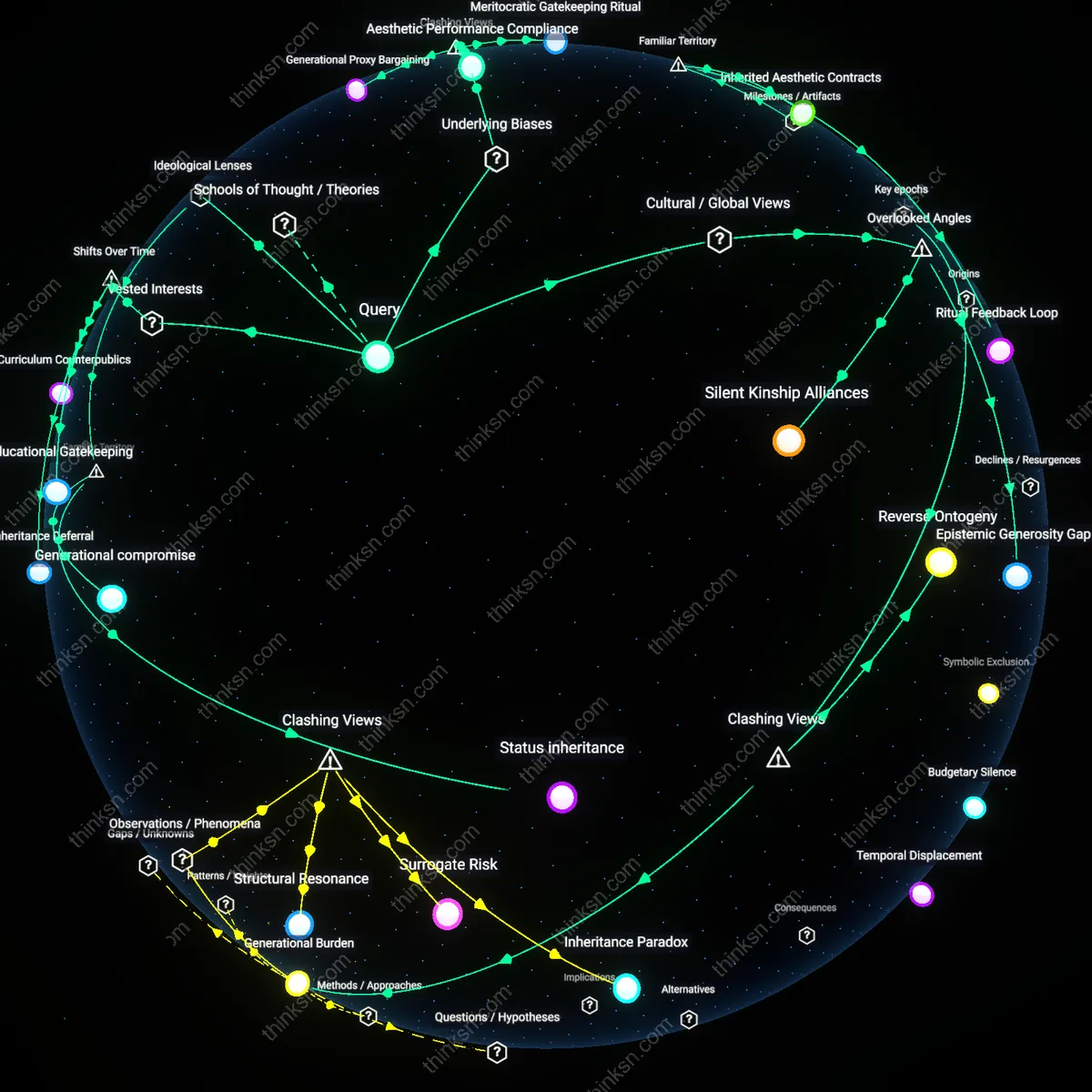
Analysis reveals 12 key thematic connections.
Key Findings
Generational compromise
A parent should establish a time-bound agreement between family generations to alternate emphasis between artistic practice and academic performance, with measurable benchmarks for both, thus converting intergenerational tension into structured reciprocity. This mechanism operates through the household as a site of negotiated authority—grandparents exert influence via emotional capital, children assert autonomy through creative output, and parents manage legitimacy by formalizing expectations. The non-obvious insight, given how people typically frame this as a values clash, is that most families already use implicit schedules (e.g., 'after homework, you can paint') but rarely recognize them as political contracts that distribute cultural power.
Ideological triangulation
A parent should publicly reframe artistic expression as cognitive rigor and academic success as self-actualization, aligning both domains under a shared discourse of 'excellence' to satisfy liberal individualism, conservative discipline, and Marxist human development simultaneously. This works through the school-home interface, where report cards, art exhibitions, and parent-teacher conferences become stages for translating differing ideologies into commensurate achievements. The underappreciated point, against the familiar narrative of irreconcilable worldviews, is that families routinely blend these belief systems pragmatically—such as praising a math grade and a painting equally—not as contradiction, but as performative synthesis.
Status inheritance
A parent should treat the grandparent’s academic expectations as a form of symbolic inheritance—like property or reputation—and allow the child to 'redeem' it through artistic means that visibly engage discipline, mastery, and public recognition. This functions through intergenerational status economies, where grandparents equate scholastic achievement with social mobility, but parents can redirect that concern into domains where effort and visibility mirror academic rituals (e.g., exhibitions as exams, portfolios as transcripts). People usually see this as resistance or rejection, but the unacknowledged pattern is that cultural legitimacy flows not from domain choice but from demonstrable rigor—making art a legitimate heir to academic tradition when performed as labor, not leisure.
Intergenerational Ritual Compromise
Parents can resolve tension between artistic expression and academic emphasis by embedding creative milestones within culturally prescribed rituals that honor senior authority. In Confucian-influenced settings such as rural Guangdong, grandparents derive status not from direct control over child-rearing but from public recognition of their lineage’s continuity; thus, when a child performs a traditional art form—like Cantonese opera—during ancestral commemoration festivals, academic achievement is symbolically fulfilled through cultural reproduction. This mechanism repurposes ritual occasions as covert spaces for artistic validation, an overlooked dynamic because most analyses treat rituals as static rather than negotiation arenas. The residual concept is the strategic use of ritual performance to satisfy hierarchical expectations while enabling creative autonomy.
Epistemic Generosity Gap
In Indonesia, particularly among Javanese Muslim families, parents quietly support children's artistic pursuits by appealing to kyai-led pondok pesantren (boarding schools) that recognize spiritual insight through music and poetry, thus reframing art as a form of religious knowledge rather than leisure. This circumvents direct conflict with grandparents who equate academic success with formal certification by treating theological artisanship as academically legitimate within an Islamic epistemic framework. The underappreciated factor is that generational conflict is less about discipline versus creativity and more about whose knowledge system is granted epistemic authority—something rarely addressed in Western dualistic portrayals. The residual concept reveals that the real tension lies in unrecognized hierarchies between knowledge forms, not time allocation.
Silent Kinship Alliances
In Yoruba communities of southwestern Nigeria, aunts and uncles—especially the paternal aunt (ìyá ará)—often serve as covert validators of non-academic talent, providing resources and advocacy under the radar of elders who publicly champion scholarly achievement. These kinship-based alliances allow artistic development to flourish without challenging the grandparent’s symbolic authority, leveraging lineage-specific roles to redistribute influence outside the direct parent-elder axis. This dynamic is overlooked because most intergenerational studies focus on vertical (parent-child-grandparent) power, ignoring lateral kin networks that absorb cultural risk. The residual concept names the hidden role of secondary kin as covert sponsors of deviant identity formation.
Generational Proxy Bargaining
Prioritize the child’s art supplies budget as a renegotiation of household authority between parent and grandparent, not as support for creativity—this financial decision becomes a low-stakes site for contesting whose values structure family hierarchy, with the parent using material access to subtly displace the grandparent’s influence. The mechanism is resource allocation within intergenerational cohabitation or gift economies, where even small purchases signal alignment with either ascendant (academic) or emerging (expressive) value systems; what is non-obvious is that the child’s artistic output is less the goal than the parent’s quiet assertion of autonomy in value formation.
Meritocratic Gatekeeping Ritual
Enforce strict time-based separation between art and study hours, privileging academic schedules during weekdays and reserving weekends for creative work—this appears balanced but actually codifies the grandparent’s hierarchy by treating academic labor as urgent and obligatory while framing art as leisure or reward. The system is temporal institutionalization, mirroring school and workplace rhythms that delegitimize non-instrumental activities unless scheduled as surplus; the friction lies in exposing how 'balance' often reproduces dominance, making the grandparent’s values the default timeline against which artistic expression must beg for margin.
Aesthetic Performance Compliance
Channel the child’s art into forms that mimic academic rigor—such as data visualization, calligraphy, or historical reenactment painting—to satisfy the grandparent’s definition of worthy knowledge production, thereby preserving peace while subverting the intent of artistic freedom. This operates through symbolic substitution in familial recognition systems, where creativity is tolerated only when it performs the aesthetics of discipline, achievement, and utility; the underappreciated dynamic is that compliance masquerades as compromise, transforming self-expression into a mimetic ritual of scholarly legitimacy.
Educational Gatekeeping
A parent can align artistic mentorship with college admissions strategy by channeling creative output into portfolio-building activities recognized by elite universities, thus reframing self-expression as competitive academic capital. The shift from mid-20th-century liberal arts cultivation to late-20th-century credentialization—particularly post-1980s when Ivy League schools began prioritizing 'well-rounded' applicants—has turned arts into a signaling mechanism for academic elitism. This transforms generational conflict into a performative negotiation where artistic expression survives only when compatible with institutional gatekeeping, revealing how grandparental academic values persist not through discipline but through assimilation into meritocratic spectacle.
Inheritance Deferral
A parent can delay inheritance discussions until the child achieves artistic recognition, thereby postponing the grandparent’s material influence while allowing artistic exploration to proceed without immediate economic sanction. During the postwar welfare state expansion (1945–1975), intergenerational support was buffered by public investment in education and housing, but from the 1980s onward, neoliberal retrenchment shifted financial risk to families, making elders’ assets decisive in youth mobility. This reversal turns symbolic artistic support into a contingent economic negotiation, revealing that the grandparent’s academic emphasis functions less as pedagogy than as a quiet mechanism of class preservation through deferred material access.
Curriculum Counterpublics
A parent can enroll their child in alternative schools or arts collectives that formally document creative development using academic rubrics, thereby satisfying grandparental demands for measurable achievement while sustaining artistic freedom. As standardized testing regimes intensified in the U.S. after No Child Left Behind (2001), arts programs were marginalized in public education, prompting private and charter institutions to develop hybrid curricula that codify creativity as assessable learning outcomes. This institutional pivot reveals how artistic legitimacy is now granted not through cultural acceptance but through bureaucratic reclassification—producing a new educational undercurrent where counterpublics survive by mimicking the assessment logic of the dominant academic regime.