Why Separate Claims Teams Stymie Insurance Negotiations?
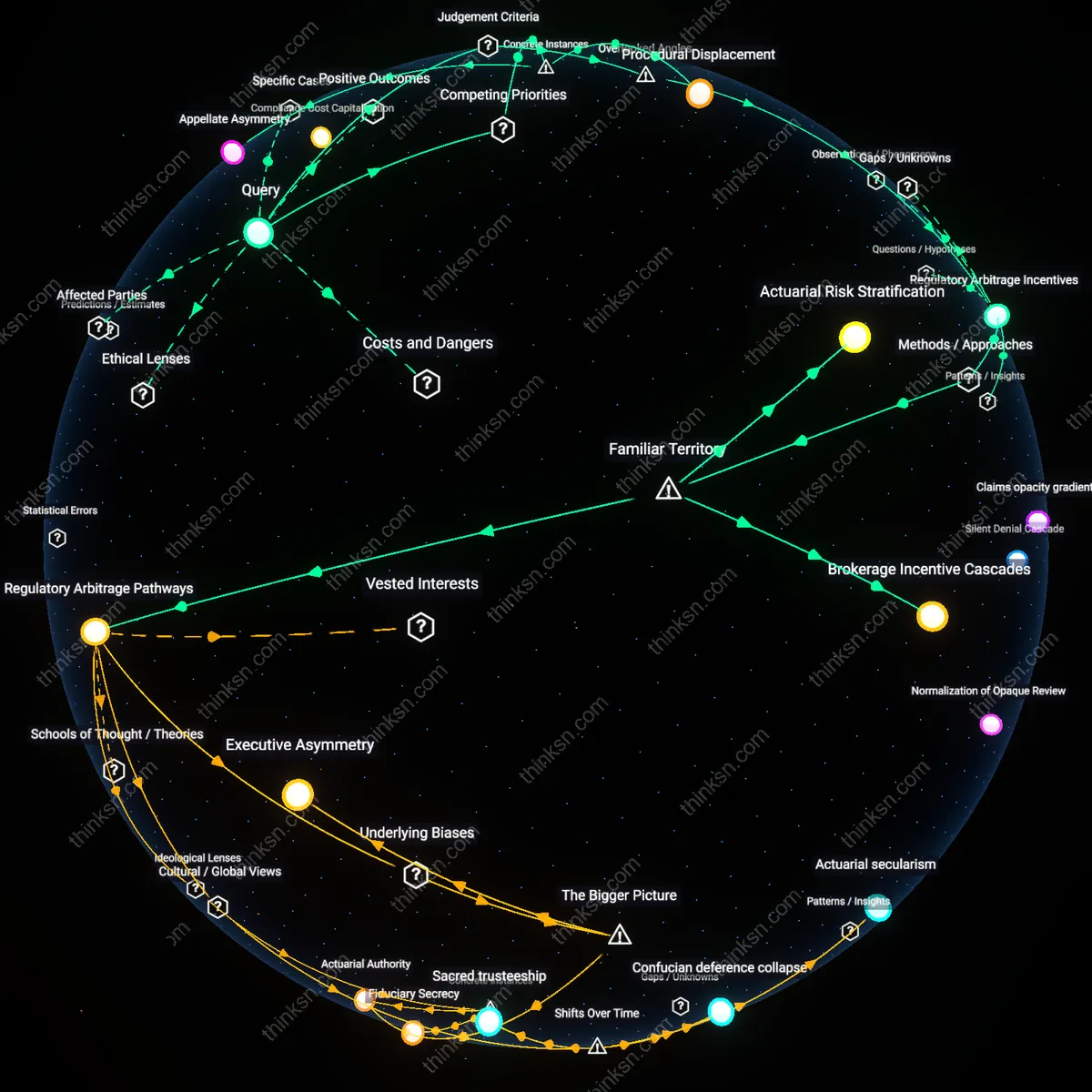
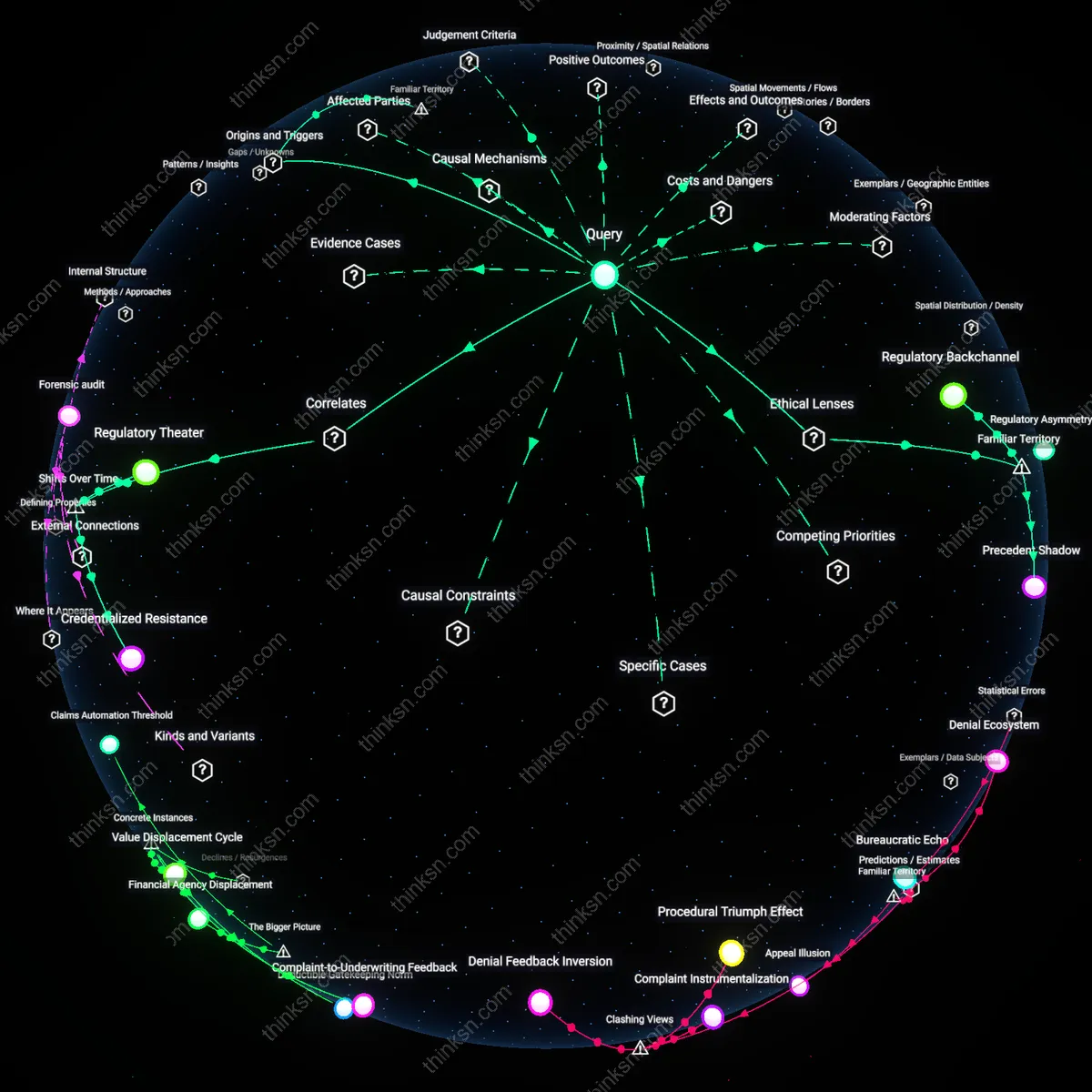
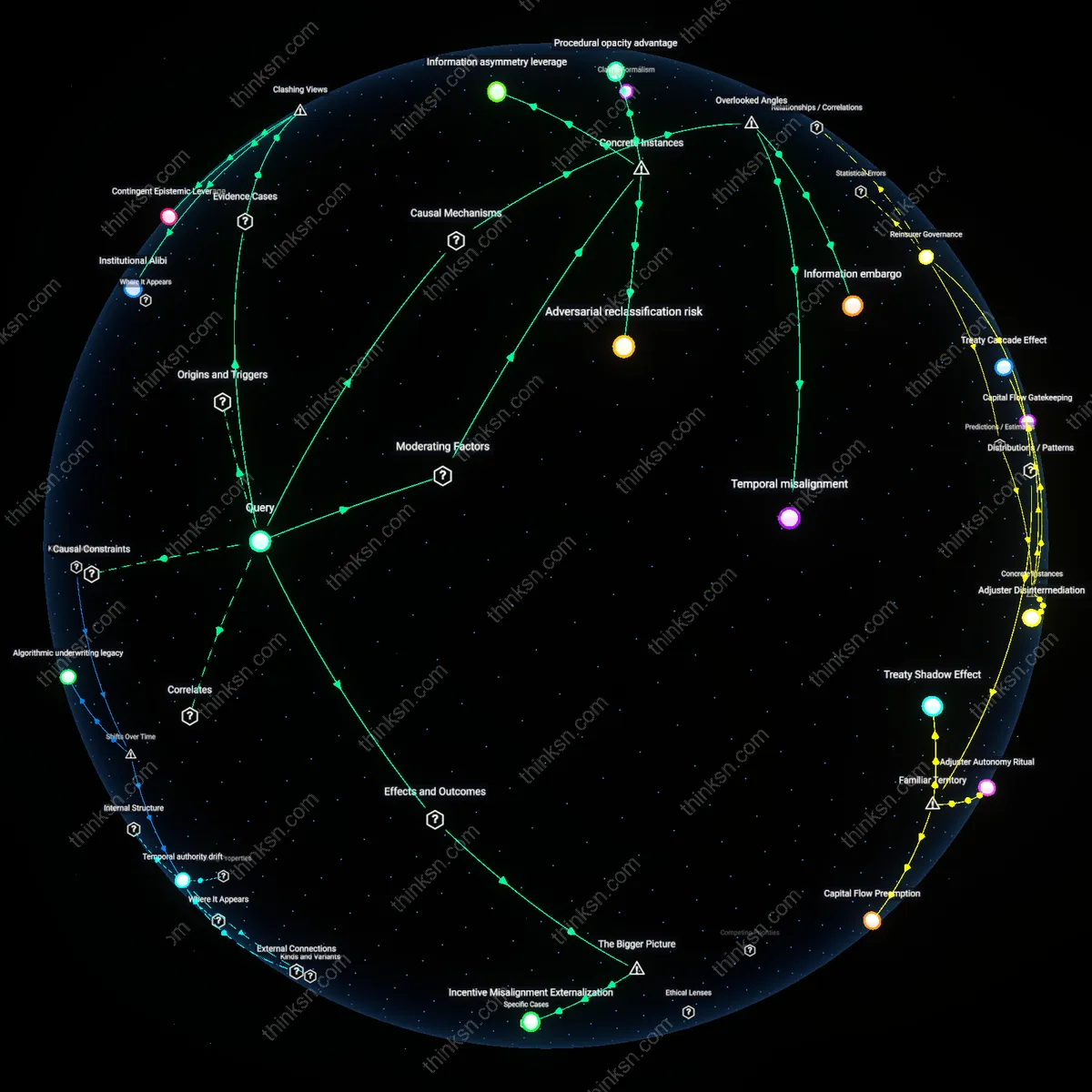
Analysis reveals 9 key thematic connections.
Key Findings
Information embargo
Structural separation between claims and underwriting teams creates an information embargo that systematically denies claimants access to risk-assessment logic used to price their policies. Underwriters develop detailed actuarial justifications for coverage terms and premiums, but claims handlers—bound by departmental silos and compliance protocols—cannot access or disclose these rationales during claim negotiations. This asymmetry prevents claimants from leveraging the insurer’s own risk models to challenge denials or lowball settlements, rendering their negotiation attempts disjointed from the foundational logic of the contract. What is typically overlooked is that claimants are not just negotiating outcomes but are structurally barred from engaging with the epistemic basis of those outcomes, turning negotiation into a performance of appeal rather than a reciprocal deliberation.
Temporal misalignment
The division between underwriting and claims processing embeds a temporal misalignment that erodes claimant leverage by decoupling exposure evaluation from loss interpretation. Underwriters assess risk at policy inception, often years before a claim arises, using forward-looking models that anticipate loss patterns, while claims handlers respond retroactively to specific events using narrow, incident-based guidelines. Because institutional memory of the original risk calculus is not operationally preserved across departments, claimants cannot reference evolving interpretations of risk to argue for broader coverage applicability. The underappreciated dynamic is that time itself—mediated through organizational structure—becomes a hidden barrier, whereby the same insurer can justify expansive underwriting logic initially and restrictive claims enforcement later without internal contradiction, leaving claimants unable to bridge the temporal gap in reasoning.
Regulatory arbitrage architecture
Separating claims and underwriting enables insurers to deploy a regulatory arbitrage architecture where each unit complies with distinct oversight regimes, indirectly weakening claimant negotiation power. Underwriting teams operate under capital adequacy and risk modeling requirements focused on solvency, while claims departments are monitored for settlement fairness and timeliness, creating divergent compliance incentives that are not reconciled internally. Claimants attempting to negotiate based on holistic policy intent encounter a fragmented accountability structure where no single unit is responsible for coherence between pricing promises and payout practices. The unnoticed mechanism is that regulatory segmentation—often seen as neutral oversight—is actively leveraged through organizational design to insulate decision layers from collective scrutiny, transforming structural opacity into a durable advantage.
Incentive Misalignment Externalization
The separation institutionalizes divergent performance incentives that collectively shift risk onto claimants during negotiation, reducing insurer accountability for coverage clarity. Underwriting teams are rewarded for pricing precision and portfolio profitability, while claims teams are evaluated on minimizing payout velocity and volume—neither is measured on customer outcome consistency. This system functions through siloed bonus structures and audit regimes that treat underwriting assumptions and claims decisions as independent events, erasing feedback loops that would expose ambiguous policy language. The overlooked consequence is that when claimants challenge denials, insurers can invoke 'operational independence' between departments to disavow responsibility for contradictions—transforming internal misalignment into externalized negotiation disadvantage.
Information asymmetry leverage
The structural separation between claims and underwriting teams at AIG in the early 2000s enabled claimants to exploit gaps in data access, as adjusters lacked real-time visibility into underwriting files containing policy intent and risk assessments, allowing policyholders with documentation to challenge denials more effectively; this dynamic reveals how fragmented information systems within a single insurer can unintentionally empower claimants by creating exploitable discrepancies in institutional memory.
Procedural opacity advantage
During the 2017 hurricane season, claimants in Houston confronting Allstate’s decentralized claims-underwriting model discovered that delays in cross-departmental approvals created time windows where initial settlement offers could be renegotiated before underwriting audits were completed, illustrating how bureaucratic latency—rooted in organizational silos—can function as a tactical opening for claimants to secure higher payouts before internal consistency checks are enforced.
Adversarial reclassification risk
In 2019, when Liberty Mutual revised underwriting classifications post-claim for California homeowners citing new risk data, claimants who had negotiated settlements based on original policy terms found their agreements challenged as underwriting teams retroactively reclassified properties as high-risk, exposing how structural separation allows one unit to undermine another’s commitments, turning claimant negotiation gains into contingent outcomes vulnerable to downstream reclassification.
Institutional Alibi
The separation absolves claimants of negotiation power by institutionalizing denial as process rather than policy. At Lloyd’s of London syndicates, claims teams routinely reject complex marine insurance filings citing 'material misrepresentation,' a determination that relies on underwriting data they are structurally barred from accessing—yet the claimant is told the decision is objective and final. The friction here undermines the intuitive belief that structural independence prevents bias; instead, it manufactures bureaucratic inevitability, where no single team is responsible for coherence, and the claimant faces a system that denies agency by design. This reveals that disconnection functions not as check-and-balance but as deflection engine.
Contingent Epistemic Leverage
Claimants gain leverage only when external actors translate structural disconnection into public accountability, as seen in the Australian Royal Commission into Misaligned Insurance Practices (2019–2020), where AMP Limited’s claims denials were linked to underwriting incentives hidden behind internal firewalls. The dissonance arises because the separation, meant to ensure discipline, produced contradictory records that consumer advocates weaponized in media and legal forums—turning internal incoherence into evidence of systemic deception. The insight is not that silos weaken claimants, but that they generate surplus data traces that, when mobilized, make the organization’s self-contradictions its greatest liability.