Family Pressure to Buy a Vacation Home: Honor or Strain?
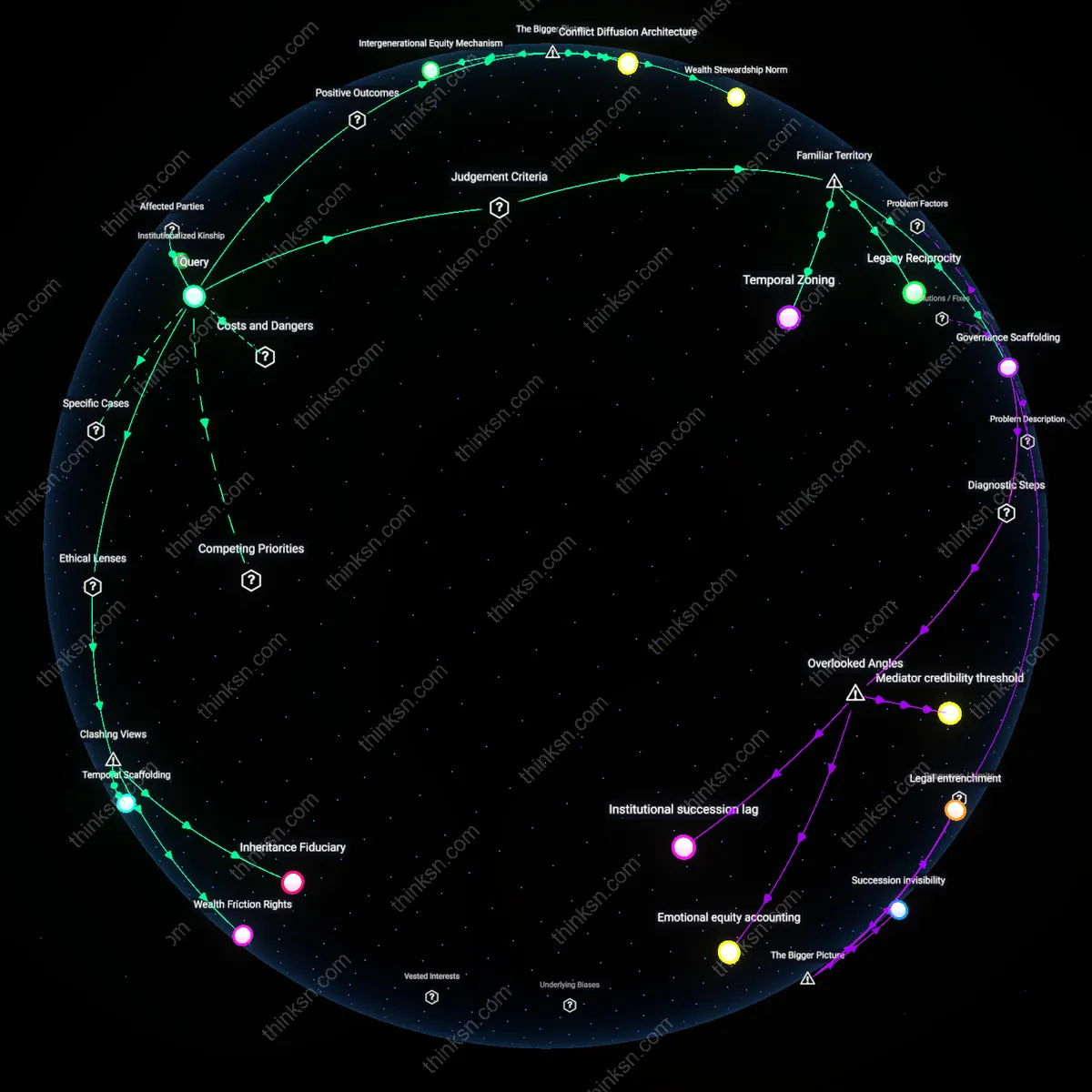
Analysis reveals 7 key thematic connections.
Key Findings
Family Financial Entanglement
Agreeing to a joint vacation home purchase with a partner's family risks marital strain because it merges personal finances with extended kin networks, creating binding obligations that bypass marital autonomy. The mechanism is the legal and emotional weight of co-ownership, where in-laws become financial counterparts in a marriage’s most sensitive domain—money—and where exit costs are high even if relationships sour. This is underappreciated in familiar discourse, which celebrates shared assets as symbols of unity, yet rarely acknowledges how such arrangements institutionalize dependency on in-laws whose priorities may shift over time.
Marital Boundary Erosion
Entering a real estate agreement with a partner’s family subtly erodes marital boundaries by embedding third-party expectations into shared decision-making about space, time, and money. The dynamic operates through recurring coordination demands—scheduling, upkeep, cost-sharing—that require spousal deference to in-law preferences, fracturing the couple’s autonomy. While common narratives frame such cooperation as maturity or generosity, the non-obvious consequence is the gradual normalization of external authority in marital life, where vacation planning becomes a proxy for ongoing negotiation with familial power structures.
Wealth-as-Proxy Conflict
Agreeing to a joint vacation home purchase with a partner's family risks marital strain by converting relational trust into a financial proxy for commitment. When extended family co-own property, disparities in income, spending habits, and maintenance contributions become visible metrics of familial worth, turning silent inequalities into active friction points. This dynamic is amplified in dual-income households where one partner’s family holds disproportionate capital, making their financial input a de facto measure of love or loyalty—activating status competition within kinship networks. The non-obvious consequence is not merely money disputes, but the redefinition of care through economic performance, embedding class tensions beneath romantic partnership.
Co-Ownership Entanglement
Joint vacation home ownership entrenches systemic interdependence that bypasses consent in future relationship renegotiations. Once assets are co-titled, divorce, geographic relocation, or inheritance disputes cannot be resolved without legal and financial entanglement, effectively locking individuals into relational structures even after emotional or marital dissolution. Real estate laws in jurisdictions like California or New York enforce shared equity claims regardless of relationship breakdown, meaning that separation requires either forced sale or ongoing cooperation with in-laws. This creates an irreversible tether—where a house meant to symbolize unity becomes a legal trap that preserves failed alliances through property code.
Emotional Equity Drain
Pooling resources for a vacation home extracts emotional equity from the couple by forcing them to subordinate joint decision-making to familial expectations. The home becomes a site where unspoken obligations—hosting holidays, deferring repairs to avoid conflict, or absorbing costs to preserve harmony—accumulate as psychological debt. Over time, the couple’s autonomy erodes as their shared space is governed by extended family norms, with each visit reinforcing asymmetrical power. The overlooked mechanism is not the expense itself, but how shared asset management redirects emotional labor toward maintaining kinship appeasement, draining the primary relationship of agency and spontaneity.
Relational Equity Drain
Agreeing to a joint vacation home purchase with a partner's family risks financial and marital strain, as seen in the case of the 2018 Jackson-Hale family co-ownership dispute in Asheville, North Carolina, where unequal use and maintenance costs between the two families led to resentment, legal mediation, and eventual estrangement between siblings-in-law; the mechanism here is asymmetric investment, where one family bears disproportionate costs while both claim equal entitlement, exposing how informal familial agreements lack enforcement mechanisms, making emotional equity fragile under material stress—an underappreciated reality being that shared assets amplify relational imbalances rather than neutralize them.
Kinship Financial Entanglement
Joint vacation home purchases can honor relationships by creating shared legacy spaces, as demonstrated by the Wong family collective in Vancouver, British Columbia, who established a jointly held cabin on Quadra Island in 2010 under a formal co-tenancy agreement with rotating usage and pooled maintenance funds; the structure succeeded because it formalized informality—binding kinship norms to legal and financial scaffolding—revealing that the durability of such arrangements depends not on trust alone but on institutionalized cooperation, a nuance often overlooked in familial financial decisions where emotional capital is assumed sufficient.