Lump Sum or Milestones? Inheritance Distributions Debated
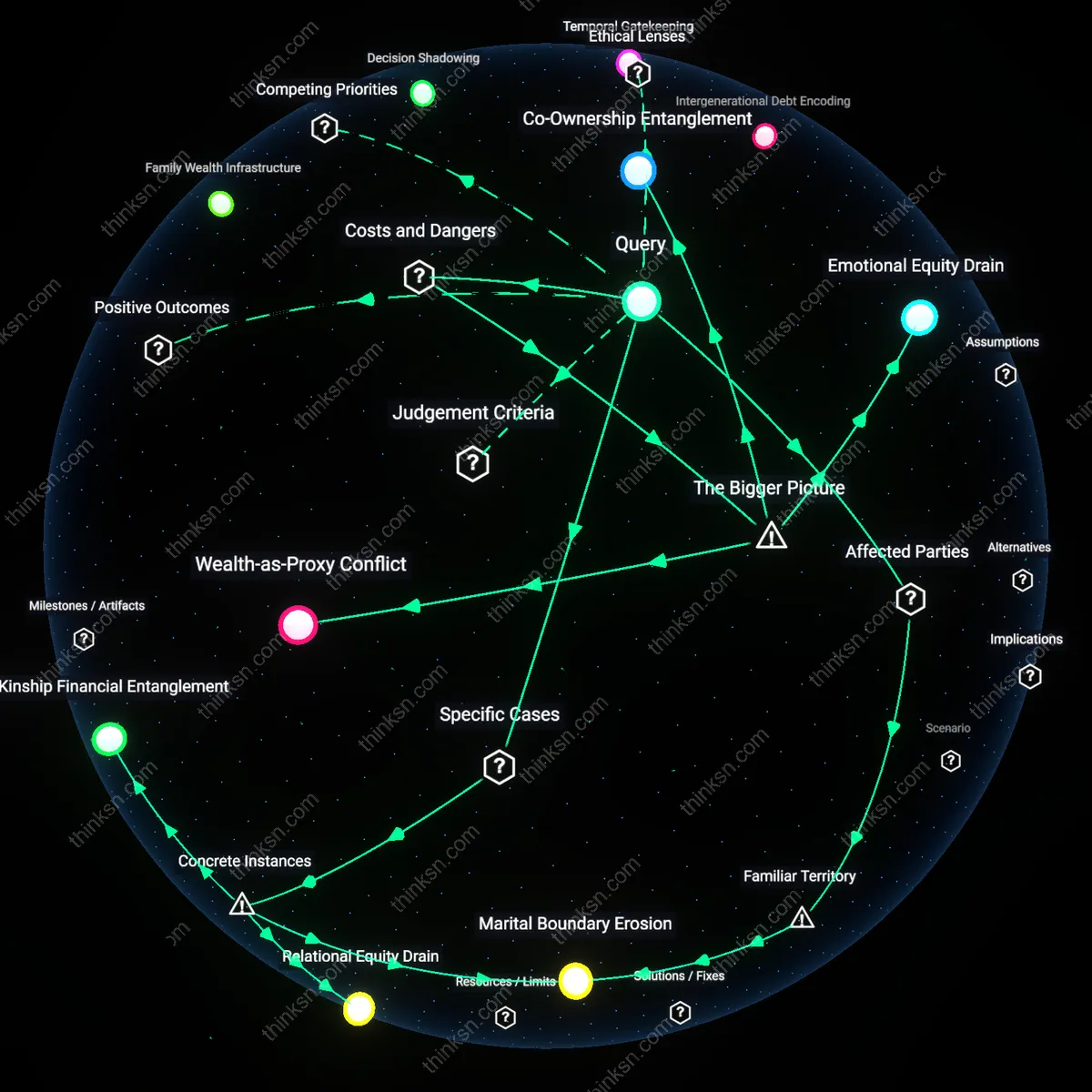
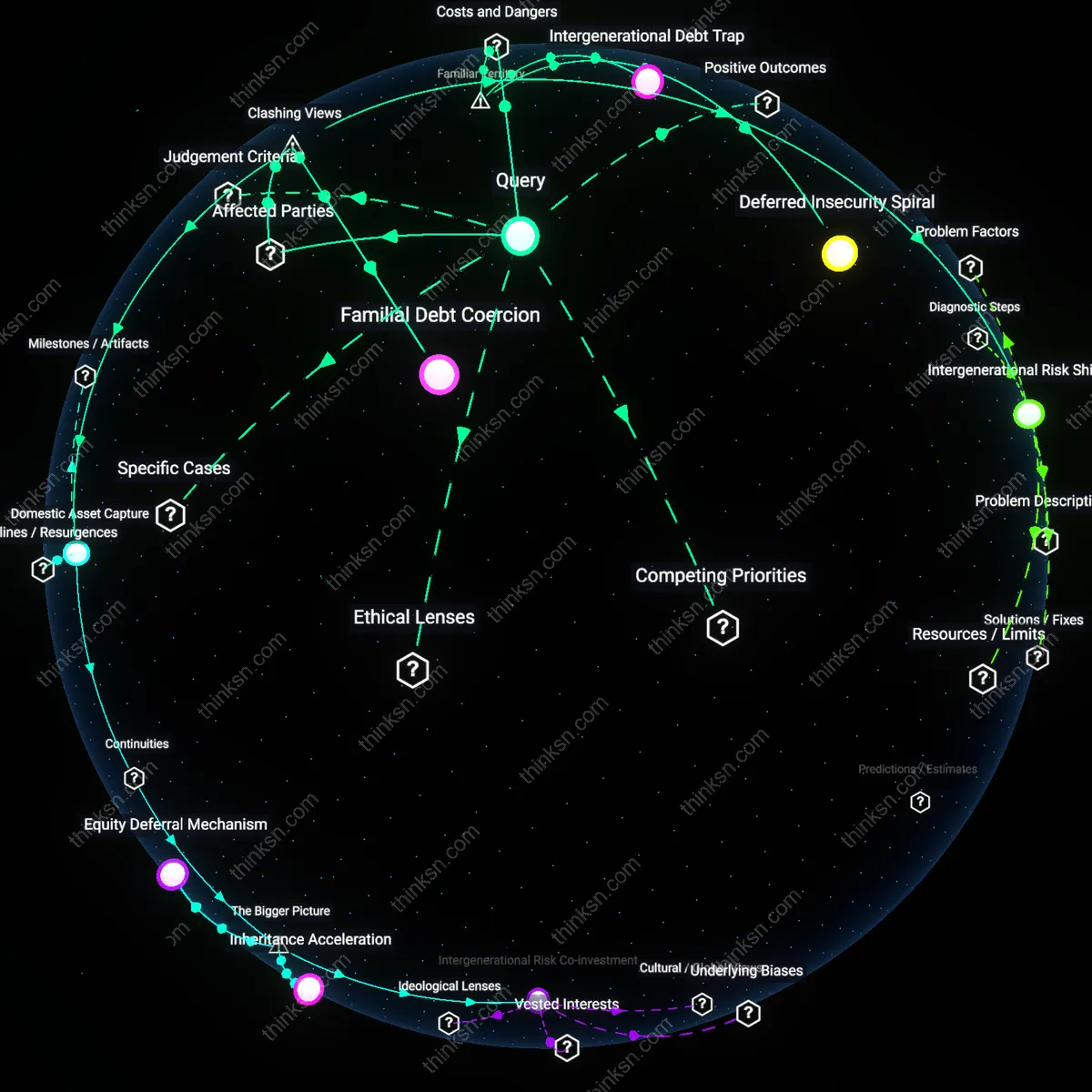
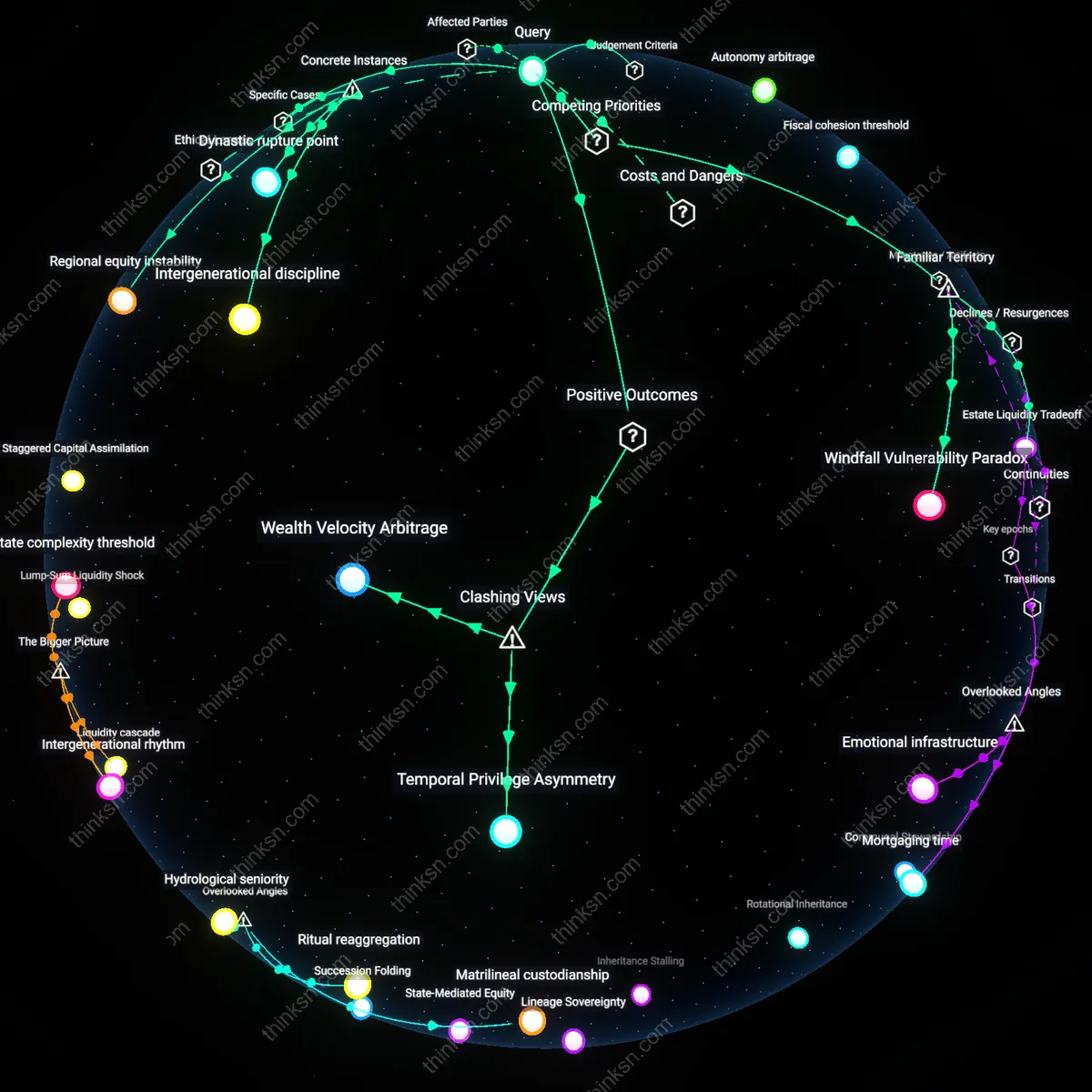
Analysis reveals 11 key thematic connections.
Key Findings
Intergenerational risk externality
Lump-sum inheritances should be favored when they prevent the systemic amplification of intergenerational risk concentration. In contexts like rural India, where land fragmentation from staggered distributions to multiple heirs leads to economically unviable plots, the resulting inability to invest or scale creates cascading household impoverishment across generations; this dynamic is driven by customary inheritance norms interfacing with constrained credit markets, and its significance lies in exposing how seemingly equitable distribution mechanisms can systematically erode long-term resilience—what is underappreciated is that fairness in timing can undermine viability in outcome.
Autonomy arbitrage
Staggered distributions are preferable when beneficiaries exercise significantly different capacities for financial self-determination over time, as seen among young adults in Nordic welfare states who gain access to portions of inheritances upon reaching educational or employment milestones. The state-backed social floor reduces existential pressure, allowing delayed funds to serve as autonomy-enhancing capital for transformative life projects; the mechanism is intertemporal choice modulation, facilitated by public-private trust structures, and the underappreciated insight is that inheritance timing can function less as a wealth transfer and more as a scaffolding device for agentic development.
Fiscal cohesion threshold
Lump-sum transfers should be evaluated against a jurisdiction’s capacity to absorb sudden wealth reconfigurations without distorting fiscal balance, such as in U.S. states with estate tax clawbacks and mandatory liquidity events upon inheritance. When heirs must sell illiquid assets (e.g., family-owned Midwest manufacturing firms) to meet tax obligations, staggered distributions aligned with asset maturity cycles preserve operational continuity; the trigger is statutory tax timing, the systemic pressure comes from capital-structure mismatches, and the non-obvious consequence is that fiscal design—often treated as separate from familial wealth planning—can effectively dictate optimal intergenerational transfer rhythms.
Inheritance Liquidity Shock
Lump-sum inheritance distributions generate positive utility by triggering an immediate liquidity shock that enables recipients to overcome fixed-cost thresholds in human and physical capital investment, such as purchasing real estate, launching capital-intensive businesses, or eliminating high-interest debt. This mechanism operates most effectively in economies with underdeveloped credit markets—like Spain’s post-2008 housing crisis—where access to collateral matters more than marginal income, and timing of capital access determines long-term wealth trajectories. The non-obvious insight, against the dominant view that staggered distributions prevent reckless spending, is that delayed access may permanently lock recipients out of time-sensitive opportunities, rendering future installments irrelevant to transformative mobility.
Temporal Privilege Asymmetry
Staggered inheritance distributions enhance equity among heirs by institutionalizing time as a corrective mechanism for behavioral risk, but in doing so, they entrench a temporal privilege asymmetry that favors older, institutionally aligned beneficiaries over younger or non-conforming ones. This dynamic manifests in jurisdictions like Canada’s trust-regulated provinces, where trustees withhold capital until heirs reach benchmark ages, assuming uniformity in financial maturity—yet the real effect is to advantage those already integrated into formal financial systems while disadvantaging those needing early capital to address systemic barriers. The dissonance lies in reframing staggered distributions not as prudent stewardship but as intergenerational time-based gatekeeping, revealing how delayed access functions as social calibration rather than economic protection.
Wealth Velocity Arbitrage
Lump-sum distributions should be preferred when the recipient operates within high-velocity economic ecosystems—such as venture capital-adjacent tech hubs in Bangalore or Tel Aviv—because the arbitrage between immediate capital deployment and compounding reinvestment cycles generates disproportionate societal returns in innovation and job creation. Unlike the conventional view that spreading disbursements reduces waste, the real utility lies in compressing the time between inheritance and productive risk-taking, where early-stage funding from young inheritors acts as patient, non-dilutive capital in underfunded markets. This underappreciated mechanism reveals that value is not in the amount or timing control, but in the inheritance’s velocity through high-multiplier economic circuits.
Windfall Vulnerability Paradox
One should favor lump-sum inheritance distributions to maximize the beneficiary’s autonomy in moments of acute need, because staggered distributions can misalign with life-cycle crises like sudden medical debt or market entry opportunities, functioning through rigid timelines that ignore emergent personal economics; this cuts against the common belief that slow disbursement always protects, exposing that the very feature sold as 'prudence' can become a liability when real-world instability demands immediate capital access.
Estate Liquidity Tradeoff
One should evaluate inheritance distribution by recognizing that lump-sum payments strain illiquid estates built on real property or private equity, where heirs may be forced to sell family assets under unfavorable market conditions to settle equal distributions, operating through probate systems that prioritize cash-equivalent fairness over sustainable holdings; this disrupts the familiar narrative of inheritance as purely moral or relational, revealing it as a material negotiation shaped by asset form and jurisdictional enforcement pressures.
Intergenerational discipline
Lump-sum inheritances at the Rockefeller family trusts eroded recipient accountability by removing performance contingencies, as evidenced by heirs like Michael Rockefeller whose ventures into high-risk ethnography reflected a lack of financial constraint, revealing how concentrated wealth transfers disable feedback loops that sustain stewardship over generations through the absence of phased responsibility calibration.
Regional equity instability
The staggered distribution of Marshall Plan aid to Western European nations—conditioned on economic reform and cross-border cooperation—prevented wealth concentration in single administrative cycles, as seen in West Germany’s gradual capital reinvestment via the ERP funds, demonstrating how phased allocation enforces adaptive governance and prevents destabilizing fiscal shocks that lump-sum infusions could provoke in post-war institutional environments.
Dynastic rupture point
The 2016 estate distribution of David Bowie’s $100 million fortune—delivered primarily in lump sum to his widow and children without phased release mechanisms—created immediate liquidity for legacy projects like the 'David Bowie Is' exhibition but also enabled rapid depletion risks through high-profile art sales, exposing how non-graduated transfers can optimize cultural immediacy at the cost of long-term preservation integrity under unmoderated agency.