STEM Only: Advancing Science or Neglecting Holism?
Analysis reveals 9 key thematic connections.
Key Findings
Curriculum Lag
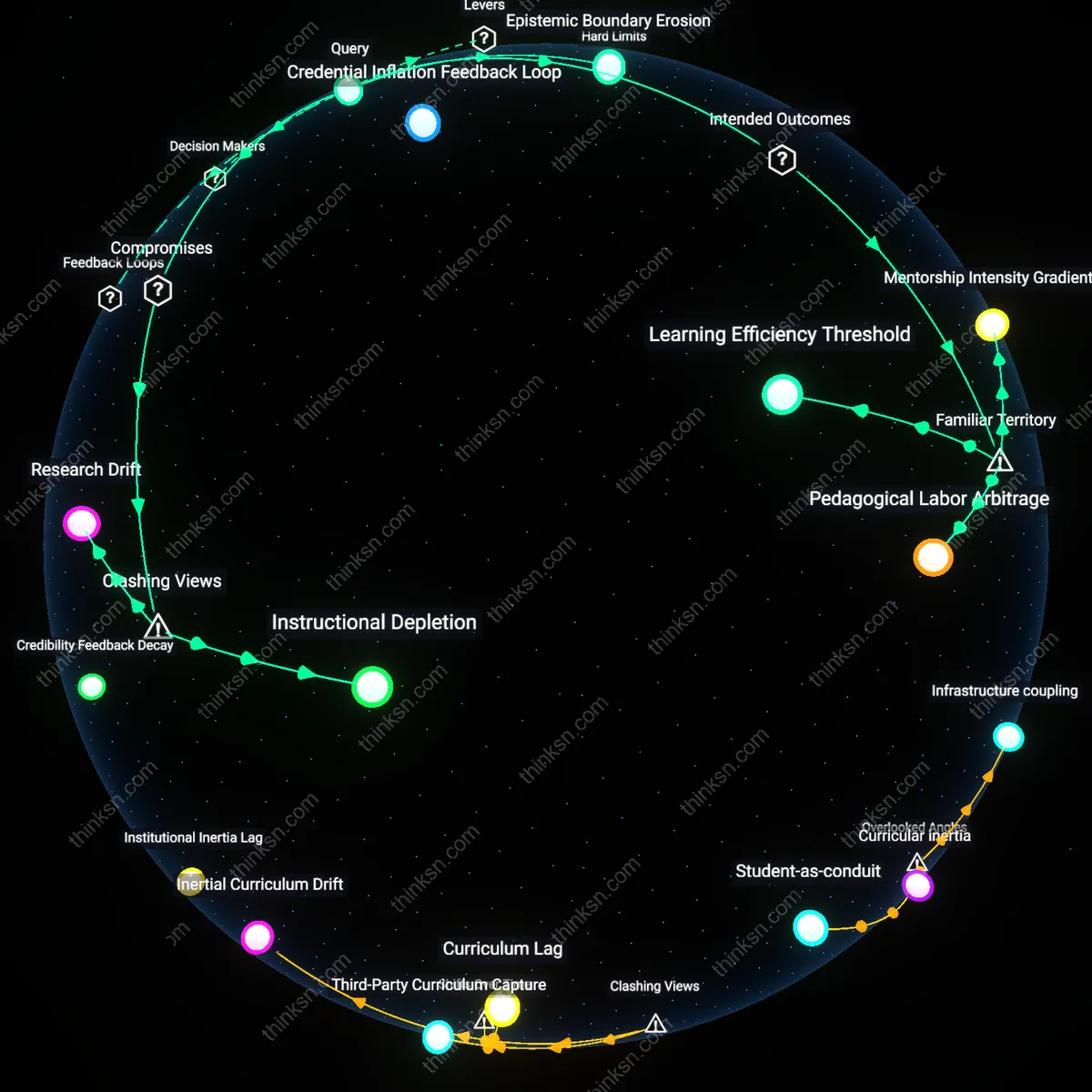
Policy must institutionalize periodic realignment of STEM magnet curricula with evolving labor and ethical demands, because the post-1990 rise of biotechnology and AI has outpaced the static disciplinary boundaries these schools were designed to reinforce. The shift from industrial-era STEM (focused on physics, mechanics, and linear engineering) to systems-based fields like bioethics and data justice reveals that specialized schools now risk training students for yesterday’s scientific paradigms. This historical misalignment—visible in AP course offerings still centered on 1980s computer science models—demonstrates that the enduring value of magnet schools is not their focus but their capacity to model adaptive learning, a function most visible when they integrate humanities-derived critical analysis into technical training.
Curriculum Gatekeeping
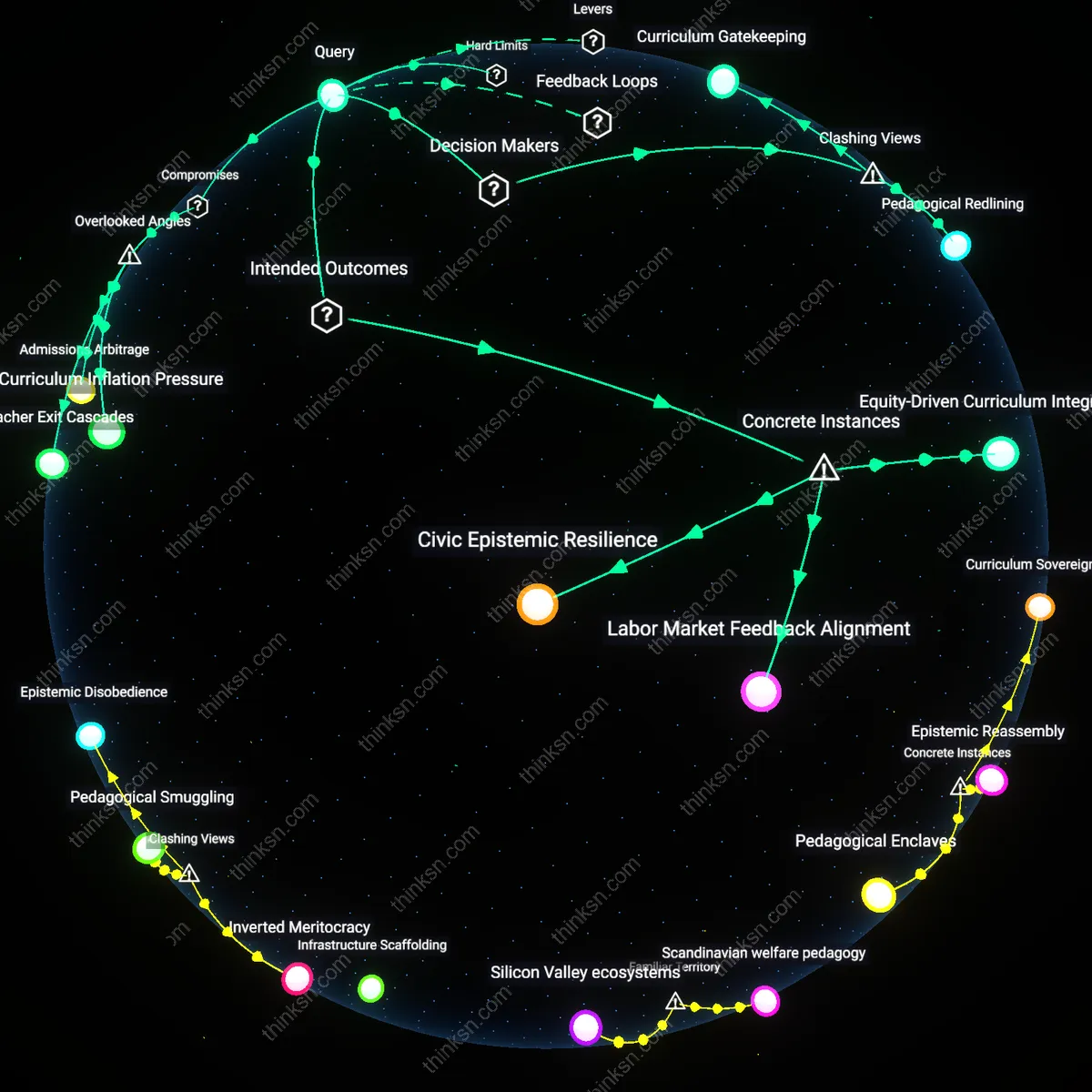
STEM-only magnet schools should be dismantled through legislative action because they institutionalize scientific advancement as an end rather than a means, enabling state education departments and funding bodies to bypass constitutional obligations to equitable, broad-based intellectual development. State boards of education, like those in Florida and Texas, leverage curriculum standards and competitive grant allocations to designate specialized STEM tracks as prestigious, which in turn justifies funneling high-performing and well-resourced students into selective institutions—this mechanism transforms academic excellence into a segregated good. The non-obvious reality is that these policies are not driven by pedagogical necessity but by regional economic lobbying, where tech industry clusters influence education policy under the guise of national competitiveness, thus normalizing meritocracy as a substitute for educational justice.
Pedagogical Redlining
The expansion of STEM-only magnet schools reinforces systemic inequity not through overt discrimination but by defining holistic education as incompatible with scientific rigor, a determination made daily by district superintendents and federal Title I administrators who allocate integration funding based on standardized outcomes in narrow domains. By treating social sciences, arts, and ethics as add-ons rather than co-requisites for scientific reasoning, decision-makers entrench a false dichotomy where schools must choose between depth and breadth—yet evidence from longitudinal studies in Chicago Public Schools shows that interdisciplinary project-based learning yields higher STEM retention and critical thinking gains than siloed models. This reveals the underappreciated truth that so-called ‘holistic neglect’ is not a side effect but a deliberate calibration by assessment designers at ETS and College Board, who build tests that reward fragmentation, thus making equity-through-integration invisible in accountability metrics.
Curriculum Inflation Pressure
Policymakers should mandate geographic caps on STEM magnet density to counter endogenous curriculum inflation driven by inter-district competition. When multiple districts in a metropolitan region concentrate prestige and funding into STEM-only magnets—such as seen in the Dallas-Fort Worth corridor—schools respond by accelerating content coverage and narrowing instruction to measurable technical competencies, inadvertently devaluing foundational skills in ethics, communication, and systems thinking; this dynamic, fueled by real estate markets and parental mobility patterns, creates a hidden feedback loop that distorts educational priorities beyond official policy intent, insulating elite student cohorts from interdisciplinary development while propagating a false standard of 'rigor.'
Teacher Exit Cascades
Over-reliance on STEM-only magnets risks triggering asymmetric attrition among mid-career educators, particularly in adjacent public schools that lose both funding and instructor motivation when industrial recruitment pipelines selectively partner with elite magnets. In states like Maryland, where biotech firms co-sponsor magnet programs, science teachers in non-magnet schools report diminished professional agency and slower access to updated pedagogical tools, leading to a quiet exodus that destabilizes district-wide instructional capacity; this creates a latent dependency where the success of specialized institutions is subsidized by the erosion of teaching ecosystems elsewhere, a consequence rarely modeled in equity impact assessments.
Admissions Arbitrage
STEM-only magnets amplify opportunity hoarding not through overt exclusion but through the weaponization of standardized testing as a proxy for 'aptitude,' which privileges students from resource-rich elementary pipelines that cultivate test-specific heuristics over broader intellectual dispositions. In New York City’s specialized high schools, for instance, the reliance on a single entrance exam enables families to engage in years of targeted test conditioning that simulate STEM success without fostering transferable analytical depth, thereby transforming admissions into an arbitrage system where access is optimized not for scientific potential but for early academic gaming; this shifts the policy debate from curriculum design to the covert financialization of cognitive traits.
Equity-Driven Curriculum Integration
California’s 2013 Next Generation Science Standards revision mandated interdisciplinary science education that embedded engineering, language arts, and social justice into K–12 STEM curricula, requiring schools to align with broader civic and cognitive development goals; this policy mechanism reveals that STEM-focused institutions can serve equity by refusing to isolate technical training from ethical and communicative reasoning, a non-obvious design principle given the historical tendency of magnet schools to prioritize academic acceleration over inclusion.
Labor Market Feedback Alignment
The Massachusetts Academy of Math and Science at Worcester Polytechnic Institute requires seniors to complete research internships at biotech firms in the Route 128 corridor, binding its STEM curriculum to regional innovation economy demands; this institutional linkage demonstrates that specialized schools maintain social relevance by structuring holistic capabilities—project management, ethics, teamwork—not as add-ons but as labor-market-necessitated outcomes, a dynamic often overlooked when debates frame holism as purely humanistic.
Civic Epistemic Resilience
After Finland’s nationwide curriculum reform in 2016, Helsinki’s Irmeli School restructured its STEM magnet track around ‘phenomenon-based learning,’ where students investigated climate change through integrated science, history, and ethics projects assessed by community panels; this shift reveals that scientific advancement is sustained not by technical isolation but by embedding epistemic practices within public deliberation, a counterintuitive insight given policy assumptions that elite STEM pipelines require cognitive sequestration.